 Installation guide
 Owner’s manual



How to fix F05 error Hotpoint washing machine?
On a Hotpoint HTWP1400F1WW washer, an F05 error is commonly tied to a drain problem (water not pumping out fast enough). We fix it by checking the drain hose setup for kinks or clogs, then verifying the washer can drain and spin with the lid closed per the HTWP1400F1WW owner's manual.
Quick checks that solve most F05 drain errors
- Unplug the washer for 1 minute, then restart the cycle.
- Make sure the lid is fully closed; this washer will not agitate or spin with the lid up.
- Inspect the drain hose for kinks, crushing, or a clog at the standpipe or sink connection.
- Confirm the drain hose is installed correctly; the top of the drain outlet should be under 6 ft (1.8 m) above the floor.
- Check that the washer is not sitting on the drain hose.
- If the tub is full of water, try a Drain/Spin (or equivalent) cycle after correcting the hose.
When to suspect a failed part
If the hose and standpipe are clear but the washer still will not drain (or you hear a hum with little or no water flow), the drain pump is a top suspect.
| Symptom | Most likely cause | What we recommend |
|---|---|---|
| Water stays in tub, pump is quiet | Power/lid switch issue | Check lid closure and lid switch operation |
| Water stays in tub, pump hums | Pump jammed or failing | Inspect pump area; replace pump if needed |
| Drains slowly, occasional F05 | Partial clog or restricted hose | Clear standpipe, straighten hose, re-test |
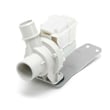
Relevant replacement part for this model: Washer drain pump WH23X10043
Why it matters
A drain-related F05 stops the cycle to prevent overflow and protect the drive system from trying to spin with a waterlogged load. Fixing the hose routing and drain flow usually restores normal washing and spinning.
Helpful reference
- For installation and drain hose routing details, use the HTWP1400F1WW installation guide.
Last updated: February 2026
How to reset a washing machine Hotpoint?
For the Hotpoint HTWP1400F1WW washer, the most reliable “reset” is a power reset: unplug the washer for about 1 to 5 minutes, then plug it back in and restart the cycle from the beginning. If the washer stopped because the lid was open, close the lid and reset the cycle as needed (the washer will not agitate or spin with the lid up).
Quick reset steps (recommended)
- Turn the timer/control to OFF.
- Unplug the washer (or switch off the dedicated breaker).
- Wait 1 to 5 minutes.
- Plug back in (or turn breaker back on).
- Set a short cycle and start the washer.
- If the cycle was interrupted with the lid open, close the lid and restart the cycle.
For control and cycle details specific to this model, use the HTWP1400F1WW owner's manual.
If it still will not start, check these first
Many “needs a reset” symptoms are actually a power, lid-safety, or control setting issue.
- Power cord fully seated in a working outlet
- House breaker/fuse not tripped (washer should be on a separate outlet)
- Hot and cold water faucets fully open
- Controls set correctly and timer knob pulled (if your version uses a pull-to-start timer)
- Lid fully closed (lid-up safety prevents agitation and spinning)
Common symptoms and what they usually mean
| Symptom | Most common cause | What to do |
|---|---|---|
| Won’t agitate or spin | Lid is open | Close lid; restart cycle |
| Won’t run at all | Unplugged or breaker tripped | Restore power; retry |
| Pauses during wash/spin | Normal operation | Let cycle continue |
Why it matters
Resetting clears minor control glitches, but it also helps you confirm whether the washer is stopping due to normal pauses, a lid-safety interruption, or a basic power/water supply issue. If the washer will not agitate or spin with the lid closed, the lid switch circuit is a common suspect; the washer lid switch assembly WH12X10334 is the model-matched part used for lid-safety switching.
Last updated: February 2026
Why is my Hotpoint washing machine leaking water from underneath?
A leak from underneath your Hotpoint HTWP1400F1WW washer usually comes from a loose or damaged drain path (pump, hoses, or clamps) or a tub seal/bearing area leak. We start by checking the fill hoses and drain system, then inspect the tub seal area for water tracks.
Quick checks we recommend first
- Unplug the washer and turn both water faucets off.
- Pull the washer forward and look for the exact drip point (front, center, or back).
- Check the hot and cold fill hose connections; the manual notes hot connects to “H” and cold to “C.”
- Look for cracks, pinholes, or loose clamps on the drain hose and internal pump hoses.
- Run a small test fill and drain while watching with a flashlight (keep hands clear of moving parts).
Most common leak sources under the washer
| Where you see water | Most likely cause | What to do next |
|---|---|---|
| Front/near floor | Drain pump or pump hose leak | Inspect pump body and hose clamps; replace pump if it weeps |
| Center under tub | Tub seal or bearing area leak | Look for rust trails or water slinging; plan for seal/bearing service |
| Back near valves | Fill hoses or valve connection | Tighten connections; replace hoses if swollen or cracked |
Parts that commonly fix an “underneath” leak on this model
If you find the leak at the pump area, the most common replacement is the washer drain pump WH23X10043. If the leak is coming from the tub center (often with rust streaks or water marks), the washer tub seal assembly WH02X10383 is a common fix.
Why it matters
Leaks from underneath can damage flooring and can also lead to spin problems if water reaches the drive components. Catching the source early usually keeps the repair limited to a pump, hose, or seal instead of larger tub or drive repairs.
Helpful reference
For safety steps and installation details (including hose hookup and location requirements), follow the HTWP1400F1WW installation guide.
Last updated: February 2026


