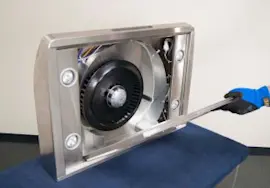
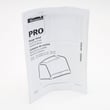
Owner’s manual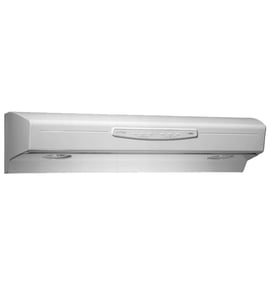





Are range hoods 120 or 240?
Most range hoods are 120V, and the Kenmore Pro 23351063600 range hood is designed to run on 120V power (the manual also specifies 120V halogen lamps). For a 240V circuit, you typically see that on electric ranges, not the hood.
How to confirm what your hood is wired for
Use these checks to verify the supply feeding the hood before you replace parts or troubleshoot power issues:
- Check the hood’s rating label (usually inside the hood canopy or near the wiring compartment)
- Confirm the circuit breaker size and what else is on that circuit
- Look for a dedicated 120V branch circuit (common for hoods)
- If hardwired, verify the wire connections match the wiring diagram in the owner's manual
- If the hood plugs into an internal receptacle, confirm it is a standard 120V receptacle
What 120V vs 240V usually means (quick comparison)
| Item | Typical voltage | Notes |
|---|---|---|
| Range hood (most homes) | 120V | Fan motor and lights run on standard household voltage |
| Electric range/cooktop | 240V | Heating elements commonly require 240V |
| Gas range | 120V | Uses 120V for controls/ignition, not for heating |
Why it matters
Using the correct voltage protects the hood’s blower controls, lighting circuit, and internal connectors from damage. It also helps you diagnose “dead hood” symptoms correctly (power supply issue vs. switch/control issue).
Related parts that fit this model
If you are working on airflow or ducting (not voltage), these model-compatible parts are commonly involved:
- Damper 421 (helps prevent backdraft)
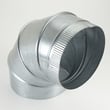
- Elbow 418 (duct routing)
- Range hood vent transition S427 (connects hood outlet to ductwork)
Last updated: February 2026
Does a 400 cfm range hood need make up air?
A 400 CFM range hood is right at the common code threshold where many jurisdictions start requiring make-up air. For your Kenmore Pro range hood model 23351063600, we recommend planning for make-up air whenever you install a higher-airflow blower and confirming requirements in your local code.
What “make-up air” does (and why it matters)
Make-up air replaces the air your hood exhausts so your home stays at a safe pressure balance. This matters most in tighter homes because strong exhaust can pull air down chimneys or flues (backdrafting) and can reduce proper combustion for fuel-burning appliances.
What our 23351063600 manual emphasizes
Our safety guidance calls out the need for sufficient air for proper combustion and exhausting of gases and to follow standards (NFPA, ASHRAE) and local code authorities. Use the owner's manual to review the ventilation and safety requirements before choosing a blower or finalizing ducting.
Practical guidance for a “400 CFM” setup
Use these checks to decide whether to include make-up air in your plan:
- Check your local code trigger: many areas use over 400 CFM as the point where make-up air is required.
- Look at your actual installed airflow: long duct runs, elbows, and transitions reduce delivered CFM.
- Confirm fuel-burning appliances: gas furnace, water heater, or fireplace increases the importance of pressure balance.
- Verify venting outdoors: ducted fans must vent outdoors (not into an attic or crawlspace).
- Use proper duct material: the manual specifies steel ductwork to reduce fire risk.
Ducting choices that affect real airflow
Even if the blower is rated at 400 CFM, restrictions can change performance.
| Installation factor | Typical effect on airflow | What to do |
|---|---|---|
| Extra elbows | More resistance | Keep runs short; minimize turns |
| Undersized duct | Higher static pressure | Match duct size to the blower system |
| Damper issues | Can restrict exhaust | Inspect/replace a sticking damper 421 |
| Poor transitions | Turbulence and loss | Use the correct range hood vent transition S427 |
Why it matters
Make-up air is about more than comfort; it helps prevent negative pressure that can interfere with combustion appliances and helps your range hood ventilate consistently.
Last updated: February 2026
What are the disadvantages of recirculating hoods?
Recirculating (ductless) range hoods filter air and send it back into the kitchen, so they are less effective than ducted setups at removing heat, moisture, and strong cooking odors. They also require more frequent filter cleaning or replacement to keep airflow and odor control consistent (see the owner's manual).
Key disadvantages to expect
- Odors can linger: filtration reduces smells, but it does not exhaust them outdoors.
- Humidity and heat stay in the room: steam and heat are not vented outside.
- More maintenance: filters load up with grease and need regular cleaning or replacement.
- Performance drops as filters clog: airflow and capture efficiency decline over time.
- Ongoing filter cost: replacement filters add recurring expense.
- Noise can be more noticeable: pushing air through filters can increase perceived sound.
How this compares to ducted venting
The Kenmore Pro 23351063600 installation guidance emphasizes that ducted fans must be vented to the outdoors for proper exhausting on ducted installations. That is the benchmark for best removal of smoke, grease, and moisture.
| Feature | Recirculating hood | Ducted hood |
|---|---|---|
| Removes smoke/odors | Filters some; can linger | Exhausts outdoors; strongest removal |
| Removes heat/humidity | Limited | Best |
| Maintenance | Higher (filters) | Lower (duct checks, grease filters) |
| Best for heavy cooking | Not ideal | Recommended |
What we recommend for better results (even if you recirculate)
- Run the blower before cooking and leave it on after cooking.
- Clean grease filters on a consistent schedule.
- Replace any odor filters at the interval listed in the owner's manual.
- Keep the hood at the recommended mounting height range for capture.
- If your kitchen allows it, consider converting to ducted venting using compatible duct components such as the damper 421 or range hood vent transition S427.
Why it matters
If you cook often (high heat, frying, searing), recirculating setups can leave more grease film, moisture, and odor behind. That affects comfort, indoor air quality, and how hard your hood has to work over time.
Last updated: February 2026
Is 36 inches too high for a range hood?
No. For the Kenmore Pro range hood model 23351063600, 36 inches is the maximum allowed height over a gas cooktop, so it is not too high when you have a gas range. Over an electric cooktop, 36 inches is too high because this hood is designed for a 24 to 30 inch mounting height. See the 23351063600 owner's manual for the exact clearances.
Recommended mounting height for this model
Our installation guidance for model 23351063600 sets these minimum and maximum distances from the cooking surface to the bottom of the hood:
- Electric cooktop: 24 to 30 inches
- Gas cooktop: 30 to 36 inches
- Staying within the range helps capture smoke, grease, and heat effectively
- Mounting higher than the maximum reduces capture and can make the hood feel underpowered
Quick reference table
| Cooktop type | Minimum height | Maximum height |
|---|---|---|
| Electric | 24 in. | 30 in. |
| Gas | 30 in. | 36 in. |
When 36 inches is a good choice (and when it is not)
36 inches works best when you need extra clearance over a gas cooking surface, especially with taller cookware.
- Good fit: gas cooktop, high-BTU burners, tall stock pots
- Not a good fit: electric cooktop (you lose too much capture)
- If smoke escapes at 36 inches, use a higher blower speed sooner and confirm your ducting is sized and routed correctly
Why it matters
Range hood height directly affects how well the hood captures cooking impurities. At the correct height, airflow pulls smoke and grease into the filters and ducting instead of letting it spread through the kitchen.
Related parts that affect performance
If the hood seems weak even at the correct height, restrictions in the vent path can be a common cause. These model-matched parts are often involved in duct transitions and airflow control:
Last updated: February 2026
What is the life expectancy of a range hood?
A range hood typically lasts 10 to 20 years; for a Kenmore Pro range hood like model 23351063600, about 15 years is a solid expectation with normal cooking and regular filter cleaning. Keeping grease off the filters and fan helps prevent motor strain and extends service life (see the maintenance guidance in the 23351063600 owner's manual).
What most affects range hood lifespan
- Filter maintenance: clogged grease filters restrict airflow and load the blower motor.
- Cooking frequency and heat: daily high-heat cooking shortens life faster than light use.
- Grease buildup on the fan and housing: buildup increases noise and reduces performance.
- Ducting design: long duct runs and multiple elbows reduce airflow and can increase workload.
- Electrical health: loose connectors or heat-damaged wiring can cause intermittent operation.
Maintenance schedule we recommend
| Task | Typical frequency | What to look for |
|---|---|---|
| Clean grease filters | Monthly (or more with heavy frying) | Sticky film, reduced suction, odors |
| Wipe hood interior surfaces | Monthly | Grease drips, residue near blower inlet |
| Check damper movement | Every 6 months | Sticking, rattling, backdraft |
| Inspect duct joints | Yearly | Leaks, loose tape, vibration noise |
Signs it is nearing end of life
- Fan runs but airflow stays weak even after cleaning filters
- New rattling or grinding noises from the blower area
- Frequent shutoffs or speeds that work only sometimes
- Grease odor that lingers because ventilation is no longer effective
Parts that commonly restore performance
If the hood is otherwise in good shape, replacing worn airflow components often brings it back to normal operation.
- If the backdraft flap sticks or chatters, check the damper 421.
- If your duct connection is damaged or leaking, the range hood vent transition S427 is a common fix.
- If your duct layout needs a change, the elbow 418 is used in many 10-inch round duct setups.
Why it matters
A hood that is clean and venting properly removes smoke, heat, and grease more effectively; that protects cabinets, improves indoor air quality, and reduces the chance of grease buildup inside the hood and ductwork.
Last updated: February 2026