Error Codes



Are bottom mount fridges better?
A bottom-mount refrigerator like the GE CWE23SP4MHW2 is “better” for many households because the fresh-food section sits higher, so you reach everyday items with less bending. If you use the freezer more than the fridge, a top-freezer layout can feel more convenient.
- You open the refrigerator compartment far more often than the freezer
- You want fresh food at eye level for faster visibility and organization
- You prefer wider refrigerator shelves and drawers for produce and deli items
- You want easier access to crisper drawers without crouching as much
- You like having a pull-out freezer drawer for bulk frozen storage
Bottom-mount designs are a strong everyday-use layout, but they are not perfect for every kitchen.
| What you care about most | Bottom-mount tends to be best when… | Another style may be better when… |
|---|---|---|
| Daily convenience | You grab fresh food many times per day | You grab frozen items many times per day |
| Ergonomics | You want less bending for fridge items | You want less bending for freezer items |
| Organization | You like drawers and bins for fresh foods | You prefer simple shelves in both sections |
No matter the layout, performance depends on airflow, door sealing, and filtration.
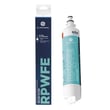
- Replace the water filter on schedule if you use the dispenser or ice maker (use the GE refrigerator water filter RPWFE)
- Keep doors closing tightly; a worn gasket can cause temperature swings and longer run times
- If temperatures seem inconsistent, a failed sensor can misread compartment temps (see the refrigerator temperature sensor WR55X10025)
Choosing the right configuration reduces daily strain, helps you keep food organized, and can prevent common issues like warm spots from overstuffing or frequent door-open time.
Last updated: February 2026
Is GE Cafe considered high end?
Yes. GE Café is widely considered a high-end line within GE’s lineup because it focuses on premium styling, upgraded features, and customizable finishes compared with standard GE models. It typically sits below true luxury tiers, but it is positioned as an upscale choice for kitchens.
GE Café is generally viewed as a “premium mainstream” brand tier. For your GE CWE23SP4MHW2 bottom-mount refrigerator, that usually translates to a stronger emphasis on design details and feature sets, while still using serviceable, replaceable components.
| GE line | Typical market position | What you usually get |
|---|---|---|
| GE (standard) | Value to mid-range | Core features, simpler styling |
| GE Profile | Upper mid-range | More features, more tech |
| GE Café | Premium mainstream (high-end look and features) | Design-forward, upgraded features, customizable finishes |
| GE Monogram | Luxury | Built-in luxury styling and premium configurations |
We recommend judging “high end” by what you care about most: performance, aesthetics, and long-term serviceability.
- Design and finishes: Café is known for a more custom, built-in look.
- Feature set: More convenience features than standard lines.
- Parts support: Key components are replaceable when issues come up.
- Cost to repair: Premium models can use higher-cost electronics and assemblies.
- Ownership experience: Maintenance (filters, gaskets, fans) matters as much as brand tier.
“High end” often means more sensors, controls, and specialty assemblies. When troubleshooting cooling, noise, or temperature swings on CWE23SP4MHW2, common repair paths include checking airflow and temperature feedback.
Here are examples of parts on this model that relate to “premium feature” operation:
- Refrigerator temperature sensor WR55X10025 (temperature feedback)
- Refrigerator main control board WR55X46805 (system control and logic)
- GE refrigerator water filter RPWFE (water quality and dispenser performance)
For brand-specific tips that come up often on GE refrigerators, we use GE refrigerator error codes to narrow down symptoms to likely causes.
Last updated: February 2026
What is the most common problem with GE profile refrigerators?
The most common issues we see on GE Profile refrigerators like model CWE23SP4MHW2 are ice maker and water dispenser troubles (no ice, slow ice, weak water flow) and temperature problems (warm fresh food section, freezer too warm). These usually trace back to airflow, frost buildup, or a failed sensor, fan, or control.
- Ice maker not making ice or slow production: restricted water supply, clogged filter, dispenser/ice path icing
- Fresh food section warm but freezer cold: weak evaporator airflow, iced air passages, fan issue
- Temps swing up and down: temperature sensor (thermistor) drifting, control logic reacting incorrectly
- Door alarm or “door open” behavior: door not sealing, door switch issue
- Water under the refrigerator: defrost drain issues or water line seepage
- Confirm controls are set to normal temps (typical targets: 37°F fresh food, 0°F freezer).
- Make sure vents inside the compartments are not blocked by food packages.
- Check door sealing with the “paper test” (paper should drag when you pull it out).
- If you have low water flow or odd-tasting ice, replace the filter with the correct one for this model.
- If you hear the fan stop and start or airflow is weak, inspect for frost buildup behind interior panels.
| Problem area | What fails most often | Example part for this model |
|---|---|---|
| Temperature sensing | Thermistor/temperature sensor | Refrigerator temperature sensor WR55X10025 |
| Water/ice quality and flow | Clogged water filter | GE refrigerator water filter RPWFE |
| Cooling control | Main control board | Refrigerator main control board WR55X46805 |
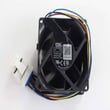
| Air circulation | Fresh food fan motor | Refrigerator fresh food fan motor assembly WR60X35205 |
| Warm air leaks | Door gasket not sealing | Refrigerator freezer door gasket WR14X36194 |
Ice maker and cooling complaints often share the same root cause: the refrigerator cannot move cold air correctly or cannot manage temperatures accurately. Fixing airflow, sealing, and filtration first prevents unnecessary part replacement and helps the compressor run less.
- Use GE refrigerator error codes to interpret any displayed fault codes before replacing electronics.
- If the issue is a door alarm or door-open warning, follow how to reset the door alarm on a GE refrigerator.
- For ice and water issues, how to replace the water filter in a GE refrigerator covers the correct replacement steps and reset basics.
Last updated: February 2026