Owner’s manual
 Error Codes



What should my Samsung bottom freezer be set at?
For your Samsung RB215BSSB bottom-mount refrigerator, we recommend setting the fresh food (fridge) section to 38°F and the freezer to -2°F for normal everyday food storage. These settings balance food safety, freshness, and energy use (see the owner's manual).
Use these model-supported ranges to fine-tune performance:
- Fridge adjustable range: 34°F to 46°F
- Freezer adjustable range: -14°F to 8°F
- Fast freeze (short-term): set freezer to -14°F for about 1 hour to chill newly added items quickly
- Before first loading frozen food: let the freezer reach at least 0°F
- After changing a setting: give temperatures time to stabilize; the display can differ slightly from the setpoint
You can change temperatures from the control panel:
- Press Fridge repeatedly until your target temperature shows.
- Press Freezer repeatedly until your target temperature shows.
- Wait about 5 seconds; the display returns to showing the average compartment temperature.
- Use Super Cool to pull the fridge back down faster after a long door opening.
- Use Super Freeze to pull the freezer back down faster after a long door opening.
| Compartment | Normal target | Adjustable range | Quick-cool option |
|---|---|---|---|
| Fridge | 38°F | 34°F to 46°F | Super Cool |
| Freezer | -2°F | -14°F to 8°F | Super Freeze |
Correct fridge and freezer settings help prevent spoilage, reduce freezer burn, and keep the compressor from running longer than necessary. If temperatures drift even with correct settings, a failed sensor can cause inconsistent cooling; the refrigerator temperature sensor assembly MK172CL2UE08 is one part we commonly see involved in temperature regulation issues.
Last updated: February 2026
What is the difference between force defrost RD and FD?
On Samsung RB215BSSB refrigerators, RD is a refrigerator-only defrost mode aimed at clearing frost on the fresh food evaporator, while FD (forced defrost) is the broader defrost mode used to melt heavier ice buildup across the cooling system. For control-panel specifics and normal defrost behavior, use the RB215BSSB owner's manual.
Use the mode that matches where the ice problem is happening.
- RD (refrigerator defrost): Targets the fresh food (refrigerator) evaporator area; best when the fridge section is warm but the freezer is mostly normal.
- FD (forced defrost): Used when ice buildup is more severe (for example, airflow blocked by frost); it is the go-to mode when you suspect system-wide frost issues.
- Neither mode fixes the root cause: If frost returns quickly, the issue is usually in the defrost system (sensor, thermal fuse, heater circuit) or airflow.
Forced defrost is meant to melt ice; plan for water and temporary warming.
- You may hear beeping or see a display indication while the mode is active.
- Water can drip as ice melts; protect floors and shelves with towels.
- Keep doors closed as much as possible to speed the melt and reduce humidity.
- After defrost, allow time for temperatures to stabilize before judging results.
If FD/RD helps only temporarily, these are common suspects on bottom-mount Samsung refrigerators.
| Symptom after defrost | Common area | Example part on this model |
|---|---|---|
| Frost returns quickly, temps swing | Defrost sensing | Refrigerator temperature sensor assembly DA32-10105S |
| Defrost stops early or overheats | Safety cutoff | Refrigerator defrost thermal fuse DA47-00095E |
| Water/ice buildup from defrost drain | Drain path | Refrigerator drain tube grommet DA63-01263C |
Choosing RD vs FD saves time and reduces food warming. RD is for a localized refrigerator-evaporator frost issue; FD is for heavier frost that can block airflow and cause warm temperatures, fan noise, or poor cooling.
Last updated: February 2026
What is the most common problem with Samsung refrigerators ice?
On the Samsung RB215BSSB, the most common ice-related complaint is the ice maker slowing down or stopping because ice clumps, freezes up, or the ice bin and feeler arm cannot move freely. This is often tied to temperature, frequent door openings, or water supply issues; start with the checks in the RB215BSSB owner's manual.
- Dump the first few batches after restoring water or turning the ice maker back on (this clears the water line).
- Make sure nothing blocks the feeler arm; if it cannot swing, the ice maker stops.
- Confirm the freezer is cold enough; ice output depends heavily on freezer temperature.
- Reduce long or frequent door openings; warm, moist air increases frost and clumping.
- If cubes are stuck together, empty the bin and let the ice maker restart with a clean bin.
The RB215BSSB ice maker is designed to produce 8 cubes per cycle and roughly 100 to 130 cubes in 24 hours, depending on freezer temperature, room temperature, and door openings.
| Situation | What you’ll notice | What to do first |
|---|---|---|
| Bin is full | Ice maker stops | Clear space so the feeler arm can drop |
| Ice clumps in bin | Cubes joined together | Empty and rinse the bin; dry fully |
| Low daily output | Fewer cubes per day | Lower freezer temp; limit door openings |
| Bad-tasting ice | Cloudy, stale cubes | Discard old ice; make fresh batches |
If the ice maker is getting power and the freezer is cold but ice production is still inconsistent, we focus on water fill and temperature sensing.
Common parts to check for this model include:
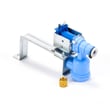
- Refrigerator water inlet valve DA62-00930A (weak or no fill)
- Refrigerator temperature sensor assembly DA32-10105S (temperature feedback issues)
- Refrigerator temperature sensor assembly DA32-00006C (temperature feedback issues)
Ice makers are sensitive to airflow, temperature stability, and water delivery. Small issues like a blocked feeler arm, warm freezer temps, or moisture from frequent door openings can stop production even when the refrigerator is otherwise cooling normally.
Last updated: February 2026