
What size blade is a Craftsman 137248481 table saw?
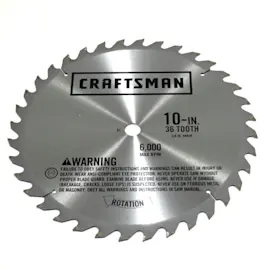
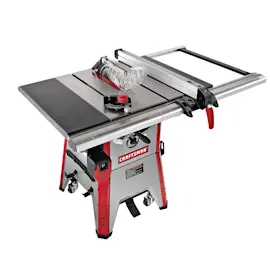
Most Craftsman table saws like model 137248481 use a 10-inch table saw blade (the most common size for this class of saw). To be sure before you buy a blade, we recommend confirming the blade diameter printed on your current blade or measured across the tips; you can also search your model on Sears PartsDirect for model-specific specs.
How to confirm the blade size on your 137248481
Use one of these quick checks:
- Read the blade label (usually shows diameter like 10 in., arbor size, and max RPM)
- Measure the blade diameter across the widest point (tip to tip through center)
- Check the arbor size marking (commonly 5/8 inch on many 10-inch table saw blades)
- Verify the max RPM rating on the blade is at least as high as your saw’s no-load speed
Blade size vs. arbor size (what you actually need to match)
A blade must match both diameter and arbor hole size.
| What to match | Typical for many Craftsman table saws | Why it matters |
|---|---|---|
| Blade diameter | 10 inch | Determines max cut depth and guard/riving knife fit |
| Arbor hole size | 5/8 inch | Ensures the blade mounts securely and runs true |
| Blade kerf | Thin or full kerf | Affects cut width and how hard the motor works |
Why it matters
Using the correct blade diameter helps the blade guard, riving knife, and height/tilt mechanisms operate correctly. Matching the arbor size and RPM rating helps prevent wobble, poor cuts, and unsafe operation.
If your cuts look off after changing blades
These guides help with common table saw setup issues:
Last updated: February 2026
How to get rid of an old table saw?
For a Craftsman table saw model 137248481, the best way to get rid of it is to reuse it first (sell, donate, or give away); if it’s not worth keeping, recycle it through a local scrap-metal or e-waste program and handle the blade as a separate sharp item. For parts lookups by model, use Sears PartsDirect.
Best disposal options (in order)
- Sell or give away if it still runs (even “needs work” units often move quickly).
- Donate to a local reuse center, school shop program, or community workshop (call ahead).
- Recycle as scrap metal if the frame, table, and stand are mostly steel or cast iron.
- Use an e-waste drop-off if it has electronic controls, a soft-start module, or a damaged power cord you do not want to repair.
- Schedule bulky-item pickup only if your local program accepts power tools (rules vary).
Safety steps before you move or dispose of it
- Unplug the saw and remove the blade; store it so the teeth cannot cut anyone.
- Remove loose accessories (miter gauge, rip fence, throat plate, guard, push stick).
- Tape or tie down moving parts (height and bevel mechanisms) so the blade arbor cannot shift.
- If it’s a portable/jobsite style, fold and lock the stand before loading.
What to do with the blade
Saw blades are treated differently than the saw body because they’re sharp and often all-steel.
| Item | Best option | Notes |
|---|---|---|
| Carbide-tipped blade | Scrap/recycling drop-off | Keep teeth covered for transport. |
| Steel blade | Scrap/recycling drop-off | Often accepted with other ferrous metal. |
| Rusty/damaged blade | Scrap or disposal per local rules | Wrap and label as “sharp.” |
Why it matters
Table saws are heavy, have sharp cutting components, and often contain recyclable metal. Disposing of the saw and blade correctly reduces injury risk during handling and keeps recoverable materials out of the trash stream.
Last updated: February 2026
How much is a Craftsman professional table saw 137248481?
A Craftsman table saw model 137248481 typically sells in the used market, so the price depends on condition, included accessories (fence, miter gauge, stand), and whether the motor and blade-height/tilt adjustments work smoothly. For current pricing, we recommend comparing recent local listings and then using Sears PartsDirect to look up parts by model.
Typical price ranges you’ll see
Most older Craftsman “professional” style table saws land in these ranges when they’re complete and running well:
- $150 to $300: working saw, average wear, basic accessories
- $300 to $500: clean condition, good fence, minimal rust, ready-to-use setup
- $50 to $150: needs repair (won’t start, slow blade, missing guard/fence)
| Condition of your 137248481 | What it usually includes | Typical value impact |
|---|---|---|
| Ready to cut | Fence, miter gauge, blade guard, smooth adjustments | Highest resale |
| Usable but worn | Surface rust, noisy bearings, fence needs tuning | Mid-range |
| Needs work | Electrical issue, height/tilt stuck, missing parts | Lowest |
Quick checks that change the value fast
Before you price it, we use these checks because they directly affect safety, cut quality, and repair cost:
- Starts and runs without tripping (switch, cord, overload)
- Blade reaches full speed and does not bog down in a test cut
- Blade height and bevel tilt adjust smoothly (no binding)
- Fence locks parallel and holds position
- Table is flat and not heavily pitted with rust
If you’re troubleshooting any of these issues, our DIY symptom pages help narrow it down, such as table saw won't start and table saw blade spins too slow.
Why it matters
A table saw’s price is driven less by the badge and more by the condition of the drive system (motor, arbor/bearings, belts if equipped) and the accuracy of the fence and blade alignment. A saw that cuts square and adjusts easily is worth significantly more than one that needs tuning or repair.
Last updated: February 2026
Can you use an 8 inch blade on a 10 inch table saw?
Yes, you can use an 8-inch blade on a 10-inch table saw like the Craftsman 137248481 as long as the blade fits the arbor and you keep the saw set up for the smaller diameter; the main tradeoff is reduced maximum cut depth.
What changes when you drop from 10-inch to 8-inch
Using a smaller blade is usually straightforward, but it affects how the saw performs:
- Shallower cuts: an 8-inch blade cuts less deep than a 10-inch blade.
- Guard and riving knife alignment: the blade sits lower, so the guard and riving knife may not line up correctly.
- Throat plate clearance: the opening must match the blade and any stabilizers.
- Arbor fit matters most: the arbor hole size and blade thickness must match what your saw accepts.
Quick fit and safety checklist
Before installing an 8-inch blade on the Craftsman 137248481, we use this checklist:
- Unplug the saw and remove the switch key (if equipped).
- Confirm the arbor hole size on the blade matches the saw’s arbor.
- Confirm the blade’s kerf (thickness) is compatible with the riving knife or splitter.
- Spin the blade by hand after tightening to confirm it clears the throat plate.
- Re-check blade-to-fence alignment and blade-to-miter-slot alignment after the swap.
8-inch blade vs 10-inch blade: what to expect
| Item | 10-inch blade (typical) | 8-inch blade (typical) |
|---|---|---|
| Max cut depth | Deeper | Shallower |
| Best use | General ripping/crosscutting | Thin stock, specialty setups |
| Guard/riving knife fit | Designed for it | May need adjustment or may not fit |
Dado note (common reason people ask)
Many dado sets are 8-inch diameter and are commonly used on 10-inch table saws because dado work is typically non-through cutting. If you’re setting up for dadoes, follow the same arbor and clearance checks, and use the correct throat plate for the wider cut.
Why it matters
Blade diameter affects cut capacity and how well safety components (guard, riving knife, anti-kickback pawls) function. A blade that “fits” mechanically can still create unsafe conditions if the guarding system no longer matches the blade position.
For more setup and technique guidance, we recommend reviewing table saw common question. For parts and accessories that match your Craftsman 137248481, start with the parts list for this model, or search by model number on Sears PartsDirect.
Last updated: February 2026