Owner’s manual
 Error Codes




What is the life expectancy of a 40 gallon electric water heater?
A 40-gallon electric water heater typically lasts 10 to 15 years. For your Whirlpool ES40R92-45D, lifespan is most affected by water quality and maintenance, especially sediment flushing and anode rod condition. Following the maintenance schedule in the ES40R92-45D use & care guide helps you reach the full service life.
- Water hardness and sediment: more mineral buildup means more tank stress and element wear.
- Anode rod condition: the anode rod protects the tank from corrosion; once depleted, tank corrosion accelerates.
- Temperature setting: higher set points can increase scaling and stress.
- Usage pattern: heavy daily demand increases cycling on heating elements.
- Maintenance consistency: regular flushing and inspections prevent early failures.
Your ES40R92-45D manual calls out two big items:
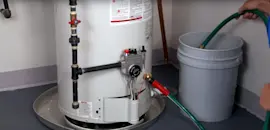
- Drain and flush the tank every 6 months to reduce sediment buildup.
- Inspect the anode rod within 3 years, then yearly after that (yearly from the start if you have artificially softened water).
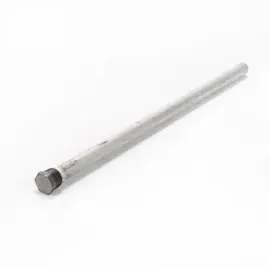
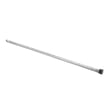
If your anode rod is worn, replacing the water heater anode rod 100109594 is one of the most effective ways to extend tank life.
| Item | Typical range | What usually ends it |
|---|---|---|
| Electric tank water heater (40-gallon) | 10 to 15 years | Tank corrosion/leak, heavy sediment |
| Anode rod | 3 years to inspect, then yearly | Depletion from water chemistry |
Once the tank begins to corrode internally, performance issues can show up as noise, reduced hot water, or leaks. Preventing corrosion and sediment buildup is the difference between replacing parts (like an anode rod) and replacing the entire water heater.
Last updated: January 2026
Why is my whirlpool water heater not heating?
If your Whirlpool ES40R92-45D electric water heater isn’t heating, the most common causes are a tripped breaker or loose wiring, a tripped high-limit safety (ECO), a failed heating element, or a problem with the electronic thermostat/sensors. We recommend checking power first, then using the built-in diagnostics in the ES40R92-45D use & care manual.
- Confirm the double-pole breaker is ON and not tripped.
- Make sure the tank is completely full of water before power is applied (dry-fire can damage elements).
- Check for an error code or alert on the Energy Smart module display.
- Verify access doors and insulation are installed correctly (running without them can cause overheating).
- If you recently drained the tank, purge air at a hot faucet until flow is steady.
| What you notice | Likely cause | What we recommend |
|---|---|---|
| No display, no heat | No power to heater | Reset breaker; check wiring connections at junction box (power off) |
| Display shows an error code | Control detected a fault | Use Whirlpool electric water heater error codes to match the code to the fix |
| Breaker trips repeatedly | Shorted element or wiring issue | Have wiring and elements tested; replace failed component |
| Some hot water, then cold | One element not heating or sensor issue | Test elements and thermistors; check thermostat operation |
If testing points to a failed control component, these model-compatible parts are commonly involved:
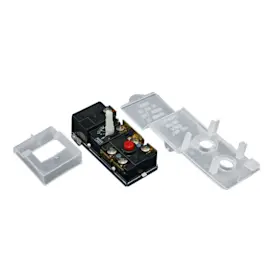
- Water heater electronic thermostat 100309396 (controls element switching and safety logic)
- Water heater high-temperature sensor 100263932 (thermistor used for temperature sensing and protection)
A “no heat” condition can be as simple as a tripped breaker, but it can also indicate dry-fire damage or a control/sensor fault. Diagnosing in the right order helps prevent repeat failures and avoids energizing elements when the tank is not full.
Last updated: January 2026
How much should a 40 gallon electric water heater cost?
A 40-gallon electric water heater typically costs $400 to $1,000 for the unit, and $1,200 to $3,000 installed in many U.S. markets. For a Whirlpool ES40R92-45D, the exact total depends on local labor rates, permit requirements, and whether plumbing or electrical updates are needed; our ES40R92-45D use & care manual helps you confirm installation requirements that can affect price.
Installed cost varies most when the job includes code upgrades or access challenges. Common cost drivers include:
- Warranty length and features (basic vs. premium controls, efficiency features)
- Electrical work (breaker, wire gauge, junction box, conduit)
- Plumbing updates (shutoff valve, dielectric unions, piping changes)
- Closed system protection (adding an expansion tank when needed)
- Permit and inspection fees (varies by city and county)
- Disposal and haul-away of the old tank
These are practical planning ranges for a 40-gallon electric tank water heater.
| Scenario | Unit cost | Typical installed total |
|---|---|---|
| DIY replacement (experienced, permitted where required) | $400 to $1,000 | $400 to $1,300 |
| Straightforward pro replacement | $450 to $1,200 | $1,200 to $2,200 |
| Complex replacement (code upgrades, tight access, extra materials) | $500 to $1,500 | $2,200 to $3,000+ |
This Whirlpool model uses an electronic control system and has specific installation and safety requirements (for example, proper grounding, correct wire size, and correct fill and purge steps before energizing). Those requirements can add labor time and materials, which changes the installed price.
If your tank is sound and you are troubleshooting performance, a repair can sometimes restore hot water without replacing the whole heater. Examples include:
- Replacing a failed control with the water heater electronic thermostat 100309396
- Addressing odor/corrosion protection with the water heater anode rod 100109594
- Fixing draining issues with the drain valve 100109106
Last updated: January 2026
Can you replace parts on a water heater?
Yes. On the Whirlpool ES40R92-45D electric water heater, many service parts are designed to be replaced (not the tank itself), including controls, sensors, and maintenance items. Always shut off electrical power at the breaker and shut off the water supply before starting; follow the ES40R92-45D use & care manual.
These are typical repairable items on this model and similar Whirlpool electric water heaters:
- Electronic thermostat/control components (temperature regulation and safety shutoff)
- Heating element-related service items (element, gasket, access covers)
- Sensors/thermistors (temperature feedback to the control)
- Anode rod (corrosion protection and odor-related maintenance)
- Drain valve (for draining and flushing)
- Dip tube and heat trap fittings (water flow and efficiency)
If the issue is a failed control, sensor, or maintenance part, replacing the part is usually worthwhile. If the tank itself is leaking, that is not a serviceable “part” repair.
| Situation | Typical best next step | Why |
|---|---|---|
| No hot water, error code, or unstable temperature | Diagnose and replace the failed component | Often a thermostat, sensor, or element-related issue |
| Rotten egg smell or accelerated corrosion concerns | Inspect/replace anode rod | The anode rod is a wear item |
| Sediment buildup, slow recovery | Drain and flush; inspect element | Sediment can shorten element life |
| Water under heater from tank seam | Replace the water heater | Tank leaks are not repairable |
If your symptoms point to one of these components, these are model-matched examples from the ES40R92-45D parts list:
- Water heater electronic thermostat 100309396 (temperature control and switching)
- Water heater high-temperature sensor 100263932 (temperature sensing for safe operation)
- Water heater anode rod 100109594 (protects the tank from corrosion)
- Drain valve 100109106 (used for draining and flushing)
Replacing the right part can restore hot water, improve efficiency, and extend the service life of your Whirlpool ES40R92-45D. Routine maintenance items (like flushing and the anode rod) also help prevent premature failures.
Last updated: January 2026
What are the three most important parts of a water heater?
For the Whirlpool ES40R92-45D electric water heater, three of the most important parts are the dip tube (brings cold water into the tank properly), the anode rod (helps protect the tank from corrosion), and the temperature and pressure (T&P) relief valve (a key safety device that relieves excess pressure/temperature). For locations, maintenance, and safety details, use the ES40R92-45D use & care guide.
- Dip tube: Helps prevent “lukewarm” water by directing incoming cold water to the bottom of the tank.
- Anode rod: Sacrifices itself to slow tank rust; a depleted rod can shorten tank life.
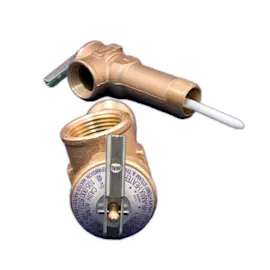
- T&P relief valve: Helps prevent dangerous overpressure conditions by releasing water when needed.
- Dip tube issues: Hot water runs out quickly, or temperature seems inconsistent.
- Anode rod issues: Rotten-egg odor, discolored water, or accelerated corrosion symptoms.
- T&P relief valve issues: Dripping/discharge, or a valve that will not reseat after testing.
| Part | Primary job | Common symptom when failing |
|---|---|---|
| Dip tube | Directs cold inlet water | Not enough hot water, rapid cool-down |
| Anode rod | Corrosion protection | Odor, discoloration, shortened tank life |
| T&P relief valve | Safety pressure/temperature relief | Dripping, discharge, will not reseat |
If you are servicing this Whirlpool ES40R92-45D, these model-matched parts are commonly involved:
These components directly affect hot water performance, tank longevity, and household safety. Keeping up with basic inspection and maintenance helps prevent “no hot water” complaints and reduces the risk of leaks or damage.
Last updated: January 2026
What fails on an electric water heater?
On the Whirlpool ES40R92-45D electric water heater, the most common failures are electrical heating and control components (heating elements, thermostat/control, and sensors), plus wear items that affect performance like the anode rod and drain valve. Use the troubleshooting and wiring guidance in the ES40R92-45D manual.
- Heating element failure: no hot water, slow recovery, or hot water runs out quickly.
- Thermostat/control failure: water too hot, not hot enough, or inconsistent temperatures.
- Sensor/thermistor issues: error codes, temperature swings, or the heater shutting down.
- Anode rod depletion: rotten egg odor, discolored water, and faster tank corrosion.
- Sediment buildup: popping/rumbling noises, reduced capacity, and element stress.
- Drain valve leaks/clogs: water in the drain pan area or trouble flushing the tank.
If symptoms point to a failed component, these are compatible examples for this model:
| Symptom | Likely area | Example compatible part for ES40R92-45D |
|---|---|---|
| No hot water or slow recovery | Heating circuit | Element 100108290 |
| Water temp erratic or won’t regulate | Control/thermostat | Water heater electronic thermostat 100309396 |
| Odor or premature tank corrosion risk | Corrosion protection | Water heater anode rod 100109594 |
| Leaking at drain connection or won’t flush | Drain system | Drain valve 100109106 |
- Confirm the double-pole breaker is on and not tripped.
- Verify the tank is completely full of water before energizing (dry-firing can damage elements).
- Check for loose/burned wiring at the junction box and element terminals (power off first).
- Look for diagnostic codes on the control display if equipped.
- Flush sediment if you hear rumbling or notice reduced hot water output.
Catching a failing heating element, thermostat, or anode rod early helps restore hot water faster and can reduce repeat failures caused by overheating, sediment, or corrosion.
Last updated: January 2026
How do I tell if my hot water heater element is bad?
If your Whirlpool ES40R92-45D has a burned-out or scaled-up heating element, you will usually notice no hot water, lukewarm water, or hot water that runs out fast. You can confirm it by safely disconnecting power and checking the element with a multimeter, following the steps in the ES40R92-45D use & care manual.
- No hot water at all (possible upper element issue, or power/control issue)
- Lukewarm water or reduced hot water volume (often the lower element)
- Hot water runs out quickly during showers
- Popping or rumbling sounds (often heavy sediment that can overheat an element)
- Breaker trips or you smell overheating at the access area (stop and disconnect power)
- Turn off the double-pole breaker for the water heater.
- Remove the element access cover and insulation.
- Verify power is off with a meter.
- Disconnect the element wires.
- Measure resistance (ohms) across the two element screws.
| Meter reading | What it suggests | Next step |
|---|---|---|
| OL or infinite resistance | Element is open (failed) | Replace the element |
| Very low resistance | Element may be shorted | Replace the element |
| Resistance present but water still cold | Could be thermostat/sensor, wiring, or sediment | Continue diagnosis |
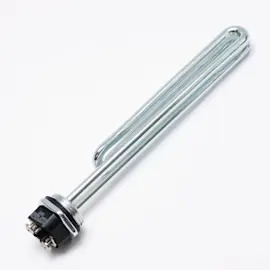
For this model, the replacement element must match the original style and voltage/wattage rating shown on the element flange/terminal block or the data plate (the manual calls this out). Use the correct replacement such as the element 100108290 when it matches your original ratings.
A weak or failed element can cause long recovery times, inconsistent water temperature, and overheating that may trip safety controls. Catching it early also helps prevent repeat failures caused by sediment buildup.
Last updated: January 2026