Owner’s manual



What brand engine is in a Husqvarna riding mower?
Most Husqvarna riding mowers use engines supplied by major small-engine makers (commonly Briggs & Stratton, Kawasaki, or Kohler), and the exact engine brand depends on the specific mower model and engine spec. For the Husqvarna TS248XD-96043030900, we recommend confirming the engine identification details in the TS248XD-96043030900 owner's manual.
How to identify the engine brand on your mower
Use the engine’s ID label, not the hood decal. On riding mowers, the engine brand and model are typically shown on a sticker or metal tag on the engine itself.
- Lift the hood and look for an engine label on the blower housing, valve cover, or near the starter
- Record the engine brand, engine model, and spec/type code (if listed)
- Compare that information to the engine section in the manual
- If the label is dirty, wipe it gently so the numbers are readable
- Use the engine model and spec to order tune-up parts (filters, plugs, belts) correctly
What you will typically see (and what it means)
Different suppliers use different ID formats. Here is what to look for.
| What you find on the engine label | What it tells you | Why you need it |
|---|---|---|
| Brand name (Briggs & Stratton, Kawasaki, Kohler) | Who built the engine | Helps match service parts and manuals |
| Engine model number | Engine family and displacement class | Needed for correct filters and spark plug |
| Spec/type code | Exact configuration for that model | Prevents ordering the wrong carburetor or ignition parts |
Why it matters
Husqvarna builds the tractor platform (frame, deck, controls), but the engine is a separate system with its own service parts and specifications. Using the engine’s model and spec ensures you get the right maintenance parts and troubleshooting steps.
Related parts that affect “engine” symptoms
If the mower will not crank or the engine shuts off, the issue is often electrical or drive-related rather than the engine brand itself. These model-matched parts are common fixes:
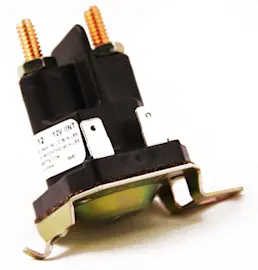
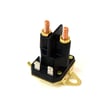
- Starter solenoid 582042802 (no-crank, clicking, intermittent starting)
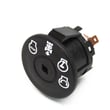
- Pto switch 582107601 (engine dies when engaging blades, safety circuit issues)
- Lawn tractor ground drive belt 592855201 (mower moves poorly, slipping under load)
Last updated: January 2026
What transmission is in Husqvarna TS248XD?
The Husqvarna TS248XD-96043030900 riding lawn tractor uses a hydrostatic (automatic) transmission, so ground speed is controlled with the forward and reverse pedal rather than manual shifting. For the exact transmission identification and service details, use the TS248XD-96043030900 owner's manual.
How to confirm the exact transmission type on your tractor
We recommend verifying by checking the product ID label and the transmission tag on the unit.
- Park on a level surface, set the parking brake, and remove the key
- Lift the seat and look for the product label with model and serial information
- Inspect the transaxle area for a manufacturer tag or stamped ID
- Note whether your unit has a forward and reverse pedal (typical hydrostatic setup)
- Match the ID information to the parts diagrams and service notes in the manual
What “hydrostatic” means for operation
A hydrostatic transmission uses hydraulic pressure to vary speed smoothly.
| Feature | Hydrostatic transmission (TS248XD-96043030900) | Manual gear drive |
|---|---|---|
| Speed changes | Smooth, variable | Fixed gears |
| Shifting | No clutching between gears | Shift lever and clutching |
| Best for | Frequent speed changes, mowing around obstacles | Straight runs, simpler drivetrain |
Common symptoms that point to a drive system issue
If the tractor will not move or feels weak, the transmission may be fine and the problem may be in the drive belt or pulleys.
- Tractor will not move forward or reverse
- Slipping or surging under load
- Burning rubber smell (often belt-related)
- Poor hill climbing or loss of speed
- Squealing from the belt and idler area
If you suspect belt slip, the Husqvarna lawn tractor ground drive belt 592855201 is a common wear item to inspect and replace when cracked, glazed, or stretched.
Why it matters
Knowing the transmission type helps you choose the right troubleshooting path (belt and linkage checks first, then hydrostatic drive checks) and ensures you order compatible Husqvarna parts for the TS248XD-96043030900.
Last updated: January 2026
What are the different YTH24V48 part numbers?
“YTH24V48” is a marketing-style series name that can cover multiple Husqvarna tractors with different product numbers (the 96045xxxxx suffix). The correct part numbers depend on the exact product number on your ID tag; for TS248XD-96043030900, use the TS248XD-96043030900 manual to confirm the right diagrams and parts.
How to identify the correct parts list
Use the tractor’s ID tag and match parts by the full product number, not just “YTH24V48.”
- Find the full model/product number on the frame ID tag (example format: 96045xxxxx).
- Use the matching parts diagram section (chassis/frame, electrical, steering, mower deck).
- Confirm the part description and mounting style (hood, grille, lens, dash pieces).
- If your tractor is TS248XD-96043030900, order parts using TS248XD-96043030900 diagrams.
Part numbers you might see for a YTH24V48 chassis/frame diagram
These numbers are commonly listed for one YTH24V48 product-number variant under a chassis/frame diagram; they are not universal across all YTH24V48 versions.
- 532444481: Applique subassembly
- 590748821: Upper dashboard assembly
- 587483301: Hood
- 532439733: Left headlight lens (LH)
- 597247201: Grille
- 532443385: Right headlight lens (RH)
- 580910801: Engine plate (welded)
Quick check: series name vs exact product number
| What you have | Example | What it means for parts |
|---|---|---|
| Series name | YTH24V48 | Multiple variants; parts can differ |
| Exact product number | 96045004600 | Correct way to match diagrams and part numbers |
| Exact model on this page | TS248XD-96043030900 | Use TS248XD diagrams for guaranteed fit |
Why it matters
Husqvarna often reuses similar-looking hoods, grilles, and dash panels across tractors; small differences in mounting holes, lens shape, or dash cutouts can cause a mismatch if the product-number suffix is not matched.
Last updated: January 2026
Does the Husqvarna TS248XD-96043030900 have a locking differential?
The Husqvarna TS248XD-96043030900 is not identified as having a locking differential in the operator information for this model; it uses a standard differential for normal mowing traction. For the exact drivetrain features and any traction-assist operation, follow the TS248XD-96043030900 owner's manual.
How to verify on the tractor (fast checks)
Use these checks to confirm what your specific tractor has before you rely on it for hills or wet grass:
- Look for a dedicated “diff lock” pedal, lever, or switch near the footrests or dash.
- Check the control labels around the operator platform for “diff lock” wording.
- Inspect the rear axle area for a linkage or cable that would actuate a lock mechanism.
- If there is no control and no linkage, the tractor is set up as an open differential.
- If traction is poor, focus on tire condition, tire pressure, and safe slope technique.
What to expect if it is an open differential
An open differential is the most common setup on lawn tractors; it allows the left and right rear wheels to rotate at different speeds for smoother turns, but one wheel can spin if it loses grip.
| Drivetrain feature | What you notice | Best use |
|---|---|---|
| Open differential | Easier turning; possible one-wheel spin | Routine mowing and flat yards |
| Locking differential (if equipped) | More pull in slippery spots; can scuff turf in turns | Slopes, wet areas, recovery |
Traction tips that help either way
- Mow up and down slopes (not across) when possible.
- Avoid sudden turns or stops on hills.
- Keep rear tires matched and properly inflated.
- Maintain the drive system; a worn belt can reduce pulling power (see lawn tractor ground drive belt 592855201 if you are troubleshooting slipping).
Why it matters
Knowing whether TS248XD-96043030900 has a diff lock helps you choose safe mowing patterns and prevents turf damage; it also keeps you from expecting a traction feature that is not present.
Last updated: January 2026