Error Codes


What is the most common problem with GE profile refrigerators?
The most common issue we see with GE Profile refrigerators like model GWE19JYLFFFS is cooling trouble (fresh food too warm, freezer not holding temperature, or temperatures swinging). The root cause is often airflow, frost buildup, or a failed sensor or fan that prevents steady, even cooling.
- Fresh food section warm but freezer still cold
- Freezer warming up or soft ice
- Frost or ice buildup on the back wall inside the freezer
- Loud humming, buzzing, or a fan noise that comes and goes
- Water leaking or puddles under the refrigerator
- Confirm settings: refrigerator about 37°F and freezer about 0°F
- Make sure vents are not blocked by food packages
- Check door seals for gaps and make sure doors close fully
- Clean dust from the condenser area (restricted airflow raises temps)
- If you see heavy frost, unplug and fully defrost 24 hours, then recheck cooling
| What you notice | Most likely area to check | Example part that can be involved |
|---|---|---|
| Temps swing, unit runs too long | Temperature sensing/control | GE profile refrigerator temperature sensor WR55X10025 |
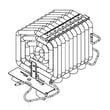
| Warm fridge, freezer OK, fan noise missing | Evaporator fan system | Motor dc evap fan WR60X39625 |
| Frost buildup, warm temps after a few days | Defrost system | Defrost heater & harness WR51X39386 |
| No water/ice, slow dispense | Water filtration/supply | GE refrigerator water filter XWFE |
Cooling problems are the fastest way to spoil food and overwork the compressor. Catching airflow, defrost, or sensor issues early helps the refrigerator hold stable temperatures and reduces expensive secondary damage.
- Use GE refrigerator error codes if your display shows an error; it narrows troubleshooting to the right system.
- If the issue is water or ice related, follow how to replace the water filter in a GE refrigerator to rule out a restricted filter.
Last updated: January 2026
Is GWE19JYLFFFS made in the USA?
GE model GWE19JYLFFFS is typically manufactured in GE’s North American production network, but the exact country of origin can vary by production run and serial number. For the most accurate answer for your specific refrigerator, check the model and serial tag for the “Made in” statement.
Look for the model and serial label (often inside the fresh food compartment on a side wall, ceiling, or near a crisper frame). Then verify the origin line printed on that label.
- Open the fresh food door and scan the interior walls and ceiling
- Check near the crisper drawer cover area and side liners
- Look for wording such as “Made in …” or “Manufactured in …”
- Write down the full serial number before contacting support
- If the label is worn, take a clear photo with good lighting
Country-of-origin wording is usually printed directly on the appliance label, not on the parts list.
| Label wording | What it means | What to do next |
|---|---|---|
| “Made in USA” | Final assembly and origin statement indicates USA | Record it for warranty and resale records |
| “Made in Mexico/China/…” | Origin statement indicates another country | Use the serial number if you need factory details |
| No clear origin line | Some labels emphasize compliance info | Use serial number with GE support for confirmation |
Country of origin can affect customer preference, parts sourcing expectations, and resale details. It does not change which replacement parts fit; fit is driven by the model number GWE19JYLFFFS and the specific part ID.
If you are maintaining water quality or troubleshooting dispenser performance on this model, these resources are commonly useful:
Last updated: January 2026
How to remove bottom grille on GE refrigerator?
On the GE GWE19JYLFFFS bottom-mount refrigerator, the bottom grille (base grille or toe grille) typically comes off by removing any retaining screws (if present) and then pulling the grille straight out to release the clips. Reinstall by aligning it and pressing or sliding it back into place.
- Unplug the refrigerator or switch off power at the breaker (safer when working near wiring and fans).
- Look along the top edge or ends of the grille for retaining screws; remove them with a Phillips screwdriver if you see them.
- Grip the grille at both ends and pull straight toward you; if it resists, pull one side slightly, then the other to release the clips evenly.
- If the grille has tabs, lift slightly while pulling to disengage the tabs from the frame.
- Set the grille aside and keep screws together for reinstallation.
| Area behind grille | What you might check | What to do |
|---|---|---|
| Condenser area | Dust and lint buildup | Vacuum and brush gently (avoid bending fins) |
| Drain pan area | Water in pan | A small amount is normal; clean if dirty |
| Fan noise area | Rattling or vibration | Make sure nothing is touching the fan shroud |
- Confirm all screws are removed (some models have screws at the ends).
- Pull straight out, not downward; downward force can bind the clips.
- Warm the room slightly if the plastic feels stiff; cold plastic can be less flexible.
- If the grille is cracked or clips are broken, replace the damaged grille or fasteners.
Removing the bottom grille correctly helps prevent broken mounting clips and gives you access for basic maintenance like condenser cleaning, which supports proper cooling and reduces compressor run time.
For related GE guidance, use how to reset the door alarm on a GE refrigerator if you are also working around the doors and alarms during service.
Last updated: January 2026