Owner’s manual
 Error Codes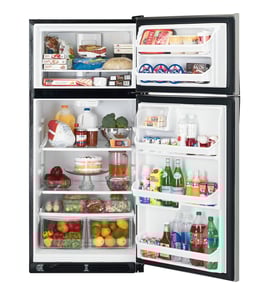




What are the disadvantages of a top mount fridge?
A top-mount (top-freezer) refrigerator like the GE GTE22JTNBRBB is usually affordable and efficient, but the main disadvantages are less convenient fresh-food access (more bending), fewer organization features than many bottom-freezer styles, and fewer built-in dispenser options on many models. See the GTE22JTNBRBB owner's manual for your exact feature set.
Common disadvantages (what most owners notice)
- Fresh-food access is lower: you bend more to reach everyday items in the refrigerator section.
- Freezer is at eye level: great for frozen foods, but it pushes fresh foods down.
- Less flexible storage: many top-mount designs have fewer premium bins, dividers, and wide pantry-style drawers.
- Fewer exterior features: many top-mount models do not include an in-door water or ice dispenser.
- More “digging” in the freezer: top freezers often use shelves and bins that can feel tighter than pull-out bottom drawers.
Quick comparison: top-mount vs bottom-freezer
| Feature | Top-mount (top-freezer) | Bottom-freezer |
|---|---|---|
| Fresh-food ergonomics | More bending | More convenient |
| Freezer access | Easy to see items | Pull-out drawers |
| Organization | Often simpler | Often more flexible |
| Typical cost | Often lower | Often higher |
Tips to reduce the downsides
- Put everyday fresh foods on the upper refrigerator shelves to reduce bending.
- Use clear bins to group items (snacks, lunch, produce) so you do less searching.
- Keep a “first to use” bin at eye level to cut down on food waste.
- If you have an ice maker, keep the area around it clear so cubes don’t clump.
- Level the refrigerator so doors close reliably; the manual explains how to adjust the leveling legs.
Why it matters
Choosing a refrigerator style is mostly about daily habits. If you use fresh foods more than frozen, a top-mount’s lower refrigerator section can feel less convenient over time, even if the design is reliable and efficient.
Last updated: January 2026
What is the most common problem with a GE refrigerator?
The most common problem we see with GE refrigerators like model GTE22JTNBRBB is not cooling properly (fresh food warm, freezer warming, or temperatures swinging). The usual causes are airflow issues, a fan problem, dirty condenser area, or a defrost system issue; start with the basic checks in the GTE22JTNBRBB owner's manual.
Most common symptoms and what they usually point to
- Fresh food warm but freezer cold: restricted airflow, iced evaporator cover, or a damper/airflow issue
- Freezer warm and fresh food warm: condenser airflow problem, compressor start issue, or control problem
- Loud humming, grinding, or rattling: evaporator fan or condenser fan area
- Water under the refrigerator or inside: defrost drain issue or water supply/valve issue (if equipped)
- Door not sealing: gasket contamination, hinge alignment, or door left ajar
Quick checks we recommend first (no parts guessing)
- Confirm settings: make sure the temperature control is not set to OFF.
- Check door seal and closing: clean the gasket folds and make sure the door closes squarely.
- Listen for fans:
- Evaporator fan noise typically comes from the freezer area.
- Condenser fan noise typically comes from the back/bottom.
- Inspect airflow: avoid blocking vents with food packages.
- Look for frost buildup: heavy frost on the freezer back panel often signals a defrost problem.
Common fixes and related parts for this model
| Problem area | What you may notice | Model-matched part examples |
|---|---|---|
| Evaporator fan not running | Warm temps, weak airflow, unusual freezer noise | Evaporator f WR60X31522 |
| Defrost system issue | Frost blanket on freezer back wall, warming over time | Refrigerator defrost heater assembly WR55X31113 |
| Water supply to ice maker (if equipped) | No ice, slow fill, small cubes | Refrigerator water inlet valve WR57X32213 |
| Electrical/control symptoms | Random temp swings, intermittent operation | Refrigerator main control board WR55X43825 |
Why it matters
Cooling complaints often start as an airflow or frost issue and then snowball into food-spoilage temperatures. Catching it early (cleaning, airflow, fan operation, and defrost clues) helps you avoid repeat failures and unnecessary part replacements.
Last updated: January 2026
How do I find the model number on my GTE22JTNBRBB?
On the GE GTE22JTNBRBB top-mount refrigerator, the model number is printed on an ID label inside the fresh food (refrigerator) compartment. Look on the left side wall, near the middle of the compartment; the same label also lists the serial number.
Where to look (fast checklist)
- Open the refrigerator door (not the freezer door)
- Check the left interior wall
- Look about mid-height (near the middle of the compartment)
- Find the label that shows both Model # and Serial #
- Write the numbers down exactly as shown (letters and numbers)
What the label typically includes
Most GE refrigerator ID labels include these fields:
- Model number
- Serial number
- Electrical ratings (volts/amps)
- Compliance and manufacturing information
| Item on label | What it’s used for |
|---|---|
| Model number | Matching parts and diagrams to your exact refrigerator |
| Serial number | Identifying production date range for service and compatibility |
| Electrical ratings | Verifying power requirements during troubleshooting |
Why it matters
Even small model-number differences can change which parts fit (for example, a control board, door switch, or icemaker). Using the exact model number helps us match the correct GE replacement parts and avoid returns.
If the label is hard to read
- Wipe the label gently with a damp cloth and dry it
- Use your phone camera zoom or flashlight to improve visibility
- Copy the characters carefully; GE model numbers are case-sensitive
For diagrams and additional identification details, use the GTE22JTNBRBB owner’s manual.
Last updated: March 2026