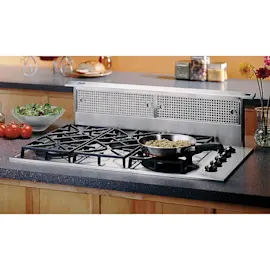
Installation guide
 Owner’s manual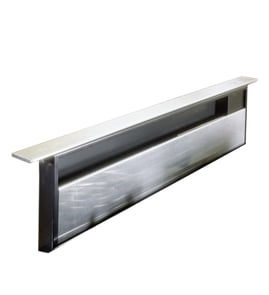



How does a downdraft ventilation system work?
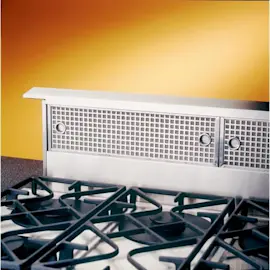
A downdraft ventilation system pulls cooking smoke, steam, and odors away from the cooktop area and moves them into ductwork for exhausting outdoors (or through a filtered recirculation setup, if configured that way). On the Dacor IVS1, the blower connects to an 8-inch round exhaust and uses a back-draft damper to help prevent outside air from flowing back in.
What’s happening when you turn it on
When we run the fan, the system creates negative pressure at the intake so airborne grease and heat are captured and directed into the exhaust path.
- Air is pulled into the intake area near the cooking surface
- The blower moves that air into the duct system
- Air exits through an 8-inch round duct (never reduce duct size)
- A back-draft damper helps limit reverse airflow when the fan is off
- Performance depends heavily on clean filters and clear ducting
Key IVS1 installation details that affect performance
The IVS1 is designed to be installed inside a custom hood canopy, and clearances and duct sizing matter for both safety and airflow.
| Item | IVS1 guidance (typical for this model) | Why it matters |
|---|---|---|
| Exhaust size | 8-inch round duct connection | Maintains airflow and reduces noise |
| Duct sizing | You can increase size; never decrease | Prevents restriction and back-drafting |
| Duct routing | Tape joints; vent outdoors | Reduces leaks, odors, and fire risk |
| Clearances | 36 inches above cooktop for combustible canopies; 30 inches for non-combustible | Helps reduce fire risk and heat damage |
For the exact dimensions and placement diagrams (including exhaust placement and electrical access), follow the installation guide.
Why it matters
Downdraft and integrated ventilation systems only work well when airflow is not restricted. Blocked filters, undersized ductwork, or leaky joints reduce capture, increase noise, and can allow grease buildup.
Quick care habits we recommend
- Always run the fan whenever the cooktop is operating
- Clean filters and grease-laden surfaces often
- Keep filters from becoming blocked or clogged
- Do not allow foreign objects to be sucked into the intake
- Keep window coverings from blowing into the cooking and ventilation area
Last updated: February 2026
What is the difference between a downdraft and a hood vent?
A hood vent sits above the cooktop and captures heat, smoke, and grease as they naturally rise; a downdraft system pulls cooking fumes sideways and down into ductwork, working against rising airflow. For Dacor model IVS1, the blower and duct design are critical for good capture. See the installation guide for placement and ducting requirements.
How each system moves air
- Hood vent: Uses natural convection (hot air rises) to help capture smoke and steam.
- Downdraft vent: Pulls air down through an intake near the cooking surface.
- Hood vent: Typically tolerates longer duct runs better.
- Downdraft vent: Performance drops quickly with restrictive ducting, sharp elbows, or poor make-up air.
- Downdraft vent: Often chosen when an overhead hood is not practical (for example, island layouts or sightline preferences).
IVS1 installation details that affect performance
For the Dacor IVS1 integrated ventilation system, the installation guide calls out several design points that directly impact how well a downdraft-style capture approach works:
- Use an 8-inch round exhaust with a backdraft damper (as specified for IVS1).
- Duct to the outside; do not vent into attics, crawl spaces, walls, or garages.
- Keep duct runs short and straight; minimize transitions.
- Prefer two 45° turns instead of one 90° turn.
- Do not add an external blower to increase duct length on IVS1.
Quick comparison
| Feature | Hood vent | Downdraft vent (IVS1-STYLE capture) |
|---|---|---|
| Best at capturing | Rising heat, steam, smoke | Smoke/steam near the intake path |
| Duct sensitivity | Moderate | High |
| Typical placement | Above cooktop | At or near cooktop, ducted down |
Why it matters
Ventilation performance is mostly about capture efficiency. A hood gets help from rising heat; a downdraft has to overcome that upward plume, so duct sizing, elbow count, and correct exhaust routing make a bigger difference.
Last updated: February 2026
Which is better, downdraft or updraft?
For most kitchens, an overhead (updraft) range hood captures smoke and steam more effectively than a downdraft because heat naturally rises. A downdraft like the Dacor IVS1 is a strong choice when you cannot use an overhead hood (for example, an island or a sightline you want to keep open). See the installation guide for IVS1 ducting and performance planning details.
Quick comparison: overhead hood vs. downdraft
| Feature | Overhead (updraft) hood | Downdraft (like Dacor IVS1) |
|---|---|---|
| Capture performance | Strongest for most cooking | Best for light to moderate smoke; can struggle with tall pots and high-heat searing |
| Best use case | Most standard cooktops and ranges | Islands, open-concept kitchens, or when an overhead hood is not practical |
| Ducting impact | Varies by hood and run | Duct design is critical; IVS1 connects to an 8-inch round duct |
| Visual impact | Hood is visible | Vent is low-profile when retracted |
What matters most for the IVS1: ducting and back-draft control
The IVS1’s real-world performance depends heavily on the duct run. The installation instructions specify an 8-inch round duct connection, allow increasing duct size over the run, and say never decrease duct size to prevent back-drafts and restriction.
Use these planning rules:
- Keep the duct route short and direct to the outside.
- Use round duct whenever possible (especially with elbows).
- Avoid back-to-back elbows; leave straight duct between bends when you can.
- Do not reduce below 8-inch duct; replace smaller existing duct with 8-inch or 10-inch.
- Plan for equivalent-length penalties for elbows and transitions.
IVS1 maximum straight duct run (from the installation instructions)
- 8-inch round: 60 ft
- 10-inch round: 50 ft
- 3-1/4 in x 10 in rectangular: 50 ft
When we recommend each option
Choose an overhead hood when:
- You do frequent high-heat cooking (searing, wok cooking, heavy frying).
- You often use tall stockpots.
- You want the most consistent capture of smoke and grease.
Choose a downdraft (IVS1) when:
- You cannot install an overhead hood (layout or design constraints).
- You want a cleaner sightline over an island cooktop.
- You can run proper 8-inch (or larger) ducting with minimal turns.
Why it matters
Ventilation is about capture, not just airflow. Since cooking heat rises, overhead hoods naturally intercept the plume; downdrafts must pull that plume downward, so duct sizing, run length, and minimizing resistance become the deciding factors.
Last updated: February 2026