Owner’s manual
 Error Codes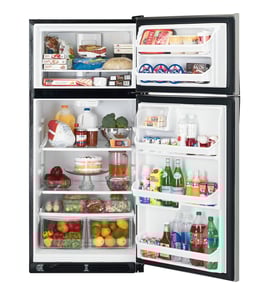


How to clean coils on GE top freezer refrigerator?
For the GE GTS18FBRERWW top-mount (top freezer) refrigerator, we clean the condenser coils by unplugging the refrigerator, accessing the coils (rear or underneath), then vacuuming and brushing off dust so the unit can release heat efficiently and cool properly. See the GTS18FBRERWW owner’s manual for model-specific care and cleaning guidance.
- Unplug the refrigerator from the wall outlet.
- Pull the refrigerator straight out to protect the floor and water line (if equipped).
- Locate the condenser coil area (commonly behind the unit or behind a lower front grille).
- Have a coil brush and a vacuum with a soft brush attachment ready.
- Keep water and wet cleaners away from electrical components.
- Unplug the refrigerator.
- Expose the coil area (rear access panel or lower front area, depending on how your unit is built).
- Vacuum loose dust using a brush attachment.
- Brush the coil fins gently to loosen packed lint and pet hair.
- Vacuum again to remove what you loosened.
- Restore airflow by making sure nothing blocks the lower front or rear ventilation space.
- Plug back in and confirm the refrigerator is running normally.
| Home situation | Recommended coil cleaning interval |
|---|---|
| No pets, low dust | Every 12 months |
| Pets or heavy dust | Every 3 to 6 months |
| Cooling issues or warm temps | Clean now, then recheck in 30 days |
Dirty condenser coils trap heat. That forces the compressor to run longer, which can cause warmer fresh food temperatures, weak freezer performance, and higher energy use.
If temperatures are still off after cleaning, common next checks include:
- Door seals not closing tightly
- Blocked interior air vents
- Frost buildup from a defrost problem
- Fan issues (for example, a noisy or stalled evaporator fan motor)
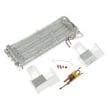
If you suspect a fan problem on this model, the refrigerator evaporator fan motor WR60X31522 is one of the listed replacement parts for GE GTS18FBRERWW.
Last updated: February 2026
What are the most commonly replaced parts in a refrigerator?
In a GE top-mount refrigerator like model GTS18FBRERWW, the most commonly replaced parts are the ones that affect cooling, airflow, defrosting, and door sealing. We also see frequent replacements for interior lighting and storage components because they wear out or get damaged during everyday use.
- Door gasket and hinge hardware (helps prevent warm air leaks and frost)
- Fan motors and fan blades (keeps air moving through the freezer and fresh food section)
- Defrost parts (heater and related components that prevent ice buildup)
- Temperature control and control housing parts (helps regulate cooling)
- Light bulb (simple fix when the interior light goes out)
- Shelves, drawers, and covers (breakage and wear)
These are model-matched examples we commonly see for this GE refrigerator:
| Symptom | Part type often involved | Example part for this model |
|---|---|---|
| Warm fridge or freezer, poor airflow | Evaporator fan motor | Refrigerator evaporator fan motor WR60X31522 |
| Noisy operation near the back/bottom | Condenser fan motor or blade | Refrigerator condenser fan motor WR60X10168 or refrigerator condenser fan blade WR60X10207 |
| Frost buildup, warming over time | Defrost heater | Refrigerator defrost heater WR51X10038 |
| Interior light not working | Appliance light bulb | GE appliance light bulb, 40-watt 40A15 |
Replacing the right part early can prevent food temperature problems, reduce frost buildup, and stop a small airflow issue from turning into a bigger cooling failure. The troubleshooting charts in the GTS18FBRERWW owner's manual also help you rule out simple causes like a door left open or a control set too warm.
- Confirm the symptom: warm temps, noise location, frost pattern, or light out
- Check basics first: door fully closing, vents not blocked, condenser area clean
- Unplug the refrigerator before any inspection or replacement
- If the light is out, remember the control set to “0” does not remove power to the light circuit
Last updated: February 2026
What is the most common problem with a GE refrigerator?
The most common issue we see with GE refrigerators like model GTS18FBRERWW is poor cooling (fresh food too warm, freezer not staying cold). In many cases, the fix starts with restoring airflow and heat removal: cleaning condenser coils, confirming fans run, and making sure vents are not blocked; see the GTS18FBRERWW owner’s manual for model-specific care and setup details.
- Dirty condenser coils: heat cannot release efficiently, so temperatures rise.
- Evaporator fan problem: weak or no airflow through the freezer and into the refrigerator section.
- Condenser fan problem: poor airflow across the condenser near the compressor.
- Blocked air vents: overpacked shelves can stop cold air circulation.
- Door not sealing: warm, humid air leaks in and forces longer run times.
- Set controls to normal mid-range and give the unit 24 hours to stabilize.
- Make sure food packages are not covering interior vents.
- Listen for fans when the compressor is running.
- Check door closure: the door should shut easily and not pop back open.
- Verify the refrigerator has breathing room; GE installation guidance calls for about 3/4 inch side clearance for air circulation.
| Symptom | Likely area | Example model-matched part |
|---|---|---|
| Freezer cold, fridge warm | Evaporator airflow | Refrigerator evaporator fan motor WR60X31522 |
| Unit runs hot, poor cooling | Condenser airflow | Refrigerator condenser fan motor WR60X10168 |
| Frost buildup, warming over time | Defrost system | Refrigerator defrost heater WR51X10038 |
Poor cooling is usually an airflow or heat-transfer problem. Fixing it early helps protect food, reduces run time, and prevents extra strain on major components like the compressor.
Last updated: February 2026