Owner’s manual
 Error Codes




What are the disadvantages of a bottom freezer?
A bottom-freezer refrigerator like the Samsung RF260BEAEBC makes fresh-food access convenient, but it can be less comfortable for freezer use because you reach down more often and manage heavier items lower to the floor. For layout and storage details specific to your unit, use the owner's manual.
Common disadvantages (what most owners notice)
- You typically bend or squat to see and reach frozen foods.
- Heavy items (bulk meat, frozen meals, ice bags) are harder to lift from a low drawer.
- Freezer organization can take more effort; items can stack and get buried.
- The freezer drawer can feel heavier when fully loaded.
- Some kitchens need more clearance in front for the drawer to pull out fully.
Bottom freezer vs. top freezer: quick comparison
| Feature | Bottom freezer | Top freezer |
|---|---|---|
| Fresh-food access | Easier (at eye level) | More bending for fridge items |
| Freezer access | More bending | Easier reach |
| Handling heavy frozen items | Harder (lift up from low) | Easier (lift from higher) |
| Organization | Often better with baskets, but can bury items | Simpler shelves, easier visibility |
Tips to reduce the downsides
- Put the heaviest items in the upper freezer basket (or closest-to-top area) to reduce lifting strain.
- Group foods by type (meat, vegetables, breakfast) and use bins so items do not get buried.
- Keep a small “use first” section near the top for frequently grabbed items.
- Avoid overloading the drawer; it improves glide and reduces wear on rails.
Why it matters
Most bottom-freezer complaints come down to ergonomics and organization. If you plan your freezer layout and keep heavy items accessible, a bottom-mount design can still be very practical for everyday use.
Last updated: February 2026
What is the average lifespan of a Samsung fridge?
Most Samsung refrigerators average about 10 to 15 years of service life with normal use and basic maintenance. For your Samsung RF260BEAEBC bottom-mount refrigerator, keeping airflow clear, doors sealing tightly, and temperatures stable helps you reach the high end of that range; see the owner's manual for model-specific care and settings.
Typical lifespan and what affects it
A refrigerator’s lifespan depends more on operating conditions than brand alone.
- Heat and ventilation: tight cabinets and dusty condenser areas shorten life
- Door seal condition: warm air leaks force longer run times
- Ice maker and water system upkeep: clogs and leaks add stress
- Defrost performance: frost buildup reduces cooling efficiency
- Power quality: frequent outages or surges can damage electronics
Quick maintenance that extends life
These steps are safe, practical, and make a measurable difference.
- Set steady temps (commonly 37°F fresh food, 0°F freezer)
- Keep vents inside the compartments unblocked
- Clean spills quickly to prevent odors and airflow restriction
- Replace the water filter on schedule; use the refrigerator water filter DA29-00019A
- If you see water under the crisper or freezer, clear the drain path; the refrigerator cap assembly DA97-06970A relates to the drain tube area on this model
When “end of life” is starting
If you notice these symptoms repeatedly, repairs can become more frequent.
| Symptom | Common cause | What to check first |
|---|---|---|
| Temps swing up and down | Sensor or airflow issue | Door closure, blocked vents, frost |
| Loud or constant running | Poor heat removal | Ventilation space, dust buildup |
| Frost on back wall | Defrost problem | Frost pattern, door seal |
| Water leaks | Drain restriction | Drain trough and tube |
Why it matters
A refrigerator that runs longer to hold temperature uses more energy and wears out sealed-system and control components faster. Simple upkeep, especially door sealing and water system maintenance, helps your RF260BEAEBC cool efficiently for years.
Last updated: February 2026
What is the most common problem with Samsung refrigerators?
The most common problems we see with Samsung refrigerators like model RF260BEAEBC are cooling issues (warm fresh food section or freezer), ice maker problems (no ice or clumping), and frost buildup caused by airflow or defrost-system trouble. Your owner's manual helps confirm normal settings and symptom checks.
Most common issues and what they usually look like
- Cooling problems: fridge is warm, freezer is OK (or both are warm)
- Ice maker not working: no ice, small cubes, or ice clumps
- Frost buildup: snow or ice on the evaporator cover, fan noise, weak airflow
- Water leaks: puddles under crisper or on freezer floor (often a drain issue)
- Temperature swings: food freezing in fresh food section or temps drifting
Quick checks we recommend first (before replacing parts)
- Set temps to typical targets: 37°F fresh food, 0°F freezer
- Make sure vents are not blocked by food packages
- Confirm doors close fully and gaskets seal all the way around
- Clean dust from condenser area (restricted airflow can raise temps)
- If ice maker is slow, verify water supply valve is fully open and line is not kinked
Parts that commonly relate to these symptoms (RF260BEAEBC)
If basic checks do not fix the issue, these parts are often involved:
| Symptom | Common system | Example part on this model page |
|---|---|---|
| Warm temps or temp drifting | Temperature sensing | Refrigerator temperature sensor DA32-10104N |
| Frost buildup, fan noise, warm fridge | Defrost system | Refrigerator defrost heater DA47-00244U |
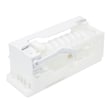
| Ice maker not producing | Ice maker assembly/module | Samsung refrigerator ice maker assembly DA97-07603B |
| Bad taste, slow water flow | Filtration | Refrigerator water filter DA29-00019A |
Why it matters
Cooling and ice maker complaints often share the same root causes: restricted airflow, a defrost problem, or incorrect temperature feedback. Catching those early helps protect food, reduce compressor run time, and prevent repeat icing.
For step-by-step ice maker troubleshooting, we also recommend why your Samsung fridge stopped making ice and how to fix it.
Last updated: February 2026