Owner’s manual

Where is the reset button on a Craftsman table saw?
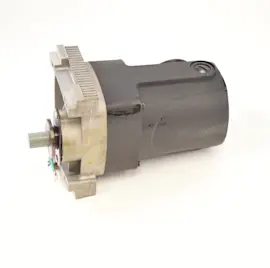
On the Craftsman 137218041 table saw, the reset is an overload relay button on the switch assembly area. If the motor shuts off from overloading or low voltage, turn the saw OFF, let the motor cool, then press the reset button to restart it (see the owner's manual).
How to reset the overload safely
- Move the ON/OFF switch to OFF.
- Unplug the saw before the cool-down period to prevent accidental starting.
- Wait for the motor to cool down fully.
- Press the reset overload relay button.
- Plug the saw back in.
- Turn the switch to ON.
What usually causes the overload to trip
Overload trips are a protection feature; they prevent motor damage when the saw is working too hard or power is unstable.
Common causes to check:
- Dull, dirty, or incorrect blade for the material
- Feeding stock too fast (especially thick hardwood)
- Blade height set too high for the cut
- Misalignment that increases drag (blade to fence or miter slot)
- Low voltage or undersized extension cord
Quick checks before you run it again
| Check | What to do | Why it matters |
|---|---|---|
| Blade condition | Clean or replace if dull | Reduces load on the motor |
| Alignment | Verify blade and fence are parallel | Prevents binding and kickback risk |
| Cut setup | Set blade just above the workpiece | Minimizes resistance |
| Power | Use a proper gauge cord, avoid long runs | Prevents low-voltage overheating |
Why it matters
If you reset and immediately trip again, the saw is still overloaded. Fixing the underlying cause (blade condition, alignment, or power supply) helps prevent repeat shutdowns and protects the drive motor.
For alignment-related cut issues, we use the steps in the owner's manual and the guidance in table saw bad angle cuts.
Last updated: February 2026
What size blade is a Craftsman 137218041 table saw?
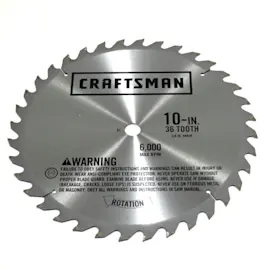
The Craftsman 137218041 table saw uses a 10-inch blade. We confirm this in the operator documentation for model 137.218041, which lists it as a 10-inch table saw with a 5000 RPM blade speed; see the 137218041 operator's manual.
Quick specs you can verify on the saw
- Blade diameter: 10 inches
- No-load blade speed: 5000 RPM
- Saw type: table saw
- Brand: Craftsman
- Model: 137218041
Blade fit checklist (before you buy or install)
Even with the correct blade diameter, these details determine whether the blade fits and cuts correctly:
- Arbor hole size (must match the arbor shaft)
- Kerf thickness (thin-kerf vs full-kerf)
- Tooth count (rip, crosscut, combination)
- Maximum RPM rating on the blade (must meet or exceed the saw’s speed)
- Blade type (standard carbide-tipped wood blade vs specialty blade)
| What you’re checking | What to look for | Why it matters |
|---|---|---|
| Diameter | 10 in. | Ensures the blade clears the insert and guard properly |
| RPM rating | Rated at or above 5000 RPM | Prevents unsafe overspeed conditions |
| Arbor hole | Match your arbor | Prevents wobble and poor cuts |
| Tooth count | 24T, 40T, 60T (typical) | Controls cut speed vs finish quality |
Why it matters
Using the correct 10-inch blade size helps the guard/splitter alignment, cutting depth, and safety features work as intended. A mismatched blade (wrong diameter or arbor) commonly causes vibration, burning, and inaccurate cuts.
Related DIY help
- If you’re swapping blades, follow the steps in how to replace a table saw blade.
Last updated: February 2026
What not to do with a table saw?
With your Craftsman 137218041 table saw, do not make unsafe cuts or setups that increase kickback risk or put your hands in the blade path. Avoid freehand cutting, cutting warped stock, pulling a workpiece backward, or running the saw unattended; follow the safety rules in the owner's manual.
What to avoid (high-risk mistakes)
- Do not cut freehand; always guide the work with the rip fence (ripping) or miter gauge (crosscutting).
- Do not use the rip fence and miter gauge at the same time.
- Do not rip wood that is twisted, warped, or bowed, or that lacks a straight edge against the fence.
- Do not pull the workpiece backward during a cut; this can cause kickback.
- Do not make through-cuts narrower than 3/4 inch.
- Do not leave the saw running unattended; wait for the blade to come to a complete stop.
- Do not cut metals or materials that create hazardous dust.
Safe setup checks we recommend before every cut
Before you start the Craftsman 137218041, verify these basics:
- Blade is tight on the arbor.
- Bevel angle lock knob is tight.
- Rip fence lock is tight and the fence is parallel to the blade (when ripping).
- Blade guard and anti-kickback components are installed and working.
- Safety glasses are on; keep the work area clear and remove sawdust frequently.
Quick guide: ripping vs. crosscutting
| Cut type | Use this guide | Do not use this at the same time | Key goal |
|---|---|---|---|
| Ripping (with the grain) | Rip fence | Miter gauge | Keep fence parallel; prevent kickback |
| Crosscutting (across grain) | Miter gauge | Rip fence | Keep work stable; hands out of blade path |
Why it matters
Most table saw injuries come from two things: blade contact and kickback (the workpiece thrown back toward you). The manual’s rules focus on keeping the work guided, the fence aligned, and guards in place so the cut stays controlled.
Last updated: February 2026
Does Craftsman make a good table saw?
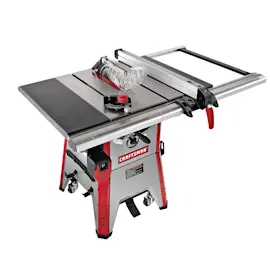
Yes. Craftsman table saws are a solid choice for many DIYers and homeowners, and the Craftsman 137218041 is built around practical, jobsite-style features (10-inch blade capacity, rip fence, and miter gauge) that handle common ripping and crosscutting tasks well when the saw is assembled, aligned, and maintained correctly. See the 137218041 owner's manual for the exact specs and adjustment procedures.
What “good” means for the Craftsman 137218041
A table saw’s real-world performance comes down to alignment, stability, and how consistently it holds settings.
- Cut capacity: Max cut depth is 3 inches at 90° and 2-1/2 inches at 45°.
- Dado capability: Supports up to a 6-inch dado diameter and 1/2-inch max dado width.
- Power requirements: Designed for 110-120V on a 15A time-delay fuse or breaker.
- Portability vs. mass: Net weight is about 52 lb, which is manageable to move but still needs a stable setup.
- Included basics: Comes with a rip fence and miter gauge for standard cuts.
How to get “good results” from this saw
Most mixed reviews on table saws come from setup and calibration, not raw motor power.
- Mount the saw on a flat, level surface; tighten all mounting hardware.
- Keep the bevel and height mechanisms clean; remove sawdust and pitch buildup.
- Use dry lubricants (graphite or silicone) on pivots and threaded rods (avoid oil/grease that traps dust).
- Use a sharp, correct blade for the material; replace blades that burn, wander, or leave rough cuts.
- Use the splitter/guard and a push stick for safer, straighter feeding.
Quick comparison: who it fits best
| User type | Fit | Why |
|---|---|---|
| DIYer / homeowner | Good | Handles common projects with proper alignment and a sharp blade |
| Hobby woodworker | Good | Works well for learning and repeatable cuts with careful setup |
| Heavy daily/pro use | Fair | May need more frequent tune-ups and a more rigid, precision-focused setup |
Why it matters
A “good” table saw is one that cuts straight, holds 90° and 45° settings, and runs reliably on the correct circuit. With the 137218041, accurate results depend heavily on calibration, clean mechanisms, and safe feeding technique.
For accuracy troubleshooting, we recommend table saw bad angle cuts.
Last updated: February 2026
Can you use an 8 inch blade on a 10 inch table saw?
Yes. On the Craftsman 137218041 10-inch table saw, you can use an 8-inch blade if it matches the arbor size and the blade is clamped flat between the flanges; you will lose cutting depth and may not be able to use the standard guard properly. Confirm the approved blade and dado limits in the owner's manual.
What changes when you drop from 10-inch to 8-inch
A smaller blade sits lower in the table, so the saw behaves differently even when everything fits correctly.
- Less maximum cut depth at both 90° and 45°
- Different guard, riving knife, and anti-kickback pawl alignment relative to the blade
- More chance the blade sits too low for some jigs or for the guard to function as designed
- Cut quality can change because tooth geometry and feed rate expectations differ by blade type
Model-specific limits that matter on 137218041
Your saw is designed around a 10-inch blade and includes specific capacity limits.
| Spec from the manual | What it means for blade choice |
|---|---|
| Blade size: 10-inch | The guard and cutting capacities are based on a 10-inch blade |
| Maximum diameter dado: 6-inch | Do not use an 8-inch dado set on this saw |
| Maximum dado cut width: 1/2-inch | Keep stacked dado width at or under 1/2-inch |
Quick safety and fit checklist (before you power on)
Use this checklist any time you change blade diameter on a table saw.
- Unplug the saw before changing blades
- Verify the blade bore matches the arbor and seats flat on the inner flange
- Install the blade with teeth pointing toward the front of the saw (correct rotation)
- Spin the blade by hand to confirm it clears the throat opening and any guard parts
- Set blade height so the top of the teeth are only slightly above the workpiece
Why it matters
Blade diameter affects cut depth and how well safety components line up with the blade. Staying within the 137218041 blade and dado limits helps prevent binding, kickback, and unsafe guarding.
For step-by-step blade change instructions, use how to replace a table saw blade.
Last updated: February 2026