Installation guide
 Owner’s manual
 Error Codes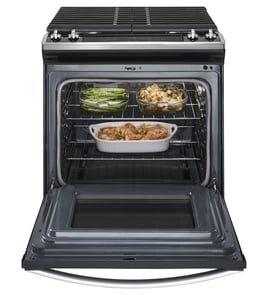


How do I tell what model Kenmore stove I have?
For Kenmore gas ranges like model 79073433310, the model and serial number are on the identification plate on the right-hand surface of the oven front frame; you typically see it by opening the storage, warmer, or broiler drawer. Confirm the exact number using the 79073433310 owner's manual.
Where to look on a Kenmore range
Check these common locations in this order:
- Open the storage drawer (or warmer/broiler drawer) and look at the right side of the oven front frame
- Look for an identification plate or rating label (often metal or a durable sticker)
- Write down model number, serial number, and any lot number/letter shown
- If the label is dirty or faded, wipe it gently with a damp cloth and dry it
- Match the model number exactly when ordering parts (every digit matters)
What the identification plate tells you (and why it matters)
Besides the model number, the plate also lists key gas range details that help with safe, correct repairs.
| Label item | What it’s used for | Example of when you need it |
|---|---|---|
| Model number | Correct parts lookup | Ordering an igniter, sensor, or control part |
| Serial number | Production run details | Confirming compatible revisions of parts |
| Fuel type and pressure | Proper setup and adjustments | Gas conversion, regulator checks |
| Burner ratings (BTU) | Performance expectations | Diagnosing weak flame or uneven heating |
Tips for ordering the right parts
When you have the model number, use it to match parts by description and ID.
- For “no heat” or delayed ignition in the oven, a common repair is the range oven burner igniter 5304509706
- For temperature problems (too hot or too cool), check the range oven temperature sensor 316233903
- For surface burners that won’t spark, ignition components like the spark module can be involved
Why it matters
Kenmore ranges often share similar styling across multiple model series, but internal components (igniters, sensors, control boards, burner parts) can differ. Using the exact model number from the identification plate prevents wrong-part returns and speeds up troubleshooting.
Last updated: February 2026
Does Kenmore make gas ranges?
Yes. Kenmore makes gas ranges, including the Kenmore 79073433310 gas range family shown in our documentation, with gas surface burners and an oven that uses electric ignition (so it needs household power for normal oven lighting). See the 79073433310 owner's manual for the exact features and control layout.
What “Kenmore gas range” means for everyday use
Kenmore gas ranges are designed to give you fast burner response on the cooktop and consistent oven performance when the ignition system and gas supply are set up correctly.
- Surface burners can be lit normally with the igniter system during regular operation
- During a power outage, surface burners can be lit with a match (use extreme caution)
- Do not try to operate the electric-ignition oven during an electrical power failure
- Proper airflow around the oven vent and base is required for safe combustion
- Installation details like clearances and anti-tip setup matter for safe, stable operation
Quick reference: cooktop vs. oven during a power outage
| Function | What typically works | What to do |
|---|---|---|
| Surface burners | Can still operate | Light with a match carefully, then turn knob to LITE |
| Oven burner (electric ignition) | Does not operate normally | Keep oven controls OFF until power returns |
Why it matters
Knowing that your Kenmore 79073433310 is a gas range with electric ignition helps you troubleshoot correctly. For example, an oven that will not light can be a power or igniter issue, while a weak surface flame is more often related to burner parts, caps, or airflow.
Parts that commonly relate to ignition symptoms
If you are diagnosing “won’t ignite” or “clicks but won’t light,” these model-matched parts are often involved:
- Range oven burner igniter 5304509706 (oven ignition)
- Range spark module 5304508269 (spark generation for surface burners)
- Frigidaire range igniter switch and harness assembly 316580615 (switching and wiring to igniters)
Last updated: February 2026
How long should a Kenmore gas stove last?
A Kenmore gas range like model 79073433310 typically lasts 15 years with normal household use. Consistent cleaning, correct burner ignition, and prompt repair of ignition or temperature issues help you reach that lifespan; see the 79073433310 owner's manual for routine care steps.
Typical lifespan and what affects it
Most gas ranges reach their full service life when heat, ignition, and airflow stay stable.
- Heavy daily cooking can shorten lifespan
- Spills and boilovers can clog burner ports and stress igniters
- Poor ventilation can increase grease buildup on surfaces and controls
- Repeated delayed ignition can wear ignition components faster
- Overheating from blocked vents can stress wiring and electronic controls
Quick maintenance checklist (high impact)
These habits prevent common failures like weak ignition, uneven flames, and temperature swings.
- Keep burner caps and heads seated correctly after cleaning
- Clean burner ports gently so flames stay even
- Wipe up acidic spills quickly to reduce corrosion
- Use the correct oven light bulb wattage when replacing
- If bake ignition gets slow (30 to 60 seconds is typical), troubleshoot before it becomes a no-heat issue
What “normal operation” looks like on this model
Your installation instructions describe expected ignition timing for both surface burners and the oven.
| Function | What you should see/hear | Typical timing |
|---|---|---|
| Surface burner ignition | Clicking/sparking at LITE, then flame | Lights within about 4 seconds after air is purged |
| Oven bake ignition | Igniter glows, then burner lights | Flame appears in about 30 to 60 seconds |
If surface burners keep clicking after lighting, or the oven takes much longer than a minute to ignite, ignition parts are common suspects.
Parts that commonly impact longevity
When ignition becomes unreliable, replacing the correct part restores safe, consistent lighting.
- Range oven burner igniter 5304509706 if the oven igniter glows weakly or bake won’t light
- Range spark module 5304508269 if multiple surface burners stop sparking
- Range oven temperature sensor 316233903 if oven temperatures swing or seem inaccurate
Why it matters
A gas range that lights quickly and holds temperature cooks more evenly, reduces stress on the gas valve and controls, and helps prevent repeated ignition cycling that can shorten the life of key components.
Last updated: February 2026