Owner’s manual
 Error Codes



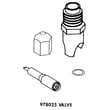
Where is the model number on a Kenmore side by side refrigerator?
On Kenmore side-by-side refrigerators like model 10656822604, the model number is printed on the appliance identification label. You will typically find that label inside the fresh food (refrigerator) compartment on a side wall near the top, or around the door opening.
- Open the refrigerator (fresh food) door and check the left and right interior walls near the top.
- Look around the door frame (the cabinet opening the door seals against).
- Check near the crisper drawer area if you do not see it up top.
- If your unit has a dispenser, the label is still usually inside the refrigerator section, not on the dispenser.
- Use a flashlight; the label can be small and easy to miss.
The same label usually includes both the model and serial information.
| Item | What it’s used for | When you need it |
|---|---|---|
| Model number | Identifies the exact design and parts list | Ordering parts like a water filter, ice maker, or door gasket |
| Serial number | Identifies production details | Service history, age reference, and documentation matching |
The model number ensures we match the correct Kenmore parts and diagrams for your exact refrigerator configuration. That prevents ordering the wrong items, especially for fit-sensitive parts like a water filter cap, ice maker, or door gasket.
Once you find the model label, compare it to the model shown on your documentation and parts list in the owner's manual.
Last updated: February 2026
Can I run my Kenmore refrigerator without a water filter?
Yes. Your Kenmore side-by-side refrigerator model 10656822604 can run the water dispenser without a water filter installed; you will still get water, but it will not be filtered. Use the filter cap correctly so the housing seals and the dispenser works normally (see the owner's manual).
When you remove the filter cartridge, you must install the filter cap into the base grille opening so water can route correctly.
- Press the eject button and pull the filter out by the cap.
- Twist the cap off the old filter (keep the cap; it is part of the refrigerator).
- Insert the cap into the base grille opening in a horizontal position.
- Turn the cap counterclockwise until it slips into the attachment slot.
- Turn the cap clockwise until it returns to a horizontal position.
- Expect the cap to sit slightly uneven with the base grille; that is normal.
That pattern usually points to a seating or activation issue at the filter head, not a problem with the refrigerator cooling system.
Common fixes to try first:
- Reinstall the filter and push firmly until it fully seats.
- Remove and reinstall the filter cap to confirm it is not cross-threaded.
- Flush air out of the system after any filter change.
- Check for a damaged or missing O-ring on the filter.
- Inspect the filter housing area for cracks or debris that prevents sealing.
Air trapped in the lines can cause sputtering or no flow right after a filter change.
| Step | What to do | Timing |
|---|---|---|
| 1 | Hold the dispenser lever | 5 seconds |
| 2 | Release the lever | 5 seconds |
| 3 | Repeat until water flows, then continue cycling | About 2 minutes |
If you need the correct replacement filter for this model, use the matching part listed for 10656822604.
Running without a filter is fine for operation, but filtration affects taste and contaminant reduction. Installing the cap correctly prevents leaks and helps ensure steady water flow at the dispenser.
Last updated: February 2026
What causes a side-by-side refrigerator to stop cooling?
A Kenmore side-by-side refrigerator model 10656822604 usually stops cooling because it is not getting power, the temperature controls are set incorrectly, airflow is blocked, or a cooling-system component (fan, defrost system, or compressor) is not running. Start with the quick checks in the owner's manual.
- Confirm the power cord is fully plugged into a grounded 3-prong outlet.
- Test the outlet with a lamp; reset the breaker or replace a blown fuse if needed.
- Make sure the refrigerator controls are turned ON (not OFF).
- If it was just installed or restarted, allow 24 hours to cool completely.
- Minimize door openings; warm air entering can make temperatures rise.
- Check that interior vents are not blocked by food packages.
| What you notice | Likely cause | What to do next |
|---|---|---|
| No lights, no sound | No power to refrigerator | Verify outlet, breaker/fuse, cord connection |
| Lights on, but warm in both sections | Controls off or cooling system not running | Confirm controls ON; listen for fans/compressor |
| Freezer cold, fresh food warm | Airflow problem (blocked vents, fan issue) | Clear vents; check for evaporator fan noise |
| Frost buildup, temps slowly rise | Defrost problem | Inspect for heavy frost; consider defrost components |
If basic checks do not restore cooling, these model-compatible parts are often involved:
- Evaporator fan motor: refrigerator evaporator fan motor WP2315549 (moves cold air through compartments)
- Defrost thermostat: refrigerator defrost bi-metal thermostat WPW10225581 (helps control defrost heating)
- Compressor start/run circuit: upright freezer run capacitor WPW10662129 (supports compressor starting)
- Main control: refrigerator electronic control 4388932 (manages defrost and cooling cycles)
Running warm for even a few hours can put food at risk and can also force the compressor and fans to run longer than normal. Doing the power and control checks first prevents unnecessary parts replacement and gets you to the right repair faster.
Last updated: February 2026
What are the most common problems with Kenmore refrigerators?
The most common issues we see on Kenmore refrigerators like model 10656822604 are cooling problems, ice maker and water dispenser troubles, water leaks, excess frost, and unusual noises. Many of these trace back to airflow restrictions, dirty condenser coils, door seal gaps, or a failing fan, thermostat, or control.
- Not cooling or warm temperatures: blocked vents, dirty coils, evaporator fan issues, or sealed-system/compressor problems
- Ice maker not making ice: water supply issue, frozen fill tube, or a failed ice maker module
- Water dispenser slow or not working: clogged filter, kinked water line, or inlet valve trouble
- Water leaking: clogged defrost drain, loose water line connections, or cracked tubing
- Excess frost in freezer: door left ajar, bad door gasket, or a defrost system fault (heater, thermostat, control)
- Noisy operation: normal compressor/fan sounds, or a worn fan blade/motor
- Confirm power and controls are on; then allow 24 hours after a new install or major temperature change for full cooling.
- Make sure doors close fully and nothing blocks interior air vents.
- Clean condenser coils (dust buildup is a top cause of poor cooling and long run times).
- If the unit will not run at all, test the outlet and check the house breaker.
- If water tastes off or flow is weak, replace the water filter and purge air from the line.
Your refrigerator can make several normal noises during operation.
| Sound | Often normal when | What to do |
|---|---|---|
| Buzzing | Water valve fills ice maker | Normal unless it is constant with no ice production |
| Pulsating | Compressor/fans adjust | Normal |
| Sizzling/gurgling | Defrost cycle | Normal |
| Loud rubbing or repeated clicking | Fan hitting ice or failing motor | Inspect for ice buildup; consider fan service |
If troubleshooting points to a failed component, these parts are commonly involved on this model:
- Water quality/flow issues: genuine Kenmore refrigerator water filter EDR3RXD1
- Defrost-related frost buildup: refrigerator defrost bi-metal thermostat WPW10225581
- Ice production failures: refrigerator ice maker WPW10190961
- Warm fridge/freezer with poor airflow: refrigerator evaporator fan motor WP2315549 and refrigerator evaporator fan blade WP2169142
Catching airflow, defrost, and water-supply problems early helps protect food temperatures, reduces compressor run time, and prevents leaks that can damage flooring.
For model-specific operating details and troubleshooting steps, use the owner's manual.
Last updated: February 2026
What is the cubic foot of my Kenmore refrigerator model 10656822604?
The cubic-foot capacity for Kenmore side-by-side refrigerator model 10656822604 is found in the specifications section of the owner's manual and on the model and serial rating label inside the fresh-food compartment. Use those two sources to get the exact total and freezer-only cubic feet for your unit.
- Check the rating label inside the refrigerator section (commonly on a side wall near the crisper drawers).
- Look for a line that lists capacity or cu. ft. (sometimes split into refrigerator and freezer).
- Open the owner's manual and look for “Specifications” or “Product data”.
- If the label is worn, take a clear photo and zoom in to read the capacity line.
- If you only need freezer capacity (for outage planning), use the freezer-only number from the label or manual.
Most side-by-side refrigerators list capacity in one of these formats:
| How it’s shown | What it means |
|---|---|
| Total capacity (cu. ft.) | Combined refrigerator + freezer space |
| Refrigerator capacity + freezer capacity | Each compartment listed separately |
| “Total” plus “usable” | Usable can be slightly lower due to shelves and bins |
Cubic feet helps you compare storage space, plan shelf and bin organization, and estimate freezer needs during a power outage (dry ice guidance is based on freezer cubic feet).
If you are trying to restore usable space (broken bins or pans), these common storage parts for this model are available:
- Refrigerator crisper pan WP2188656
- Refrigerator meat pan WP2188664
- Refrigerator glass shelf WPW10141748
Last updated: February 2026