
How do I know if my heat pump control board is bad?
If your York heating and cooling combined unit model D2CG072N09925A won’t respond to the thermostat, runs in odd cycles, or won’t start key components (blower, outdoor fan, compressor), the control board is a top suspect. We confirm it by checking for correct power in and missing control-voltage outputs, plus visible board damage.
Common symptoms that point to the control board
- No response to thermostat calls (no heat, no cool, no fan)
- Blower runs constantly or won’t run at all
- Outdoor unit will not start (no compressor or condenser fan)
- Short-cycling or erratic cycling (starts and stops rapidly)
- Repeated lockouts or flashing fault/diagnostic lights (if equipped)
- Burn marks, melted spots, swollen components, or corrosion on the board
Quick checks we use before blaming the board
These checks help separate a bad board from a power, thermostat, or safety-switch issue.
- Verify the disconnect and breaker are on; confirm line voltage is present at the unit
- Confirm the low-voltage transformer is supplying about 24 VAC
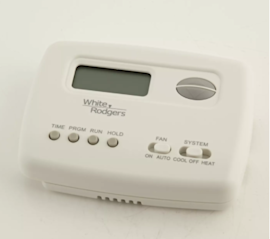
- Check the thermostat wiring (R, C, Y, G, W/O/B as applicable) for loose or damaged conductors
- Check safety devices that can stop operation (door switch, float switch, high/low pressure switches, rollout limits)
- Inspect for blown fuses on the control circuit (if your unit uses one)
If you find damaged wiring or questionable connections, our guide on how to repair broken or damaged wires video helps you correct common issues safely.
What “bad board” looks like on a meter
A control board is typically considered failed when:
| What we test | Normal result | What suggests a bad board |
|---|---|---|
| Board power input | Correct line voltage and 24 VAC present | Missing power (usually not the board) |
| Thermostat call into board | 24 VAC call present (ex: Y or W energized) | Call present but no response |
| Board output to loads | 24 VAC sent to contactor/relays when called | No output even with correct call |
| Relay action | Relay clicks and switches | Relay doesn’t switch or is stuck |
Why it matters
Misdiagnosing a control board can waste time and money because the real cause is often a failed capacitor, a safety switch opening, or damaged wiring. For example, a weak run capacitor can prevent motors from starting and make it look like the board is not doing its job; if your symptoms include humming, hard starts, or a fan that won’t spin up, check the capacitor 12910 or capacitor TRCF5 options listed for this model.
Last updated: February 2026
How much is a combined heating and cooling system?
A combined heating and cooling system typically costs about $10,000 to $20,000 installed, with many homeowners landing near the middle of that range. Your final price depends on system capacity, efficiency rating, ductwork condition, and installation complexity for a packaged unit like the York D2CG072N09925A.
What drives the installed price
- System type and size: packaged rooftop/combined units are priced differently than split systems
- Efficiency level: higher SEER/EER and AFUE ratings usually cost more up front
- Ductwork and airflow fixes: sealing, resizing, or replacing ducts can add significant cost
- Electrical and gas work: disconnects, breakers, gas piping, and venting updates
- Labor and access: roof access, crane needs, and curb/adapter work
- Permits and code requirements: varies by location and job scope
Typical cost ranges (installed)
| Scenario | Typical installed range | What it usually includes |
|---|---|---|
| Like-for-like replacement (minimal changes) | $10,000 to $14,000 | Unit swap, basic startup, minor materials |
| Replacement plus ductwork or electrical upgrades | $14,000 to $20,000 | Duct repairs, electrical/gas updates, added labor |
| Complex rooftop job (access, curb, crane, controls) | $18,000+ | Specialized labor, rigging, additional fabrication |
Why it matters
Sizing and airflow are what protect comfort and equipment life. An oversized or undersized unit can short-cycle, struggle to dehumidify, and wear out parts faster (including run capacitors and motors).
Parts vs. full system replacement
If you are troubleshooting a no-cool or no-start issue on the York D2CG072N09925A, a failed run capacitor is a common, lower-cost repair compared with replacing the entire unit. For example, we list capacitors such as the capacitor 12910 and capacitor TRCF5 for this model.
Last updated: February 2026
Is it cheaper to repair or replace HVAC parts?
For a York heating and cooling combined unit like model D2CG072N09925A, it’s usually cheaper to repair when the problem is isolated (for example, a failed capacitor) and the system has been reliable; replacement makes more financial sense when repair costs keep stacking up or the unit is in the 10 to 15+ year range.
A practical way to decide
Use these checkpoints to choose the lower-cost path over the next few years, not just today.
- Repair when the issue is a single, common wear part (capacitor, contactor, fuse) and the rest of the system is in good shape
- Repair when the total repair is relatively small compared to a full replacement (a common rule of thumb is staying well under about half the cost of a new unit)
- Replace when you’ve had multiple breakdowns in the last 1 to 2 seasons
- Replace when major components are failing (compressor, heat exchanger, or multiple motors)
- Replace when comfort problems persist (poor cooling, uneven temps, high humidity) even after repairs
Parts that are often worth repairing first
On this model, a failed run capacitor is a common, relatively low-cost fix that can restore operation.
Quick comparison
| Situation | Usually cheaper | Why |
|---|---|---|
| Unit runs but fan or compressor struggles to start | Repair | Often a capacitor or electrical start issue |
| One-time failure, no history of service calls | Repair | Lowest total cost and fastest turnaround |
| Repeated service calls and rising repair totals | Replace | Repair costs compound and reliability drops |
| Major sealed-system or heat-side failure | Replace | High labor and part cost, longer downtime |
Why it matters
Repairing the right part can get your D2CG072N09925A back online quickly and keep total cost low; replacing too late can mean paying for repeated emergency calls, while replacing too early can waste years of usable life.
Last updated: February 2026
What is the 20 rule for air conditioners?
The “20-degree rule” for air conditioners is a rule of thumb: on very hot days, most central AC systems (including a York heating and cooling combined unit like model D2CG072N09925A) typically cool indoor air about 15 to 20°F below the outdoor temperature, and trying to force a bigger drop can mean long run times, higher energy use, and more wear.
What the rule really means (and what it does not)
This guideline is often misunderstood as a thermostat-setting limit. It is better used as a performance expectation.
- It describes a typical real-world cooling capability during peak heat.
- It is not a guarantee; insulation, humidity, duct losses, and equipment condition change results.
- It does not mean your thermostat “should” be set to a specific number.
- It does mean that if it is 95°F outside, expecting 68°F inside may be unrealistic without excellent insulation and a properly sized system.
- It is different from the normal temperature split measured across the evaporator coil (supply vs. return air).
Quick examples
| Outdoor temp | Typical achievable indoor temp range | What you may see happen |
|---|---|---|
| 85°F | 65 to 70°F | Normal cycling if the home is tight |
| 95°F | 75 to 80°F | Longer run times, especially late afternoon |
| 105°F | 85 to 90°F | Near-continuous running is common |
If your unit cannot get close to the guideline
If your D2CG072N09925A struggles to cool even 10°F below outdoor temperature, focus on common causes first:
- Dirty air filter or blocked return grille
- Outdoor coil clogged with debris
- Supply registers closed or ducts leaking
- Low airflow from a failing blower component
- Weak compressor start/run support (capacitor issues are common)
If you suspect a capacitor problem (hard starting, humming, fan not spinning), match the replacement by ratings and application; the parts list for this model includes options like the capacitor 12910 and capacitor TRCF5.
Why it matters
Using the 20-degree rule as a reality check helps you avoid overworking the system, manage comfort expectations during heat waves, and spot when a maintenance or electrical issue (like a run capacitor) is pushing the unit outside normal performance.
Last updated: February 2026