Installation guide
 Owner’s manual
 Error Codes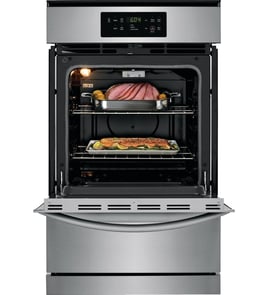


Does anyone make a 27 inch gas wall oven?
Yes. 27-inch gas wall ovens exist, and your Frigidaire FFGW2415QSA is a gas wall oven designed to fit a 24-inch-wide cabinet cutout with an overall face width around 27 inches, which is the common “27-inch wall oven” class. Use the cutout specs in the installation guide to confirm your cabinet opening before you shop or replace.
What “27-inch” means for gas wall ovens
Most wall ovens are labeled by their nominal exterior width (the front frame/trim), not the rough opening. For many 27-inch models, the cabinet cutout width is closer to 24 inches.
Typical sizing you will see:
| Label on oven | Typical cabinet cutout width | Common use case |
|---|---|---|
| 24-inch class | ~22 to 23 inches | Tight spaces, smaller ovens |
| 27-inch class | ~24 inches | Replacing many older wall ovens |
| 30-inch class | ~28 1/2 inches | Most common new installs |
How to confirm fit in your kitchen
Measure the cabinet opening and compare it to the required cutout dimensions.
We recommend checking:
- Cutout width (side-to-side inside the cabinet opening)
- Cutout height (top-to-bottom inside the opening)
- Cutout depth (front-to-back clearance)
- Front clearance for full door swing (the guide calls out about 21-1/4 inches)
- Gas hookup location (the guide shows a 1-1/2 inch hole for the gas hookup)
For the exact numbers for this model, follow the dimension diagram in the installation guide.
Why it matters
Gas wall ovens are less common than electric, so matching the cutout is the fastest way to avoid cabinet modifications. If your opening matches the FFGW2415QSA cutout, you are already in the right size category for a 27-inch gas wall oven replacement.
Last updated: February 2026
Why no gas wall ovens?
Gas wall ovens like the Frigidaire FFGW2415QSA still exist, but they are less common because many homes and remodels now favor electric wall ovens, and because gas wall ovens still require electrical grounding plus a properly regulated gas supply. See the installation guide for the exact gas and electrical requirements.
What’s driving the shift away from gas wall ovens
Several practical factors have reduced demand for gas wall ovens (even though they are still sold):
- More new construction and remodels are designed around electric wall ovens
- Induction and electric cooking have become more popular, so manufacturers prioritize those lines
- Gas wall ovens still need a grounded electrical connection for controls and ignition
- Installation is more complex because you must meet both gas-supply and electrical-code requirements
- Fewer model choices in showrooms leads to fewer purchases, which further reduces selection
What a gas wall oven still needs (FFGW2415QSA example)
Your FFGW2415QSA is a good example of why gas wall ovens are not “gas only”; they require both utilities.
| Requirement | What it means for a gas wall oven | Why it matters |
|---|---|---|
| Electrical grounding | Must be properly grounded (3-prong receptacle) | Prevents shock hazard and supports safe operation |
| Gas supply and regulation | Regulator stays in the supply line; correct manifold pressure | Ensures stable flame and proper heating |
| Leak-check practices | Never use a flame to check for leaks | Reduces fire and explosion risk |
If you’re shopping or troubleshooting instead
If the real issue is that your oven will not heat or will not ignite, the “gas wall ovens are gone” idea often comes from a no-heat symptom. These checks help narrow it down:
- Confirm the external manual shutoff valve is fully open
- Confirm the oven’s regulator gas valve is on
- Verify the circuit breaker is on (gas ovens still need electricity)
- If ignition is weak or intermittent, inspect the igniter and wiring
- If baking temperatures are erratic, test the sensor circuit
Model-matched parts commonly involved in no-heat or ignition problems include the Frigidaire range oven burner igniter 5303935066 and the range oven temperature sensor 5304504897.
Why it matters
Choosing gas versus electric is not just about fuel preference; it affects installation complexity, available model selection, and the types of parts (igniter, gas valve, regulator, sensor) that control safe heating.
Last updated: February 2026
Why is my gas wall oven not heating up?
If your Frigidaire FFGW2415QSA gas wall oven isn’t heating, the most common causes are a gas supply shut-off that’s closed, a power issue (tripped breaker), or an ignition/heating control problem such as a weak igniter or a faulty oven temperature sensor. Use the FFGW2415QSA owner's manual to confirm the correct control settings and basic checks.
Quick checks we recommend first
- Confirm the oven controls are set correctly and the time of day is set (some models will not operate until the clock is set).
- Check the house fuse or circuit breaker and reset it fully.
- Verify gas supply is on: the external shut-off valve must be open.
- Verify the built-in regulator shut-off valve is in the UP (OPEN) position.
- If you smell gas, stop and shut off the gas supply before continuing.
What usually fails on a gas wall oven that won’t heat
When gas and power are both present, these parts are frequent culprits:
- Igniter: a weak igniter may glow but not pull enough current to open the gas valve.
- Oven temperature sensor: a bad sensor can cause no heat or incorrect cycling.
- Gas valve/regulator issues: the valve may not open even with a working igniter.
Parts that match this model
| Symptom | Likely part | What you’ll notice |
|---|---|---|
| No bake ignition, delayed ignition | Frigidaire range oven burner igniter 5303935066 | Clicking or glowing but no flame |
| Oven heats poorly or shuts off early | Range oven temperature sensor 5304504897 | Temperature swings, underbaking |
| No gas flow to burner (after supply confirmed on) | Range oven gas valve 807192701 | Igniter operates but burner never lights |
Why it matters
A gas wall oven needs both electricity and gas to heat. The igniter and safety gas valve work together; if either side of that system is interrupted (power, shut-off valves, igniter strength, sensor feedback), the oven will not light or will shut down.
When a guide helps
If you’re seeing an error code or the display is acting unusual, use our Frigidaire manual clean wall oven error codes reference to narrow the failure to a sensor, control, or wiring issue.
Last updated: February 2026
What is the lifespan of a Frigidaire oven?
A Frigidaire oven typically lasts 15 years. With normal home use and basic upkeep (cleaning, keeping the door seal tight, and fixing ignition or temperature issues early), many ovens reach or exceed that mark, including the Frigidaire FFGW2415QSA.
What affects how long your oven lasts
- How often you cook (daily use wears igniters, valves, and door parts faster)
- Heat and grease buildup (especially around the burner area and venting)
- Door seal condition (heat loss makes the oven work harder)
- Accurate temperature control (overheating stresses components)
- Timely small repairs (a weak igniter can lead to bigger problems)
Maintenance that extends life (high impact)
Use the care and cleaning guidance in the owner's manual. Focus on these habits:
- Keep spills and grease from baking onto surfaces
- Avoid blocking airflow and keep the vent area clear
- Confirm the door closes evenly and latches properly
- Preheat fully for baking consistency
- Address unusual symptoms early (slow ignition, uneven heat, error codes)
Common “wear” parts that can shorten lifespan if ignored
If your FFGW2415QSA starts heating inconsistently or takes longer to light, these parts are frequent culprits:
| Symptom | Common cause | Example part for this model |
|---|---|---|
| Bake burner clicks but won’t light or lights slowly | Weak igniter | Frigidaire range oven burner igniter 5303935066 |
| Oven temperature swings or bakes unevenly | Failing sensor | Range oven temperature sensor 5304504897 |
| Heat leaks, longer cook times | Worn door seal | Seal 807108501 |
Why it matters
Knowing the typical 15-year lifespan helps you decide when a repair is a smart investment. Replacing a key part like an igniter, temperature sensor, or door seal often restores safe, reliable heating and reduces strain on the gas valve and controls.
Last updated: February 2026