Owner’s manual
 Error Codes


Is there a way to reset a Kenmore Elite refrigerator?
Yes. For Kenmore Elite model 59677593801, the most reliable reset is a power reset: unplug the refrigerator (or switch the breaker off) for about 5 minutes, then restore power and allow the controls to reboot. For the water filter indicator, use the built-in Filter Reset control.
Quick reset options (most common)
- Power reset (control reboot): Unplug for ~5 minutes, then plug back in.
- Breaker reset: Turn the refrigerator circuit breaker off for ~5 minutes, then back on.
- Water filter light reset: Press and hold Filter Reset for 3 seconds until the Replace light turns off (on models with this feature). See the 59677593801 owner's manual.
- Temperature alarm reset (silence/clear display): Press Temp Alarm once to stop the audible alarm; the light can keep flashing until temperatures return to normal.
- After any reset: Confirm doors close fully and air vents are not blocked by food packages.
When a reset helps (and when it does not)
A reset is best for control glitches, a stuck filter light, or after a brief power interruption. It will not fix a failed cooling component (like a compressor start issue) or an airflow problem caused by heavy frost.
| Situation | Best action | What to expect |
|---|---|---|
| Control panel acting odd | Power reset | Display and controls reboot |
| “Replace” filter light on | Filter Reset (3 seconds) | Light turns off if feature is present |
| Temp alarm sounding | Press Temp Alarm once | Alarm stops; light may flash until temps recover |
| Not cooling after reset | Basic checks, then diagnosis | May point to fan, defrost, or sealed system issue |
Why it matters
Resetting clears temporary control-board states so the refrigerator can resume normal temperature regulation, ice maker timing, and filter tracking. It also helps you separate a one-time glitch from a real cooling or defrost problem.
If it still will not cool after resetting
- Make sure the outlet has power (test with a lamp).
- Verify the controls are turned on.
- Allow 24 hours after restoring power for temperatures to stabilize.
- Listen for the evaporator fan in the freezer and check for heavy frost buildup.
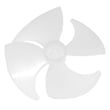
- If you suspect a fan issue, the refrigerator evaporator motor W11024089 is a common related part on this model.
Last updated: January 2026
What does DH mean on Kenmore Elite refrigerator?
On Kenmore Elite refrigerator model 59677593801, DH commonly indicates a defrost heater issue (the unit is not heating properly during the defrost cycle), which can lead to frost buildup and warm temperatures. Use the troubleshooting steps in the 59677593801 owner's manual to confirm symptoms and safe checks.
What you’ll usually notice when DH shows up
- Frost or ice building up on the freezer back wall
- Freezer temperature slowly rising
- Refrigerator section getting warmer than normal
- Evaporator fan noise changing as airflow gets restricted
- Water leaking or refreezing near the freezer floor after a defrost attempt
Quick checks we recommend first (safe, no disassembly)
- Power reset: Unplug the refrigerator (or switch off the breaker) for 5 minutes, then restore power.
- Airflow check: Make sure vents are not blocked by food packages.
- Door seal check: Look for gaps, rips, or areas not sealing flat.
- Condenser cleaning: Vacuum dust from the condenser area if accessible.
- Temperature settings: Return controls to normal settings if they were changed recently.
Parts that commonly cause a DH (defrost heat) problem
If the code returns after a reset and airflow is good, the issue is typically in the defrost circuit.
| What can fail | What it does | Example part for 59677593801 |
|---|---|---|
| Defrost heater | Melts frost off the evaporator | Refrigerator defrost heater WP67002493 |
| Temperature sensor | Tells the control when to defrost and when to stop heating | Refrigerator temperature sensor 12002355 |
| Wiring/connector | Carries power to heater and sensor | Inspect for loose or burned terminals |
Why it matters
A defrost heater problem reduces airflow across the evaporator coil. That forces longer run times, causes temperature swings, and can eventually stop cooling well in both compartments.
Last updated: January 2026
Where is the temperature sensor on a Kenmore Elite refrigerator?
On Kenmore Elite model 59677593801, the temperature sensor (thermistor) is typically mounted inside the fresh food compartment or freezer compartment near an air vent or on the evaporator area behind an interior panel. Use the 59677593801 owner's manual to match the sensor location to your exact compartment layout.
Common sensor locations on bottom-mount refrigerators
On this style of Kenmore Elite bottom-mount refrigerator, we most often see temperature sensors in these spots:
- Behind the rear interior panel in the freezer, clipped near the evaporator coil
- In the refrigerator section, tucked into a small housing near the upper back wall air return
- Near the control housing (depending on control style), sensing compartment air temperature
- In the freezer airflow path, close to the evaporator fan cover
How to find it safely (quick checklist)
Before removing panels or testing parts:
- Unplug the refrigerator or switch off power at the breaker
- Empty the area you are working in (shelves, bins, baskets)
- Look for a small plastic “bullet” or capsule-shaped probe with two wires
- Follow the wire harness from the control area or rear panel toward the air vents
- Take a photo of wire routing and connector positions before disconnecting anything
When the sensor is the likely problem
A failed or out-of-range thermistor can cause symptoms that look like control issues:
| Symptom | What it often points to |
|---|---|
| Refrigerator too warm but freezer OK | Refrigerator air sensor or airflow restriction |
| Freezer too warm and ice soft | Freezer sensor, defrost issue, or evaporator frost buildup |
| Temps swing up and down | Sensor reading drifting or poor sensor contact |
| Alarm sounds after temps rise | Compartment temperature exceeded set point |
If you are troubleshooting temperature problems, we also check for blocked vents and allow 24 hours after any control change for temperatures to stabilize (as described in the manual).
Parts that are commonly involved in temperature-sensing problems
Depending on what you find during diagnosis, these parts are often checked together:
- Refrigerator temperature sensor 12002355 (sensor itself)
- Evaporator fan motor (air movement across the evaporator)
- Defrost heater (frost control on the evaporator)
Why it matters
The control board relies on the temperature sensor signal to decide when to run the compressor and fans. If the sensor is loose, iced over, or electrically out of range, the refrigerator can run too long, not long enough, or trigger temperature alarms.
Last updated: January 2026