Installation guide
 Owner’s manual
 Error Codes



Why is my Kenmore Elite oven not working?
If your Kenmore Elite wall oven model 79047913604 is not working at all, the most common causes are a power supply issue (breaker/fuse, wiring connection), the clock not being set after a power interruption, or controls that are not set correctly. Start with the basic power and control checks in the 79047913604 owner's manual.
- Confirm the display is on; if it is flashing, set the clock before trying to bake or broil.
- Check the home circuit breaker or fuse; reset or fully re-engage it.
- Verify the oven is properly connected at the electrical junction box (wall ovens are typically hardwired).
- Press STOP/CANCEL to clear the control, then try a simple BAKE cycle.
- If an F-code appears (example: F11), press STOP/CANCEL, write down the code, and service is needed.
- If the oven shut off after a power interruption, reprogram the cooking function.
When the control panel works but the oven will not heat, we focus on the temperature sensing and control side first.
Common parts to check
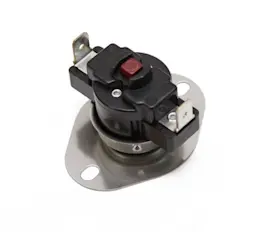
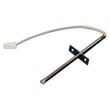
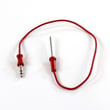
- Frigidaire range oven temperature sensor 316217002 (sensor out of range can prevent proper heating)
- Wiring connections to the sensor and control (loose or damaged connectors)
- Relay/control boards (if the oven will not energize elements)
| Symptom | What it usually points to | What to do next |
|---|---|---|
| Display dead | No power to oven | Check breaker, wiring, junction box connection |
| Display flashing | Clock not set after power loss | Set clock, then retry BAKE |
| F-code error | Control detected a fault | Press STOP/CANCEL, record code, schedule service |
| Fan runs but no heat | Control or sensor issue | Check sensor and wiring, then control board |
Wall ovens use electronic controls that often will not allow heating if power is unstable, the clock is not set after an interruption, or a fault code is active. Doing the power and control reset steps first prevents unnecessary part replacement.
Last updated: February 2026
How to reset a Kenmore Elite oven?
To reset the Kenmore Elite wall oven model 79047913604, clear stored recipes and restore factory-default control settings by pressing and holding the recipe pad for about 6 seconds until it beeps, then pressing START once. This also resets clock format, tones, and temperature display settings.
A factory-style reset on model 79047913604 is tied to clearing stored recipes; it restores multiple control preferences at the same time.
- Erases any stored recipes you previously recorded
- Resets 12/24-hour time-of-day display preference
- Resets 12-hour energy saving or continuous bake mode
- Resets silent control (beeps/tones) setting
- Resets Fahrenheit/Celsius temperature display
- Clears any oven temperature offset/adjustment
It does not repair heating problems caused by failed parts (for example, a bad sensor or control board).
Follow these steps at the keypad:
- Press and hold the recipe pad (the same pad used to store/recall recipes) until you hear the first single beep (about 6 seconds).
- After the beep, press START once.
For the exact button name and display behavior on your specific control panel, use the 79047913604 owner's manual.
A reset helps when the control is acting “glitchy” (odd beeps, settings not saving, unexpected modes). If the oven still will not heat or heats incorrectly after the reset, these checks are more effective:
| Symptom | Most common cause | What to check next |
|---|---|---|
| Oven temperature seems wrong | Temperature sensing issue | Test/inspect the frigidaire range oven temperature sensor 316217002 and its wiring |
| No heat or intermittent heat | Control or power connection issue | Verify terminal connections, then evaluate the relay/control board |
| Door shows locked or will not unlock | Lockout or self-clean lock | Cancel lockout or allow cool-down after self-clean |
Resetting the control is the fastest way to eliminate incorrect programming (recipes, silent mode, time format, temperature units) before you spend time troubleshooting wiring, a temperature sensor, or a relay control board.
Last updated: February 2026
What temperature is hold on a Kenmore oven?
On the Kenmore Elite 79047913604 wall oven, the Warm & Hold feature maintains the oven at 170°F to keep cooked foods warm; it can run for up to 3 hours and then the oven shuts off automatically (for food safety). See the steps in the 79047913604 owner's manual.
Warm & Hold is designed to keep already-cooked foods warm, not to cook or reheat from cold.
- Maintains a set temperature of 170°F
- Can be used by itself or after Bake or Convection bake
- Can be set to turn on automatically after Timed bake finishes
- Shuts the oven off after 3 hours
- For safety, avoid holding perishable foods too long before or after cooking
| Feature | Temperature | Typical use | Auto shutoff |
|---|---|---|---|
| Warm & Hold | 170°F | Keep cooked food warm for serving | Yes, after 3 hours |
| Bake (for comparison) | 170°F to 550°F | Normal cooking | No |
Using Warm & Hold at the correct temperature helps keep food ready to serve without overcooking. The 3-hour limit also helps reduce the risk of food sitting too long at warm temperatures.
If the oven will not hold near 170°F, these checks help narrow it down:
- Cancel the cycle and restart Warm & Hold to rule out a control setting issue
- Confirm the door is fully closed and the door seal is not leaking heat
- If temperatures swing widely, test the oven temperature sensor circuit
- Check for loose wiring connections at the sensor and control
- If the oven is consistently off-temperature, calibration may be needed per the manual
A common part involved in temperature regulation is the frigidaire range oven temperature sensor 316217002.
Last updated: February 2026
Where can I find my Kenmore Elite oven model number?
For Kenmore Elite wall oven model 79047913604, the model and serial number are printed on the serial plate located along the interior side trim of the lower oven, and you can see it when you open the oven door. See the exact location diagram in the 79047913604 owner's manual.
- Open the lower oven door fully.
- Look along the interior side trim (the vertical trim just inside the oven frame).
- Find the serial plate label with the model and serial information.
- Write down the full model number and serial number before ordering parts.
- If the label is hard to read, wipe it gently with a damp cloth and dry it.
The serial plate usually lists the key identifiers we use to match the correct Kenmore Elite wall oven parts.
| Label item | What it’s used for |
|---|---|
| Model number (example: 79047913604) | Ensures parts fit your exact wall oven configuration |
| Serial number | Helps confirm production details when parts vary by run |
| Lot number or letter (if shown) | Helps narrow down correct replacement parts |
Kenmore Elite wall ovens can have similar-looking trim and controls across model series, but internal components like the relay control board, wiring harness, or oven temperature sensor can differ. Using the serial plate information helps us match the right part the first time.
Last updated: February 2026
Does anyone make a 36 wall oven electric?
Yes, manufacturers do make 36-inch electric wall ovens; they are less common than 30-inch models, but they are available as single electric wall ovens with features like convection and self-clean.
A 36-inch cutout and electrical requirements can differ from a 30-inch wall oven like Kenmore Elite 79047913604, so we recommend confirming these items first:
- Cabinet cutout width and height (measure the opening, not the old oven)
- Electrical supply: dedicated circuit, correct voltage and breaker size
- Single vs. double oven configuration
- Vent clearance and surrounding cabinet heat tolerance
- Door swing and handle clearance (especially in tight aisles)
For Kenmore Elite 79047913604, the installation information calls for a dedicated 60 Hz AC supply and notes that a single wall oven can be on a 30 Amp breaker and a double wall oven can be on a 40 Amp breaker (wire gauge and local code requirements apply). An extension cord is not recommended.
Use these as a baseline when comparing any 36-inch electric wall oven:
| Item to compare | Typical wall oven requirement | What to do |
|---|---|---|
| Voltage | 240V AC | Match the oven nameplate |
| Circuit | Dedicated | Do not share with other loads |
| Breaker size | Often 30A to 50A | Follow the oven’s install specs |
| Cord | Hardwired or approved kit | Avoid extension cords |
For the exact installation specs and clearances for your current unit, use the 79047913604 installation guide.
A 36-inch electric wall oven can be a great fit for a wider cabinet layout, but the cutout size and electrical load must match your kitchen setup. Verifying measurements and circuit capacity upfront prevents costly cabinet rework and nuisance breaker trips.
Last updated: February 2026
What are the dimensions of a Kenmore elite?
For Kenmore Elite wall oven model 79047913604, the installation guide lists dimensions for 27-inch and 30-inch built-in single wall ovens. Most 27-inch units are about 27 inches wide, and most 30-inch units are about 30 inches wide; use the 79047913604 installation guide for the exact cabinet cutout and clearance dimensions.
When customers ask for “dimensions,” we typically confirm these measurements before ordering trim, planning cabinetry, or scheduling installation:
- Oven width class: 27-inch or 30-inch
- Cutout width (cabinet opening)
- Cutout height (cabinet opening)
- Cutout depth (critical for trim fit and convection noise)
- Front clearance for the door to open
- Support capacity of the base shelf
These are common make-or-break items for a built-in electric wall oven installation:
- Allow at least 21 inches of clearance in front of the oven for the door when open
- The base must support 300 lb (27-inch models) or 375 lb (30-inch models)
- Cutout depth (often labeled as a critical dimension) must be correct so the trim sits flush
- Spacers (if equipped) help center the oven to prevent excess heat buildup
Use this as a planning shortcut, then confirm the exact cutout specs in the guide.
| Oven size class | Nominal width | Typical use |
|---|---|---|
| 27-inch wall oven | 27 in | Replacing older 27-inch built-ins |
| 30-inch wall oven | 30 in | Most common modern cabinet openings |
Wall ovens are sized to the cabinet cutout, not just the appliance face. Getting the cutout width, height, and depth right prevents gaps, trim not seating against the cabinet, overheating around the cabinet, and door clearance problems.
Last updated: February 2026
Who makes Kenmore Elite ovens?
Kenmore Elite ovens (including model 79047913604) are made for Kenmore by major appliance manufacturers; the actual maker varies by model and production run. For this wall oven series, the parts and documentation align with the Frigidaire/Electrolux manufacturing family, which is common for many Kenmore Elite 790 models.
We use the model number and the data plate to identify the manufacturing source and the correct replacement parts.
- Check the serial plate location: along the interior side trim of the lower oven, visible when the door is opened (noted in the 79047913604 use and care manual).
- Record the full model number and serial number exactly as shown.
- Match parts by model, not by appearance; Kenmore used multiple suppliers.
- If you are comparing parts, look for cross-brand labeling (for example, Frigidaire-style part numbering).
Kenmore is a brand; it does not operate its own oven factories. Instead, Kenmore contracts manufacturing to companies such as Electrolux/Frigidaire, Whirlpool, LG, and Samsung, depending on the product and year.
| What you see | What it usually indicates | Why it helps |
|---|---|---|
| Model starts with 790 | Frigidaire/Electrolux-built Kenmore cooking products | Parts, wiring layouts, and controls often match Frigidaire families |
| Different prefix (varies) | Different contracted manufacturer | Prevents ordering the wrong control board, sensor, or harness |
The manufacturer family affects which control board, temperature sensor, wiring harness, and installation clearances apply. For example, if your oven is not heating correctly or shows temperature issues, a common diagnostic path is checking the oven temperature sensor such as the frigidaire range oven temperature sensor 316217002 that fits this model.
Last updated: February 2026
Why is my Kenmore Elite oven not heating up?
If your Kenmore Elite wall oven model 79047913604 is not heating, the most common causes are a power supply issue (clock not set after an outage), incorrect control settings, a failed heating circuit component (like an element or relay board), or a bad temperature sensor. Start with the quick power and control checks in the 79047913604 owner's manual.
- Confirm the display is on; after a power interruption the display can flash and the oven will not program until the clock is set.
- Make sure you selected BAKE (or BROIL) and then START; cancel and retry if needed.
- Verify the door is fully closed (some modes will not run with the door open).
- Try a different cooking mode (BAKE vs. BROIL) to see if one heats and the other does not.
- If the oven was recently hot, the bake indicator may not show immediately even though the cycle is running.
If the controls are set correctly and the oven still stays cold, these parts are the usual suspects.
| Symptom | Most likely area | Example part for this model |
|---|---|---|
| Oven runs but temperature never rises | Temperature sensing | Oven temperature sensor 316217002 |
| No heat in BAKE, but BROIL works | Bake heating circuit | Bake element or wiring connections |
| No heat in BROIL, but BAKE works | Broil heating circuit | Broil element or wiring connections |
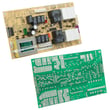
| No heat in any mode, display works | Control/relay switching | Wall oven relay control board 316443910 |
- Shut off power at the breaker before removing panels or touching wiring.
- Check the house breaker (wall ovens typically need a 240V supply; a tripped leg can cause weak or no heat).
- Inspect wiring connections for discoloration or looseness at the junction box and terminal connections.
- If you use a meter, test the sensor and heating circuits for continuity and obvious opens.
- If you see burnt wiring or repeated fault codes, stop and schedule service.
A wall oven that will not heat is often a simple setup or power-reset issue, but it can also be a failed sensor, element, or relay that prevents the control from energizing the heating circuit. Starting with the clock and control checks avoids unnecessary parts replacement.
Last updated: February 2026
What does PF mean on Kenmore Elite oven?
PF on the Kenmore Elite 79047913604 wall oven means power failure; the control detected an interruption in electrical power. To clear it, press the Clear/Off (or Stop) key once; the beep confirms the code cleared so you can reset the clock and resume cooking.
- Press Clear/Off (or Stop) to acknowledge and clear PF.
- Reset the clock; PF commonly appears after power is restored.
- If PF returns, check the home breaker for a partial trip (flip fully OFF, then ON).
- Avoid using an extension cord; wall ovens should be on a proper dedicated circuit.
- If the display is blank or keeps resetting, stop using the oven and check the power supply connection.
| What to check | What you are looking for | Why it matters |
|---|---|---|
| Breaker | Fully ON, not half-tripped | A weak trip can cause brief dropouts |
| Terminal connections | Tight, no heat damage | Loose lugs can arc and interrupt power |
| Household power events | Storms, outages, generator transfer | PF is expected after interruptions |
If PF happens frequently without a known outage, we focus on power connections and the control system:
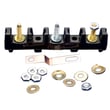
- Terminal block 5304409888 (power cord or supply wiring connection point)
- Wiring harness 318370368 (internal wiring that carries power/signals)
- Wall oven relay control board 316443910 (routes power to heating circuits)
A PF message is usually harmless after an outage, but repeated PF events can point to a loose electrical connection that can overheat. Clearing PF and confirming stable power helps protect the control board, heating elements, and wiring.
For the exact key sequence and clock-setting steps for model 79047913604, follow the 79047913604 owner's manual.
Last updated: February 2026
What are the parts of an electric oven?
An electric wall oven like Kenmore Elite 79047913604 is built around heating elements, airflow and venting parts, and electronic controls that regulate temperature and cooking modes. Common core components include the bake and broil elements, oven temperature sensor, convection fan system (if equipped), racks, door and gasket, light, and control boards.
- Bake element: primary heat source for baking and roasting (usually bottom of the cavity).
- Broil element: high, direct heat for broiling (typically at the top of the cavity).
- Oven temperature sensor: tells the control board the actual oven temperature; a failed sensor can cause overheating or underheating.
- Electronic oven control and relay boards: switch power to elements and manage timing, modes, and temperature.
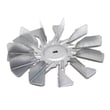
- Convection fan and motor (some models): circulates hot air for more even baking; a cooling fan may also run after shutoff to protect electronics.
- Oven vent: releases heat and moisture; on many wall ovens the vent is at the upper front.
- Oven racks and rack supports: hold cookware and allow multiple rack positions.
- Door assembly: glass, hinges, handle, and oven seal (gasket) to keep heat inside.
- Oven light and lens/cover: illuminates the cavity for viewing.
| Part type | What it affects | Example part for this model |
|---|---|---|
| Temperature sensing | Accuracy, error codes, overheating | Range oven temperature sensor 316217002 |
| Heat source | No-heat, weak heat, uneven cooking | Oven element 318601604 |
| Sealing | Heat loss, long preheat, hot exterior | Oven seal 318053120 |
| Controls | Intermittent heat, no bake/broil | Wall oven relay control board 316443910 |
Knowing which part does what helps you troubleshoot faster. For example, temperature swings often point to the sensor or control, while long preheat times can be caused by a weak element or a leaking door seal.
- Shut off power at the breaker before any inspection or repair.
- If the oven overheats or underheats, start by checking the sensor connection and condition.
- If convection baking is uneven, listen for the fan and check for obstructions.
- If you see heat escaping around the door, inspect the gasket for gaps, tears, or flattening.
- Use the wiring diagram and component locations in the 79047913604 owner's manual to match symptoms to parts.
Last updated: February 2026