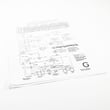
Installation guide
 Owner’s manual
 Error Codes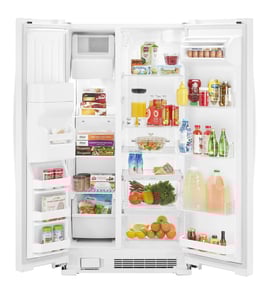


How wide is a Kenmore side-by-side refrigerator?
Kenmore side-by-side refrigerator widths vary by model and capacity, so we can’t confirm an exact cabinet width for model 25357388601 from the model-specific documents provided. Most side-by-side units are built to fit a standard 36-inch opening, but you should verify your exact measurement before ordering or installing.
How to get the right width for model 25357388601
Use a tape measure and record three numbers: cabinet width, door clearance, and installation clearance. For setup guidance and clearance notes, use the 25357388601 installation guide.
Measure these points:
- Cabinet width: left outside edge to right outside edge (doors closed)
- Overall width with doors/handles: widest point across the front
- Door swing clearance: space needed so doors open fully without hitting a wall
- Top and side clearance: space for airflow and leveling
- Back clearance: space for power cord and water line (if equipped)
Typical width ranges (general guidance)
These ranges are common across many Kenmore side-by-side refrigerators, but they are not a guarantee for model 25357388601.
| What you’re sizing | Typical range | Why it changes |
|---|---|---|
| Cabinet width | ~32–36 in. | capacity and design family |
| Overall width (with doors/handles) | often slightly wider than cabinet | handle style, door contour |
| Recommended opening | commonly 36 in. | ventilation and door swing |
Why it matters
Getting the width right prevents installation problems like doors that can’t open fully, rubbing against cabinets, or restricted airflow that can hurt cooling performance.
Quick tip for planning an install
If your refrigerator sits next to a wall, plan extra hinge-side space so the door can swing wider. The clearance checklist in the 25357388601 installation guide is the best place to start.
Last updated: January 2026
Where is the defrost timer on Kenmore side-by-side?
On the Kenmore 25357388601 side-by-side refrigerator, the defrost system is automatic; a separate, customer-accessible “defrost timer” is typically not used. Instead, defrost is controlled by an electronic defrost control (adaptive defrost) and related defrost components.
Where to look on this model
We can’t identify a single, serviceable “defrost timer” location for model 25357388601 based on the model-specific documentation; this is normal because many side-by-side designs use an internal control rather than a standalone timer.
Common access areas to inspect for defrost-related components include:
- Behind the toe grille or lower front kickplate area
- Inside the fresh food control housing (temperature control area)
- Behind the rear access cover (machine compartment)
- Behind the freezer rear panel (evaporator area, where frost builds)
For safety steps and component locations by section, use the 25357388601 use & care manual.
If you’re troubleshooting a “not defrosting” symptom
If the freezer back wall is heavily frosted or airflow is weak, the issue is usually in the defrost circuit, not a timer.
Start with these checks:
- Unplug the refrigerator before removing panels
- Look for heavy frost on the evaporator cover in the freezer
- Listen for the evaporator fan; no airflow can mimic a defrost failure
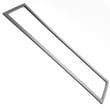
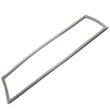
- Check door gaskets for gaps that cause excess frost
- If the unit warms up, move food to a cooler and limit door openings
Parts that commonly affect defrost
If testing indicates a failed defrost safety or control component, these model-compatible parts are examples to consider:
| Part | What it does | When it’s suspect |
|---|---|---|
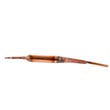
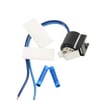
| Refrigerator defrost bi-metal thermostat 5303918214 | Opens/closes the defrost heater circuit based on temperature | Frost buildup, defrost heater not energizing |
Why it matters
On an automatic-defrost refrigerator like the Kenmore 25357388601, chasing a “timer location” can waste time. Focusing on the evaporator frost pattern and the defrost thermostat/control path is usually the fastest way to restore proper cooling.
Last updated: January 2026
How much freezer space is in a side-by-side?
Freezer space in a side-by-side refrigerator varies by model; for Kenmore model 25357388601, the exact freezer cubic-foot capacity isn’t identified in the model-specific information we have here. In general, many side-by-side units have about 7.5 to 10 cu. ft. of freezer space within a 22.5 to 31 cu. ft. total capacity range; see the 25357388601 use & care manual for model-specific features and storage guidance.
What you can use to estimate freezer capacity
If you don’t have the capacity label handy, we typically estimate usable freezer space by looking at the freezer-side layout and how much is taken up by the ice maker and bins.
- Check for a capacity label inside the fresh food section (often on a side wall near the serial plate)
- Note whether you have an in-door ice bin and dispenser (these reduce usable shelf space)
- Count fixed shelves vs. adjustable shelves and basket depth
- Consider door bin depth (door storage is usable but not always counted the same way)
- Compare to common side-by-side ranges (below)
Typical side-by-side freezer space ranges
| Refrigerator type | Typical total capacity (cu. ft.) | Typical freezer portion (cu. ft.) |
|---|---|---|
| Side-by-side (common range) | 22.5 to 31 | 7.5 to 10 |
| Side-by-side (smaller homes/condos) | 20 to 23 | 6 to 8 |
| Side-by-side (larger footprint) | 28 to 31+ | 9 to 11 |
Why it matters
Freezer capacity affects how well you can organize airflow around packages (important for consistent temperatures) and whether bulky items will block vents. Better airflow usually means fewer warm spots and less frost buildup.
Related model-specific tip
If your freezer feels “tight” on space because of the ice system, keeping the ice container from clumping and emptying old ice can help you reclaim usable room and improve dispensing performance; the 25357388601 use & care manual covers ice container handling and cleaning.
Last updated: January 2026