Owner’s manual
 Error Codes



How to remove bottom grille on GE refrigerator?
On the GE GFE26GGKIWW bottom-mount refrigerator, the bottom grille (base grille) typically comes off by releasing its retaining tabs or removing any mounting screws, then pulling the grille straight out from the front. Use gentle, even pressure so you do not crack the plastic or bend the grille.
Quick steps
- Unplug the refrigerator or switch off power at the breaker (safer when working near wiring).
- Look along the top edge and corners of the bottom grille for screws; remove them if present.
- If there are no screws, grip the grille near both ends.
- Pull the grille straight toward you to release the clips (do not twist).
- If it feels stuck, press in on the clip areas while pulling outward.
- Set the grille aside on a towel to prevent scratches.
What to check before you pull
The grille style can vary by configuration, so we recommend confirming the exact clip and screw locations for your unit in the GFE26GGKIWW owner's manual.
| What you see at the grille | What it usually means | What to do |
|---|---|---|
| Phillips-head screws at corners/top edge | Screw-mounted grille | Remove screws, then pull grille forward |
| No screws, grille sits tight and flush | Clip-mounted grille | Pull straight out to release tabs |
| Grille won’t budge easily | Tabs are binding or you are pulling at an angle | Re-grip both ends and pull evenly |
Why it matters
Removing the bottom grille gives you access for basic cleaning and inspection (dust buildup, airflow path, and front leveling area). Keeping this area clear helps the refrigerator run efficiently and can reduce warm-temperature complaints.
Reinstall tip
To reinstall, line the grille up with the openings, push it straight in until it snaps into place, then reinstall any screws.
Last updated: February 2026
Is GE GFE26GGKIWW considered high end?
GE GFE26GGKIWW is generally considered a mid-range to upper-mid-range bottom-mount refrigerator, not a true luxury or “high-end” line. In GE’s lineup, models like this typically sit below premium series that emphasize pro styling, specialty finishes, and higher-end feature packages.
How we think about “high end” for refrigerators
“High end” usually means a combination of premium materials, advanced features, and a higher price tier. For a bottom-mount refrigerator like the GFE26GGKIWW, the most common high-end indicators are:
- Counter-depth design and built-in style fit
- Premium exterior finishes and upgraded hardware
- Advanced dispenser features and specialty ice
- More robust temperature management and sensors
- Higher-end interior lighting and storage systems
For model-specific features and control details, we recommend checking the GFE26GGKIWW owner's manual.
Quick comparison: where this model typically fits
| Tier | What it usually includes | Where GFE26GGKIWW fits |
|---|---|---|
| Value | Basic cooling, fewer features | Not typical |
| Mid-range | Strong core features, standard styling | Possible |
| Upper-mid-range | More features, better fit and finish | Most common fit |
| High-end | Premium styling, specialty features, top-tier pricing | Usually not |
Why it matters
If you’re deciding whether to repair or replace, the “tier” helps set expectations for parts cost and feature set. For example, higher-feature refrigerators often rely more on electronics and sensors, such as a refrigerator main control board WR55X46805 or a refrigerator temperature sensor WR55X10025, which can affect repair decisions.
Practical tip if you’re comparing models
Use these checkpoints when comparing GE refrigerators:
- Depth type: standard depth vs counter depth
- Control style: what settings and readouts your control panel supports
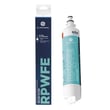
- Water system: filter type and replacement schedule (this model uses the GE refrigerator water filter RPWFE)
- Ice system: ice maker style and serviceability
- Repair profile: availability and cost of common parts (fan motor, control board, sensors)
Last updated: February 2026
What is the life expectancy of a GE GFE26GGKIWW refrigerator?
A GE bottom-mount refrigerator like model GFE26GGKIWW typically lasts 12 to 15 years with normal household use. Consistent maintenance (cleaning condenser coils, keeping doors sealing tightly, and changing the water filter on schedule) helps you reach the upper end of that range.
Typical lifespan and what affects it
Most refrigerators fail early due to heat buildup, airflow restrictions, or ice and water system issues. These factors have the biggest impact:
- Condenser coil cleanliness (dust and pet hair make the compressor work harder)
- Door seal condition (warm air leaks increase run time and frost)
- Stable temperatures (avoid frequent warm-ups from long door openings)
- Water filter changes (protects the dispenser and ice maker water path)
- Fan airflow (evaporator fan problems can cause warm sections and overwork the system)
Maintenance schedule we recommend
Use this as a practical baseline for the GFE26GGKIWW.
| Task | How often | Why it matters |
|---|---|---|
| Replace water filter | Every 6 months (typical) | Helps maintain water flow and ice quality |
| Clean condenser coils | Every 6 to 12 months | Reduces compressor run time and heat stress |
| Check door gaskets and door alignment | Every 6 months | Prevents air leaks and frost buildup |
| Listen for fan noise or airflow changes | Monthly | Early warning of cooling system strain |
For model-specific care steps and filter guidance, follow the GFE26GGKIWW owner's manual.
Parts that commonly relate to longevity
If you are troubleshooting warm temperatures, heavy frost, or weak airflow, these parts are often involved:
- Refrigerator temperature sensor WR55X10025 (helps the control board regulate cooling)
- GE refrigerator evaporator fan motor WR60X26866 (moves cold air through the compartments)
- Refrigerator defrost heater WR51X10132 and refrigerator defrost bi-metal thermostat WR50X10108 (prevent ice buildup that blocks airflow)
- GE refrigerator water filter RPWFE (supports reliable dispenser and ice maker performance)
Why it matters
A refrigerator that runs hotter, runs longer, or builds up frost usually wears out key components faster (especially the compressor and fans). Keeping airflow clear and temperatures stable is the simplest way to extend service life and reduce costly repairs.
Last updated: February 2026
What is the most common problem with a GE refrigerator?
The most common issue we see with GE refrigerators like model GFE26GGKIWW is a cooling complaint (fresh food too warm, freezer not holding temperature). In many cases, the root cause is restricted airflow or a failed cooling component such as the evaporator fan motor, a temperature sensor, or a defrost-system part; the owner's manual helps confirm the correct checks and settings.
Quick checks that fix many “not cooling” complaints
- Make sure air vents inside the fresh food and freezer sections are not blocked by food packages.
- Set temperatures to normal targets (most households use 37°F for fresh food and 0°F for freezer).
- Clean dust from the condenser area (dirty coils make the compressor run longer and cool poorly).
- Confirm doors close fully and gaskets seal all the way around.
- Listen for the evaporator fan running when the doors are closed (a failed fan often causes warm temps).
Common causes and the parts that often solve them
If basic airflow and settings look good, these are frequent culprits on bottom-mount designs:
| Symptom | Likely cause | Example part for GFE26GGKIWW |
|---|---|---|
| Fridge warm, freezer cold or uneven temps | Weak or failed evaporator fan | GE refrigerator evaporator fan motor WR60X26866 |
| Temps swing, unit runs too long | Bad sensor reporting wrong temperature | Refrigerator temperature sensor WR55X10025 |
| Frost buildup, airflow drops over time | Defrost system not clearing ice | Refrigerator defrost heater WR51X10132 or refrigerator defrost bi-metal thermostat WR50X10108 |
| Random cooling issues, odd behavior | Control not driving fans/defrost correctly | Refrigerator main control board WR55X46805 |
Why it matters
Cooling problems are usually progressive: restricted airflow or a failing fan can lead to warmer food temps, more frost, and longer compressor run time. Catching the cause early helps protect food and reduces strain on major sealed-system components.
Best next step for accurate diagnosis
Use the troubleshooting and temperature-setting guidance in the owner's manual, then match symptoms to the most likely system (airflow, fan, sensor, defrost, or controls) before ordering parts.
Last updated: February 2026