Installation guide
 Owner’s manual
 Error Codes



What is the lifespan of a whirlpool dishwasher?
Most Whirlpool dishwashers last 10 to 12 years with normal household use. For your Whirlpool DU810SWPU4 undercounter dishwasher, regular cleaning, correct detergent use, and fixing small leaks or draining issues early are the biggest factors in reaching that typical lifespan (or longer).
Typical lifespan and what affects it
A dishwasher’s service life depends more on conditions than brand name alone.
- Usage frequency: multiple loads per day shortens life compared to 3 to 5 loads per week
- Water quality: hard water speeds up mineral buildup in the tub, pump, and inlet valve
- Maintenance: cleaning filters and checking the drain path prevents strain on the motor
- Loading habits: stable loading reduces rack wear and prevents damage during wash action
- Detergent choice: use only recommended dishwasher detergents (too much suds can cause problems)
For model-specific care and operating guidance, follow the DU810SWPU4 owner's manual.
Quick “is it worth repairing?” guide
If your DU810SWPU4 is near the 10 to 12 year mark, compare the symptom to the likely repair.
| Symptom | Common cause | Parts to check first |
|---|---|---|
| Not filling | Water supply issue or failed inlet valve | Dishwasher water inlet valve W10844024 |
| Not draining well | Clogged drain path, air gap issue, kinked hose | Dishwasher drain hose WP3374077 |
| Door won’t latch | Worn latch or misalignment | Dishwasher door latch WP3380854 |
| Poor drying | Heating circuit issue, heavy mineral buildup | Heating element seals/supports (inspect) |
Maintenance that extends life (high impact)
These steps prevent the most common “wear-out” failures.
- Run hot water at the sink before starting a cycle so the dishwasher fills with hotter water
- Clean the drain air gap (if your setup has one) when draining slows
- Inspect for small leaks under the unit; tighten clamps and connections as needed
- Keep the door seal area clean so the door closes and latches consistently
- Use rinse aid to improve drying and reduce spotting, especially with hard water
Why it matters
A dishwasher that drains poorly, doesn’t fill correctly, or won’t latch forces the motor and controls to work harder. Fixing those issues early helps prevent bigger failures and helps your Whirlpool DU810SWPU4 reach its full expected lifespan.
Last updated: February 2026
What is the most common problem with a whirlpool dishwasher?
Drain and wash-performance problems are the most common issues we see with Whirlpool dishwashers, including the Whirlpool DU810SWPU4. Typical symptoms are standing water in the tub, weak spray, or dishes coming out gritty because water is not circulating or draining correctly. For model-specific checks and troubleshooting steps, use the owner's manual.
Most common symptoms (and what they usually point to)
- Standing water after the cycle: drain path restriction (air gap, hose routing, disposer connection)
- Poor cleaning or food left behind: spray arm blockage, low fill, or circulation problem
- Cloudy glassware or film: detergent and rinse conditions (often hard water related)
- Stops mid-cycle: door not fully latched, power interruption, or motor overload reset
- Not drying well: heating circuit or airflow issues (often noticed as cool, wet dishes)
Quick checks you can do first
- Confirm the door is fully closed and latched. A weak latch can cause stopping or no-start; the dishwasher door latch WP3380854 is the common wear item.
- Check the drain setup:
- If you have an air gap, clean it (the manual calls this out for poor draining).
- Make sure the drain hose is not kinked; replace a damaged hose with the dishwasher drain hose WP3374077.
- Verify the dishwasher is filling properly. The manual notes typical home water pressure should be 20 to 120 psi for proper filling.
- Reset power if it stops. If a breaker trips or a fuse blows, reset/replace it; if the motor overloaded, it can reset itself after a few minutes.
Common causes and the best “next step”
| Problem you notice | Most likely area | Best next step |
|---|---|---|
| Won’t drain | Drain path (air gap, hose, disposer inlet) | Clean air gap, inspect hose routing, check for clogs |
| Poor cleaning | Water circulation or spray blockage | Clean spray paths, confirm proper fill |
| Spots/film | Detergent, rinse aid, water chemistry | Adjust detergent, use rinse aid, run a vinegar rinse |
| Won’t start/stops | Door latch or power | Check latch engagement and household power |
Why it matters
Drain and circulation issues do more than leave water behind; they also reduce wash pressure, redeposit soil, and can make detergent perform poorly. Fixing the drain path and confirming proper fill solves a large share of “not cleaning” complaints.
Last updated: February 2026
Is it worth repairing a whirlpool dishwasher?
Repairing a Whirlpool dishwasher is worth it when the fix is a common, contained repair (like a latch, drain hose, or inlet valve) and the machine is otherwise cleaning and draining well. For a Whirlpool DU810SWPU4, we use the part cost, labor time, and overall condition to decide whether repair beats replacement.
Quick repair vs. replace checklist
- Repair when the problem is isolated (leak, no fill, won’t latch, poor drain) and the tub and racks are in good shape.
- Repair when the needed part is readily available and the job is straightforward.
- Replace when multiple major symptoms show up at once (won’t run, won’t heat, won’t drain) and performance has been declining.
- Replace when rusted racks, a damaged tub, or repeated leaks suggest broader wear.
- Repair first if you can confirm the failure with basic checks in the DU810SWPU4 owner's manual.
Common “worth repairing” failures on this model
These are typical dishwasher repairs that often restore normal operation without replacing the whole unit:
| Symptom | What to check first | Part that’s often involved (if applicable) |
|---|---|---|
| Won’t fill or fills slowly | Water supply valve open, inlet screen, float not stuck | Dishwasher water inlet valve W10844024 |
| Door won’t latch or cycle stops | Latch alignment, strike, door closing fully | Dishwasher door latch WP3380854 |
| Not draining well | Kinked hose, high loop/air gap, clogs | Dishwasher drain hose WP3374077 |
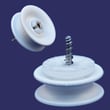
| Lower rack won’t roll smoothly | Worn or broken rollers | Dishwasher dishrack roller assembly, lower WP8268645 |
Why it matters
A dishwasher that still has a solid tub, stable racks, and normal wash action is usually a good repair candidate because targeted part replacement can restore reliability. Using the correct detergent and loading dishes so they do not strike each other also prevents avoidable damage and repeat issues (details are covered in the manual).
Practical cost rule we use
| If your total repair cost is… | Typical recommendation |
|---|---|
| Under about $300 | Usually worth repairing |
| $300 to $500 | Depends on overall condition and how many symptoms you have |
| Over about $500 | Replacement often makes more sense |
Last updated: February 2026