Installation guide
 Owner’s manual
 Error Codes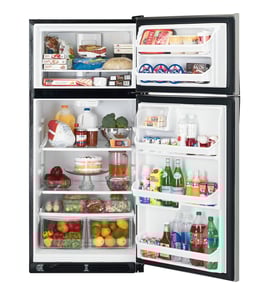



What are the disadvantages of a top mount fridge?
A top-mount refrigerator like the Frigidaire FFUI1826MW0 typically puts the freezer at eye level and the fresh-food section lower, so you bend more for everyday items; it also usually offers fewer premium convenience features than bottom-freezer designs.
Common disadvantages (what you will notice day to day)
- More bending for fresh food: produce drawers, deli items, and drinks sit lower.
- Less “wide-open” organization: many top-mount layouts have fewer adjustable storage options than larger bottom-mount styles.
- Fewer built-in features: in-door ice and water dispensers are less common on basic top-mount models.
- Smaller freezer access: the freezer is convenient, but can feel tighter for bulky boxes.
- Door-swing clearance matters: you may need extra space to fully open doors and drawers.
What to check on your FFUI1826MW0 before deciding it is a “bad fit”
Use the FFUI1826MW0 installation guide to confirm the setup details that affect daily usability:
| Setup item | What “good” looks like | Why it helps |
|---|---|---|
| Leveling | Cabinet level side-to-side and slightly tilted back | Doors close more reliably and seals stay tight |
| Clearances | Typical guidance is 3/8 inch at sides/top and 1 inch at back | Better airflow and easier door swing |
| Door seal | Gasket contacts the cabinet on all sides | Fewer temperature swings and less frost |
Why it matters
Many “top-mount disadvantages” feel worse when the refrigerator is not leveled correctly or the doors do not seal well. A solid, level install improves door closing, temperature stability, and overall convenience.
When a top-mount is still the right choice
- You want a simpler design with fewer dispenser-related repairs.
- You prefer freezer items at eye level.
- You have a tighter budget but still want reliable cooling.
Last updated: January 2026
Is a top mount fridge better than a bottom mount?
A top-mount refrigerator like the Frigidaire FFUI1826MW0 is “better” when you want a lower purchase price, simpler layout, and easy access to the freezer at eye level; a bottom-mount is “better” when you want the fresh-food section at eye level for everyday use.
Quick comparison: top-mount vs bottom-mount
- Top-mount (freezer on top): freezer is easiest to reach; fresh food requires more bending.
- Bottom-mount (freezer on bottom): fresh food is easiest to reach; freezer access is lower.
- Energy and performance: both styles can cool well; real-world efficiency depends more on usage, seals, and airflow than freezer position.
- Maintenance: both need good door sealing and proper leveling to prevent temperature swings and moisture issues.
| Feature | Top-mount (like FFUI1826MW0) | Bottom-mount |
|---|---|---|
| Most-used area at eye level | Freezer | Fresh food |
| Typical value | Often lower cost | Often more features |
| Ergonomics | More bending for fridge items | More bending for freezer items |
| Common fit | Often narrower, simpler | Often taller, heavier |
What we recommend choosing based on how you use the fridge
- Choose top-mount if you use frozen foods often, want a straightforward design, or need a budget-friendly replacement.
- Choose bottom-mount if you cook frequently and want produce, dairy, and leftovers at eye level.
- Choose either style only after confirming door swing, clearance, and leveling in your kitchen.
Why it matters (fit, airflow, and door sealing)
Even the “best” style will disappoint if it is not installed correctly. For FFUI1826MW0, proper clearances and leveling help the doors seal fully and keep temperatures stable. The installation checklist also calls out verifying the door seals and leveling (including a slight tilt front-to-back) for reliable operation.
For model-specific setup details, use the FFUI1826MW0 installation guide.
Last updated: January 2026
What is the most common problem with a Frigidaire refrigerator?
For the Frigidaire FFUI1826MW0 top-mount refrigerator, the most common problem we see is poor cooling (warm fresh food section or weak freezing), usually tied to airflow restrictions, dirty condenser area, or a fan issue; ice maker water-supply problems are also very common.
Quick checks that fix many “common problems”
- Confirm the temperature controls are set correctly; after any change, wait 24 hours before adjusting again.
- Make sure the doors seal fully on all sides.
- Verify the refrigerator is level side-to-side and tilted about 1/4 inch (6 mm) front-to-back.
- If the ice maker is installed, confirm the house water supply is connected and there are no leaks (recheck connections after 24 hours).
- Turn the ice maker OFF if the water supply is not connected immediately.
Most common symptoms and what they usually point to
| Symptom | Most likely cause | What to check first |
|---|---|---|
| Fresh food is warm | Airflow problem or fan not moving air | Listen for evaporator fan, check vents for blockage |
| Freezer is warm | Airflow/defrost issue | Look for heavy frost on the evaporator cover |
| Ice maker not making ice | Water supply or valve issue | Confirm water supply, check for leaks, verify ice maker is ON |
| Frost or sweating around doors | Door not sealing | Inspect gasket contact all the way around |
Parts that commonly relate to these issues
If troubleshooting points to a failed component, these model-matched parts are commonly involved:
- Refrigerator evaporator motor 242077705 (no/weak airflow from the freezer)
- Refrigerator condenser fan blade 241639502 (poor heat removal at the back/bottom)
- Refrigerator temperature control thermostat 241537103 (temperature not regulating well)
- Refrigerator water inlet valve assembly 242252603 (ice maker not filling)
Why it matters
Cooling and ice maker complaints often share the same root causes: airflow, leveling, and stable temperatures. Getting the cabinet level and the controls set correctly prevents warm spots, excess frost, and door-seal leaks that force the compressor to run longer.
Recommended references
- Use the FFUI1826MW0 installation guide for leveling targets, clearance guidance, and the ice maker water-supply checklist.
- If your unit shows a code or unusual behavior, use Frigidaire refrigerator error codes to narrow the failure to a specific system.
Last updated: January 2026
Why is my Frigidaire top mount freezer not freezing?
If your Frigidaire FFUI1826MW0 top-mount freezer is not freezing, the most common causes are incorrect control settings, poor airflow from a failed evaporator fan, or warm air leaking past the door gasket. Set the controls correctly, confirm fans run, and check the door seal first using the FFUI1826MW0 installation guide.
Quick checks we recommend (in order)
- Confirm the freezer control is set to a colder setting; after any change, wait a full 24 hours before adjusting again.
- Make sure the freezer door closes fully and the gasket seals all the way around.
- Listen for the evaporator fan in the freezer; if it is not running, cold air will not circulate.
- Check for heavy frost on the back freezer wall (a sign of a defrost airflow problem).
- Verify the refrigerator is level and tilted slightly back so doors self-close.
- Avoid overpacking; blocked vents reduce airflow and freezing performance.
Settings and timing (what “normal” looks like)
The installation instructions for this refrigerator note that control changes need time to stabilize; we follow that same rule for no-freeze complaints.
| What you do | What to expect | What it tells us |
|---|---|---|
| Turn freezer colder | Temperature improves within 24 hours | Likely a settings or load issue |
| Fan is silent in freezer | Freezer warms, fridge may also warm | Evaporator fan or wiring issue |
| Frost blanket on rear panel | Weak airflow, poor freezing | Defrost system or airflow restriction |
Parts that commonly fix “not freezing” symptoms
If the freezer is warm and you do not hear airflow, these model-matched parts are common suspects:
- Refrigerator evaporator motor 242077705 (drives the evaporator fan)
- Refrigerator evaporator fan blade 5308000010 (can slip, crack, or ice-bind)
- Frigidaire refrigerator freezer door gasket, 18 x 30 inches, white 241872503 (prevents warm air leaks)
Why it matters
A freezer that is not freezing usually comes down to one of three things: the unit is not moving cold air, it is letting warm air in, or it is not being given enough time after a control change. Fixing the root cause quickly helps prevent food spoilage and reduces compressor run time.
Last updated: January 2026