Error Codes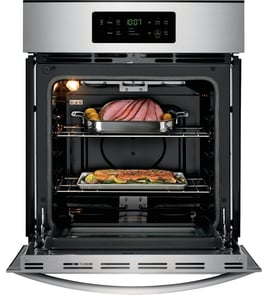

Are electric wall ovens 110 or 220?
Most GE electric wall ovens like model JKP26 are designed for a 240-volt (often called 220-volt) circuit, not a standard 120-volt (110-volt) outlet. In U.S. homes, that typically means a dedicated double-pole breaker and hardwired connection or a 240V receptacle, depending on the installation.
What you should expect for voltage and wiring
Electric wall ovens almost always use 240V to heat properly; 120V is commonly used only for controls, lights, and the clock (supplied through the same 240V feed).
- Typical supply: 240V (commonly referred to as 220V)
- Typical breaker: double-pole (commonly 30A to 50A, sized to the oven’s rating)
- Typical wiring: 3-wire or 4-wire branch circuit (depends on home wiring and local code)
- Typical connection: hardwired junction box or 240V cord set (varies by model and install)
- Do not use: a standard 120V household outlet
Quick check: 120V vs 240V
| Item | 120V (110V) outlet | 240V (220V) oven circuit |
|---|---|---|
| Common use | Small appliances | Electric wall ovens, ranges, dryers |
| Breaker type | Single-pole | Double-pole |
| Heating performance | Not enough for an oven | Correct for bake/broil heating |
Why it matters
If the oven is connected to the wrong voltage, it can cause no heat, weak heating, nuisance tripping, or damage to electrical components. Correct power also helps bake and broil elements heat evenly, which protects parts like the range bake element WB44X200 and broil unit WB44X173.
Safe next steps before you install or troubleshoot
- Turn off power at the breaker before opening any junction box.
- Confirm you have a double-pole breaker feeding the oven.
- Check the home wiring condition (burnt wires, loose lugs, brittle insulation).
- If you’re diagnosing a no-heat issue, test voltage and continuity with proper tools (a meter rated for 240V).
- Use a proven method for electrical testing such as how to use a multimeter to test electrical parts video.
Last updated: February 2026
Do wall ovens need to be hardwired?
Yes. For a GE electric wall oven like model JKP26, the standard installation is direct-wired (hardwired) to a dedicated junction box on a properly sized 240/208-volt circuit. A cord-and-plug connection is uncommon for wall ovens and is typically not accepted unless the specific installation instructions for your exact unit allow it.
What we recommend for a safe, correct installation
- Turn off power at the breaker before touching any wiring.
- Use a dedicated 2-pole breaker (most wall ovens are 240/208V).
- Confirm wire gauge and breaker size match the oven’s electrical rating.
- Use an approved junction box and proper strain relief where the conduit enters.
- Verify the home wiring is copper or otherwise approved for the installation.
- If you see aluminum wiring, damaged insulation, or overheated connections, stop and have it evaluated.
Hardwired vs plug-in: what’s the difference?
Most wall ovens are designed to be installed in a cabinet cutout and connected through a junction box. A plug can create clearance issues behind the oven and may not meet local electrical requirements.
| Connection type | Typical for wall ovens | Where it connects | Common reason it’s used |
|---|---|---|---|
| Hardwired (direct wire) | Yes | Junction box | Permanent built-in installation |
| Cord and plug | Rare | Receptacle outlet | Only when explicitly allowed by the unit’s instructions |
Why it matters
A wall oven draws high current. A correct hardwired connection helps prevent nuisance breaker trips, overheating at connections, and damage to critical wiring and heating circuits.
Related repair note (when wiring issues cause heating problems)
If your oven is not heating correctly after power or wiring work, inspect heating components and connections. For example, a failed range bake element WB44X200 can also cause poor baking performance.
Last updated: February 2026
How to replace GE Wall Oven control panel?
To replace the control panel on your GE JKP26 electric wall oven, we shut off power at the breaker, remove the mounting screws that secure the panel, tilt the bottom outward, then lift up to release it. Transfer wiring one connector at a time to the new panel.
Safety first (do this before touching anything)
- Turn both oven breakers OFF (most wall ovens use a 240V double-pole breaker)
- Confirm the display is dark and the oven will not heat
- Use cut-resistant gloves; sheet metal edges behind the panel are sharp
- Avoid pulling on wires; always pull on the connector body
Step-by-step: remove and reinstall the control panel
- Kill power at the breaker.
- Open the oven door(s) to access the control panel mounting area.
- Remove the screws securing the control panel (typically along the underside or side trim).
- Pull the bottom of the panel outward, then lift the panel up to release the top tabs.
- Support the panel so it does not hang by the wiring.
- Move wire connectors one at a time from the old panel/control to the new one (take a photo first).
- Re-seat the panel on the top tabs, swing the bottom in, and reinstall screws.
- Restore power and test: clock, bake, broil, and keypad response.
Quick troubleshooting if the panel still acts up
- Dead display: check house breaker, junction box connections, and harness plugs
- Buttons not responding: reseat ribbon/connector plugs; look for bent pins
- Random beeping or error behavior: inspect for pinched wires behind the panel
- No heat but display works: test heating circuits; the issue can be an element, relay, or wiring
Related parts that often get checked during control-panel work
| Symptom | Common area to inspect | Example part for this model |
|---|---|---|
| Broil not heating | Broil element and terminals | Broil unit WB44X173 |
| Bake not heating | Bake element and terminals | Range bake element WB44X200 |
Why it matters
A loose connector, pinched harness, or mis-seated panel can cause intermittent keypad problems, error tones, or heating failures. Moving connectors one at a time and routing wires correctly prevents miswiring and repeat repairs.
Last updated: February 2026
What are the parts of an electric oven?
An electric oven like the GE JKP26 is built around heating components (bake and broil), temperature control, and basic cooking hardware. Most ovens share the same core parts, even if features vary by model (standard vs. convection, single vs. double wall oven).
Main parts you will find in most electric ovens
- Bake element: the lower heating element that provides steady heat for baking and roasting (example: range bake element WB44X200).
- Broil element: the upper heating element that provides intense top-down heat for broiling (example: broil unit WB44X173).
- Oven racks: support cookware at different heights.
- Oven temperature sensor: tells the control how hot the oven is.
- Electronic control board or thermostat: regulates temperature and cooking modes.
- Door and door gasket: seals heat in; the gasket helps maintain stable temperatures.
- Light and light lens/cover: illuminates the oven cavity.
How these parts work together (quick map)
| Part | What it does | Common symptom when it fails |
|---|---|---|
| Bake element | Primary heat for baking | Oven won’t heat, slow preheat, uneven baking |
| Broil element | High heat from above | No broil, weak browning |
| Sensor/control | Maintains set temperature | Temperature swings, over/underheating |
| Door gasket | Keeps heat inside | Long preheat, heat escaping, poor baking results |
Why it matters
Knowing the major oven parts helps you troubleshoot faster. For example, “won’t bake but broils” usually points to the bake element or its wiring, while “bakes but won’t broil” often points to the broil element.
Helpful DIY checks before buying parts
- Turn off power at the breaker before inspecting anything.
- Look for blistering, cracks, or burn spots on the element.
- If the oven heats unevenly, verify rack position and cookware first.
- If you’re testing electrical parts, use a meter and follow safe procedures (see how to use a multimeter to test electrical parts video).
Last updated: February 2026
Where can I find the GE Wall Oven model number?
You can find the model number for your GE electric wall oven on the oven’s identification label; on most wall ovens it’s visible when you open the oven door and look around the door frame (often along the left or right side). For this parts page, the model is JKP26.
Where to look on a GE wall oven
Check these common label locations first:
- Open the oven door and inspect the door frame on the left and right sides
- Look along the front frame near the bottom edge of the oven opening
- Check the underside of the control panel area (if accessible with the door open)
- For double wall ovens, check both upper and lower oven frames
- If the label is worn, use a flashlight and take a close-up photo to zoom in
What you need from the label (and why)
The label usually includes a model number and serial number. We use the model number to match the correct GE wall oven parts, diagrams, and compatible replacements.
| Label item | What it’s used for | Example format |
|---|---|---|
| Model number | Ensures part compatibility | JKP26 |
| Serial number | Helps identify production details | Varies |
Why it matters
GE wall ovens can look similar across model families, but parts like a bake element or broil element can differ by revision. Using the exact model number helps avoid ordering the wrong part.
If you’re still not sure you have the right model
Use these quick checks:
- Match every character exactly (letters and numbers)
- If your model has extra digits after JKP26, use the full model from the label
- Compare your oven configuration (single vs. double) before ordering parts
- If you’re troubleshooting heating issues, common replacements include the range bake element WB44X200 or a broil element such as the broil unit WB44X173 (only after confirming your exact model)
Last updated: February 2026