Error Codes
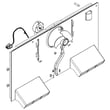



How to remove bottom grille on GE refrigerator?
On the GE GNE25JYKHFFS bottom-mount refrigerator, the bottom grille (base grille or toe grille) typically comes off by removing any retaining screws (if present) and then pulling the grille straight out to release the clips. Work gently to avoid cracking the plastic tabs.
- Unplug the refrigerator or switch off power at the breaker (recommended if you will reach near wiring or the condenser fan).
- Open both fresh food doors for better access.
- Look along the top edge of the grille for screws; remove them with a Phillips screwdriver if you see them.
- Grip the grille near both ends and pull straight toward you to pop it off the retaining clips.
- If it feels stuck, wiggle side-to-side slightly while pulling; do not pry hard with a screwdriver.
Removing the grille is often done for cleaning or airflow issues. With the grille removed, we recommend checking:
- Dust buildup on the condenser area (restricted airflow can cause warm temps).
- The condenser fan area for obstructions.
- Any signs of rubbing, rattling, or vibration.
If you find the condenser fan is noisy or not running, the compatible replacement for this model may be refrigerator condenser fan WR60X10209.
| What you see on the grille | What it usually means | Removal method |
|---|---|---|
| Phillips screws along the top edge | Grille is screw-retained | Remove screws, then pull grille forward |
| No screws visible | Grille is clip-retained | Pull straight out to release clips |
The bottom grille is the main air intake for the condenser area on many GE refrigerators. Keeping it secure and unobstructed helps the refrigerator cool efficiently and can reduce compressor run time.
Related help: refrigerator maintenance checklist
Last updated: January 2026
Which is better, top mount or bottom mount fridge?
For the GE GNE25JYKHFFS bottom-mount refrigerator, a bottom-mount style is usually the better choice if you want everyday convenience because fresh-food items sit at eye level and the freezer is in a pull-out drawer. A top-mount is often the better pick when lowest purchase cost and simpler layout matter most.
| Feature | Top mount (freezer on top) | Bottom mount (freezer on bottom) |
|---|---|---|
| Most-used section access | Fridge section lower | Fridge section higher (more convenient) |
| Freezer access | Easy reach | Drawer style, easier to organize |
| Typical price | Lower | Higher |
| Typical efficiency | Often slightly better | Often slightly lower |
| Best for | Budget, simplicity | Convenience, organization |
We recommend choosing based on how you shop and cook, not just the door style:
- If you use fresh foods daily, bottom-mount usually feels better on your back and knees.
- If you use the freezer more than the fridge, a top-mount can be more convenient.
- If you meal prep and store lots of frozen items, bottom freezer drawers can be easier to sort.
- If you want fewer moving parts and a simpler layout, top-mount designs are typically straightforward.
- If you are tight on space, measure door swing and drawer clearance before deciding.
“Better” depends on what you touch most. With a bottom-mount like the GE GNE25JYKHFFS, the design prioritizes fresh-food access and organization, which can reduce door-open time and make daily use feel easier.
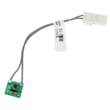
If you already own a bottom-mount refrigerator, keeping airflow and temperatures stable helps performance. If you ever suspect temperature swings, a common component to check is the thermistor style temperature sensor, such as the GE profile refrigerator temperature sensor WR55X10025.
Last updated: January 2026
What is the most common problem with GE refrigerators?
The most common issue we see with GE refrigerators, including the GE GNE25JYKHFFS bottom-mount design, is a cooling complaint (fresh food or freezer not cold enough). The most frequent root causes are restricted airflow, dirty condenser coils, or a fan/control problem; ice maker and water system issues are also very common.
- Fridge warm, freezer OK: airflow restriction, evaporator fan issue, or defrost problem
- Both sections warm: condenser coils clogged, condenser fan issue, or sealed-system/compressor concern
- Runs constantly: dirty coils, door not sealing, warm room temps, or control/thermistor input problems
- No ice or slow ice: water supply restriction, inlet valve issue, or ice maker problem
- Water tastes bad or flow is weak: overdue filter or air in the water line
- Set temps to typical targets: 37°F fresh food, 0°F freezer
- Make sure vents are not blocked by food packages
- Clean condenser coils and confirm the rear/bottom area has airflow
- Check door gaskets for gaps, tears, or areas not sealing
- If you have an error code, match it to the symptom using GE refrigerator error codes
If basic checks do not help, these model-compatible parts are often involved:
| Symptom | Common suspect part | Example from this model’s parts |
|---|---|---|
| Not cooling well, warm temps | Temperature sensing/control input | GE profile refrigerator temperature sensor WR55X10025 |
| Warm cabinet, noisy or no airflow at back | Condenser fan motor/fan | WR60X29573, WR60X10209 |
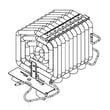
| Frost buildup, poor airflow | Defrost heater circuit | WR51X39386 |
| No ice or no water | Water inlet valve | WR57X30890 |
| Bad taste/low flow | Water filter | XWFE |
Cooling and ice maker complaints often start as simple airflow or maintenance issues, but if they continue, food safety and compressor run time can become a concern. Catching a dirty coil, weak fan, or failing sensor early can prevent bigger problems.
Last updated: January 2026