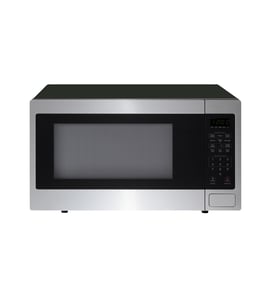

Can you replace a built-in microwave with a countertop?
Yes, you can replace a built-in microwave with a countertop model, but we only recommend doing it if the cabinet opening, ventilation clearances, and power supply match what the countertop microwave requires. A countertop microwave like the Emerson MW8102SS is designed to sit on a counter, not be enclosed like a built-in unit.
What to check before you swap
- Ventilation and airflow: Countertop microwaves need open airflow around the sides, top, and back.
- Cabinet opening size: Measure height, width, and depth of the cutout, plus door swing clearance.
- Support surface: The microwave must sit fully supported on a solid shelf (not on trim).
- Electrical: Use a properly grounded outlet; avoid extension cords.
- Heat and steam exposure: Don’t place it where it will vent into tight wood cabinetry or directly above high-heat cooking unless the setup is designed for it.
Built-in vs countertop: key differences
| Feature | Built-in microwave | Countertop microwave (MW8102SS type) |
|---|---|---|
| Mounting | Trim kit or built-in frame | Sits on a flat surface |
| Venting design | Engineered for enclosure | Needs open air space |
| Finished look | Flush/trimmed | Exposed appliance |
| Service access | Front access planned | Needs space to pull out |
Safer options that usually work better
If you want the built-in look, the most reliable path is to use a microwave that is specifically rated for built-in installation (often with a matching trim kit). If you still want to use a countertop unit in that space, plan on leaving generous open space around it and ensuring the shelf and outlet location make it easy to slide the unit out for service.
Why it matters
Microwaves generate heat and need airflow to protect internal components like the magnetron, high-voltage transformer, and cooling fan. When a countertop microwave is boxed into a tight built-in cavity, overheating and premature part failure become much more likely.
For related troubleshooting and safety tips, use our DIY guide: never do these things with a microwave.
Last updated: February 2026
How many watts is the Emerson MW8102SS?
The Emerson MW8102SS countertop microwave has 1100 watts of cooking (output) power. That number is the heating performance you use to compare microwaves and adjust cook times; the electrical power it draws from the outlet is higher than the output rating.
Output watts vs input watts (what to look for)
- Output watts (cooking power): the 1100W rating used for heating performance
- Input watts (power draw): higher than output; used for electrical load planning
- Voltage: most countertop microwaves use a standard 120V household outlet
- Why it matters: higher output usually means faster cooking and reheating
Quick reference table
| Spec on the label | Typical wording | What it helps with |
|---|---|---|
| Cooking power | “Output” or “Microwave output” | Comparing models, adjusting cook times |
| Electrical load | “Input”, “Watts”, or “Amps” | Avoiding overloaded outlets and tripped breakers |
How to confirm on your exact unit
- Check the rating label (often inside the door frame, on the back, or on a side panel)
- Look specifically for “Output” to confirm the 1100W cooking power
- If the microwave runs but heats poorly, follow: why is my microwave not heating
Why it matters
Using the correct wattage helps you set realistic cook times and troubleshoot heating complaints. A unit that turns on but does not heat points to common issues such as a door switch circuit problem, a blown fuse, or a high-voltage component failure.
Last updated: February 2026
What is a standard size Countertop Microwave?
Most countertop microwaves are “standard” in the sense that they fit common counter depths and cabinet clearances; typical exterior size is about 18 to 22 inches wide, 12 to 14 inches tall, and 14 to 20 inches deep. For your Emerson MW8102SS, confirm the exact outside dimensions before you plan a shelf or built-in trim fit.
Typical countertop microwave size ranges
These ranges cover most compact, mid-size, and larger countertop units:
- Width: 17 to 24 inches (most common: 18 to 22 inches)
- Height: 10 to 14 inches (most common: 12 to 14 inches)
- Depth: 13 to 20 inches (most common: 14 to 18 inches)
- Capacity (interior): about 0.7 to 2.2 cubic feet
| Size class | Typical capacity | Typical width | Best for |
|---|---|---|---|
| Compact | 0.7 to 1.0 cu ft | 17 to 19 in | Dorms, small kitchens |
| Mid-size | 1.1 to 1.6 cu ft | 19 to 22 in | Most households |
| Full-size countertop | 1.7 to 2.2 cu ft | 22 to 24 in | Large dishes, frequent use |
Clearances you should plan for
Even when the microwave “fits,” airflow space matters for performance and longevity.
- Leave at least 3 inches at the sides and top (more is fine)
- Keep the rear vent area from being pressed tight to a wall
- Avoid placing it directly next to a heat source (range, toaster oven)
- Make sure the door can open fully without hitting a backsplash or cabinet pull
Why it matters
“Standard size” affects more than countertop footprint. It determines whether your microwave has enough ventilation, whether the door swing works in your space, and whether common dishes (like a 10 to 12 inch dinner plate) rotate without rubbing.
Helpful troubleshooting and care tips
If you are sizing a replacement because the current unit is acting up, these guides help you decide whether repair or replacement makes sense:
Last updated: February 2026