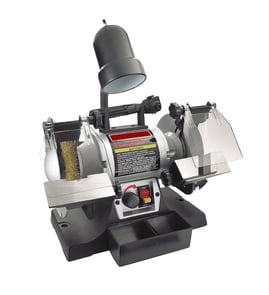

What is a Craftsman bench grinder?
A Craftsman bench grinder (including model 319211280) is a stationary, bench-mounted power tool that spins abrasive wheels to shape metal, sharpen edges, and clean up rough surfaces. It is commonly used for sharpening tools, deburring, and light grinding in a home shop or garage.
What you can do with an 8-inch bench grinder
- Sharpen chisels, lawn mower blades, and other edged tools
- Grind and shape metal parts (light material removal)
- Deburr cut edges after sawing or drilling
- Clean rust or scale with a wire wheel attachment (if equipped)
- Smooth welds and rough spots before finishing
Key parts and features (typical)
Most Craftsman 8-inch bench grinders like the 319211280 include the same core components.
| Component | What it does | Common issue it helps solve |
|---|---|---|
| Grinding wheels | Removes material and sharpens edges | Dull tools, rough edges |
| Tool rests | Supports the workpiece at a steady angle | Uneven bevels, chatter |
| Eye shields/spark guards | Helps control debris and sparks | Safer grinding and better visibility |
| Motor and switch | Powers and controls wheel speed | No-start, intermittent running |
Safe, effective use tips
- Wear eye protection and keep guards in place.
- Let the wheel reach full speed before grinding.
- Use light pressure; forcing the tool overheats metal and can glaze the wheel.
- Keep the tool rest close to the wheel (small gap) to reduce snagging.
- If the grinder vibrates, stop and check wheel condition, mounting, and balance.
Why it matters
A bench grinder is one of the most useful shop tools because it saves time and improves results: sharp tools cut cleaner, deburred parts fit better, and properly ground edges reduce the chance of cracking or poor weld prep.
For general DIY safety guidance before repairs or adjustments, we recommend reviewing are diy appliance repairs safe.
Last updated: February 2026
What are the 4 important rules for a bench grinder?
For the Craftsman 319211280 8-inch bench grinder, the 4 most important rules are: wear proper eye and face protection, keep guards and tool rests correctly adjusted, use only wheels rated for the grinder’s RPM, and keep hands, clothing, and hair safely controlled so nothing can contact the spinning wheel.
The 4 rules (with the key details that make them work)
- Protect your eyes and face every time: safety glasses plus a face shield is the safest combo; grinding sparks and wheel grit can rebound.
- Set the guards and tool rests before you grind: keep the tool rest close to the wheel (commonly about 1/8 inch) and keep the spark guard close as well; re-check after wheel changes and as the wheel wears.
- Match wheel speed to grinder speed: only install a grinding wheel with a maximum RPM rating that meets or exceeds the grinder’s no-load RPM.
- Control entanglement and kickback risks: no loose sleeves, gloves near rotating parts, jewelry, or dangling cords; tie back long hair and keep a stable stance with the work supported on the rest.
Quick safety checklist before you switch it on
- Inspect the wheel for chips or cracks; replace damaged wheels.
- Confirm the wheel is mounted securely and runs true.
- Stand to one side at startup and let it reach full speed.
- Grind on the wheel face (not the side) unless the wheel is specifically designed for side grinding.
- Use light pressure; forcing the work can overheat the wheel and the metal.
Common settings and “do / don’t” guide
| Item | Do | Don’t |
|---|---|---|
| Tool rest gap | Keep it close (often ~1/8 inch) | Leave a wide gap that can snag the work |
| Wheel RPM | Use a wheel rated at or above grinder RPM | Install an under-rated wheel |
| Startup | Let it come to full speed | Start grinding immediately |
| Grinding surface | Use the wheel face | Grind on the side (unless rated) |
Why it matters
Bench grinders can throw debris, grab the workpiece, or fail a damaged wheel at high speed. These four rules reduce the biggest injury risks: impact to eyes/face, entanglement, and wheel failure.
For general shop safety habits that apply to power tools, we also recommend reviewing are diy appliance repairs safe.
Last updated: February 2026
What is the difference between 6 and 8 bench grinder?
An 8-inch bench grinder (like the Craftsman 319211280 8-inch bench grinder) gives you a larger wheel diameter, which typically runs cooler, removes metal a bit more smoothly, and creates a shallower hollow grind on tool edges. A 6-inch grinder is smaller, usually lighter-duty, and takes up less bench space.
Key differences that affect real-world use
- Wheel diameter: 8-inch wheels have a larger radius, so the grind is less aggressive at the edge.
- Heat control: 8-inch grinders typically build less heat at the cutting edge for the same pressure.
- Hollow grind shape: 8-inch wheels leave a shallower hollow, which many users prefer for chisels and plane irons.
- Footprint and weight: 6-inch units are usually more compact and easier to move.
- Wheel selection: 8-inch wheels often have more options in premium abrasives (varies by brand).
Quick comparison
| Feature | 6-inch bench grinder | 8-inch bench grinder (Craftsman 319211280 type) |
|---|---|---|
| Typical best use | Light sharpening, small cleanup | Sharpening tools, heavier grinding |
| Edge geometry | Deeper hollow grind | Shallower hollow grind |
| Heat at edge | More likely to overheat | Easier to keep cooler |
| Space needed | Less | More |
What to choose for common jobs
- Sharpening chisels and plane irons: 8-inch is usually the better feel and geometry.
- Lawn and garden blades, bolts, rust cleanup: Either size works; wheel grit matters more.
- Occasional DIY use with limited space: 6-inch is often the practical pick.
Why it matters
Wheel diameter changes the contact patch and grind angle at the edge. That affects how quickly you remove material, how much heat you generate (important for temper on tool steel), and how easy it is to control the grind.
For electrical troubleshooting on any bench grinder (switch, cord, motor windings), we use the same safe testing approach shown in how to use a multimeter to test electrical parts video.
Last updated: February 2026
Can you run a bench grinder with only one wheel?
Yes, a Craftsman 319211280 8-inch bench grinder can run with only one wheel installed, but we only recommend doing it temporarily for testing. With one wheel missing, the grinder has less rotating mass, so it spins up and slows down faster and can feel less stable under load.
Safety first (before you power it on)
- Unplug the grinder before removing any wheel, guard, or tool rest.
- Keep both wheel guards and the eye shields in place; do not run it with an open side.
- Make sure the remaining wheel is rated for the grinder’s RPM and is properly tightened.
- Stand to the side at startup and let it run for about 60 seconds before grinding.
- Stop immediately if you feel strong vibration, wobble, or hear scraping.
What changes when you run one wheel
Running one wheel is mainly about feel and control, not “will it turn on.” Here is what typically changes:
| What you notice | Why it happens | What it affects |
|---|---|---|
| Faster spin-up | Less inertia | Startup feels quicker |
| Easier to bog down | Less stored energy | Heavy pressure slows it sooner |
| More sensitivity to imbalance | Uneven rotating mass | Vibration can increase |
| Different airflow/dust pattern | One side is open inside the guard | Debris control can be worse |
When it is OK vs. not OK
Usually OK (short-term):
- You are waiting on a replacement wheel.
- You are doing a brief function test after a repair.
Not OK (avoid):
- The grinder vibrates noticeably or “walks” on the bench.
- The remaining wheel is chipped, out-of-round, or glazed.
- You cannot keep the guard securely installed on the empty side.
Why it matters
Bench grinders rely on balanced rotating parts for smooth operation. Excess vibration can damage bearings, loosen fasteners, and make grinding less accurate, especially on an 8-inch wheel where imbalance is more noticeable.
Helpful DIY reference
If you need to troubleshoot power, switches, or wiring while the wheel is off, use how to use a multimeter to test electrical parts video.
Last updated: February 2026
How to restore a bench grinder?
Restoring a Craftsman bench grinder model 319211280 means fully cleaning, inspecting, and rebuilding it so it runs smoothly and grinds safely. Focus on mechanical condition (bearings, shafts, wheels, guards) and electrical safety (cord, switch, grounding) before you worry about paint.
Safety first (before any teardown)
- Unplug the grinder and remove the wheels before deeper disassembly.
- Wear eye protection and a dust mask; old grinding dust and rust are messy.
- If the grinder has cracked guards, missing tool rests, or damaged eye shields, replace those parts before use.
- Never test-run a grinder with a questionable wheel; a failed wheel can cause serious injury.
Step-by-step restoration checklist
- Document it: Take photos of wiring, spacers, flanges, and guard orientation.
- Disassemble: Remove guards, tool rests, eye shields, wheels, and flanges; then remove end bells to access the motor.
- Clean and de-rust: Degrease the housing and hardware; remove rust from guards and tool rests.
- Inspect bearings: Spin the shaft by hand; roughness, wobble, or noise points to worn bearings.
- Inspect electrical: Check the power cord for cracks, stiff spots, or exposed copper; inspect the switch and internal connections.
- Reassemble and align: Reinstall parts in the same order; confirm the wheels sit flat on clean flanges.
Electrical checks that matter
Use a multimeter to confirm the grinder is safe to power:
- Continuity through the switch (on should read closed, off should read open)
- No continuity from hot to the metal frame (short check)
- Ground continuity from plug ground to the frame (if equipped)
Helpful references:
Wheel setup and first test run
After restoration, wheel setup is what makes the grinder usable.
| Task | What “good” looks like | What to fix |
|---|---|---|
| Wheel condition | No chips, cracks, or glazing | Replace wheel |
| Tool rest gap | Close and even (about 1/16 inch) | Adjust rest |
| Vibration | Minimal at speed | Dress wheel, check flanges/bearings |
| Tracking | Wheel runs true | Reseat wheel, clean flanges |
- Dress the wheels if they are glazed or out-of-round.
- Do a safe first run: stand to the side and let it run for about a minute before grinding.
Why it matters
A restored bench grinder is only “restored” if it is safe and stable. Clean wiring, good bearings, intact guards, and properly set tool rests reduce vibration, improve control, and help prevent wheel damage.
Last updated: February 2026