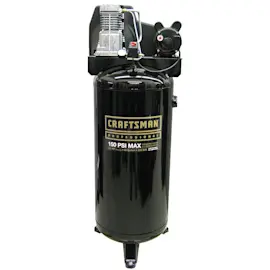
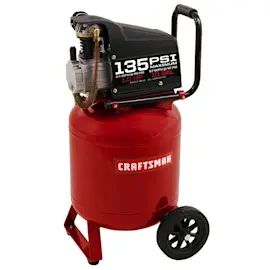
Owner’s manual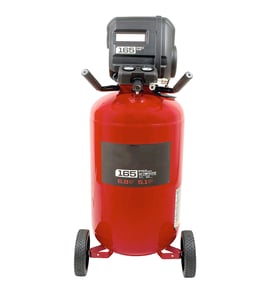

What is the average lifespan of an air compressor?
Most homeowner-grade air compressors last about 10 years with normal use and routine maintenance. For your Craftsman 919195411 air compressor, keeping the pump within the recommended duty cycle and following the maintenance schedule in the owner's manual is what most directly extends service life.
Typical lifespan by compressor type
Lifespan depends more on duty cycle, maintenance, and environment than brand name.
| Compressor type | Typical lifespan | Best fit for |
|---|---|---|
| DIY / portable (pancake, hot dog, small wheeled) | ~10 years | Home projects, intermittent air tools |
| Prosumer / contractor (larger portable) | ~10 to 15 years | Frequent jobsite use |
| Industrial (rotary screw, etc.) | ~20 years | Continuous production environments |
What matters most on the Craftsman 919195411
Your manual notes the pump can run continuously, but recommends maintaining a 50% to 75% average duty cycle (about 30 to 45 minutes of run time per hour) to prolong compressor life.
- Keep run time within the recommended duty cycle
- Drain the tank regularly to reduce internal corrosion
- Check oil level before use (oil-lubricated pump)
- Change oil on schedule and use proper compressor oil
- Keep the air filter clean, especially in dusty areas
- Fix air leaks promptly so the pump does not overwork
Quick maintenance checklist (high impact)
Use this as a practical baseline; then follow the intervals in your manual.
- Before each use: check oil level, look for oil leaks, verify the safety valve works
- After each use: drain the tank
- Regularly: inspect/clean the air filter; check belt condition and alignment
- Anytime: address unusual noise or vibration early
Why it matters
Air compressors usually fail early from overheating (too much run time), dirty intake air, low or incorrect oil, and moisture left in the tank. Staying ahead of those issues helps your Craftsman compressor build pressure faster, run cooler, and avoid premature pump and motor wear.
Last updated: February 2026
How to tell if an air compressor pressure switch is bad?
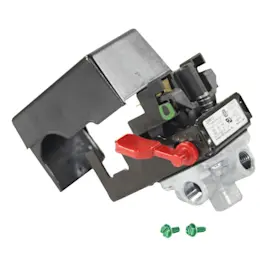
On a Craftsman 919195411 air compressor, a bad pressure switch shows up when the motor does not start at low tank pressure, does not stop at cut-out pressure, or short-cycles. You may also hear the pressure release valve leaking air when it should only hiss briefly after shutoff.
Quick symptoms to watch for
- Compressor will not start even with the On/Auto/Off switch set to ON/AUTO
- Compressor runs but never shuts off (safety valve may pop from overpressure)
- Rapid on/off cycling (short-cycling)
- Stops too soon and leaves low tank pressure
- Burnt smell, heat discoloration, or visible pitting on switch contacts (after power is disconnected)
- Constant leaking from the pressure release valve after the unit reaches cut-out and stops
Simple checks you can do safely
Before any inspection, we unplug the compressor, bleed all tank pressure, and let the unit cool. Then:
- Confirm normal operation basics: The pressure switch should start the motor when tank pressure drops below cut-in and stop it at cut-out.
- Listen at shutdown: A brief hiss from the pressure release valve for a few seconds after the motor stops is normal; air should not keep leaking once the unit is stopped and stable.
- Watch the gauges: Compare tank pressure behavior to what the switch is doing. If tank pressure climbs past normal shutoff and the motor keeps running, the switch is not opening the circuit.
What the symptoms usually point to
| What you observe | Most likely cause | What to do next |
|---|---|---|
| Motor never starts as pressure drops | Pressure switch not closing, or power supply issue | Verify outlet/circuit first; then inspect switch wiring and contacts per the owner's manual |
| Motor will not shut off at high pressure | Pressure switch not opening at cut-out | Turn OFF immediately; have the switch tested/replaced |
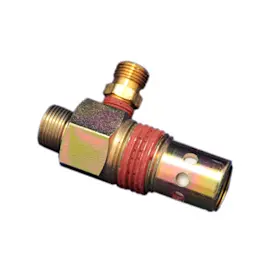
| Constant leak at pressure release valve after shutdown | Check valve leaking back, or release valve issue | Follow how to replace an air compressor check valve steps; re-test |
| Safety valve pops | Switch not shutting off, or cut-out set too high | Turn OFF; service the pressure switch and verify settings |
Why it matters
The pressure switch is the control that starts and stops the motor based on tank pressure. When it fails, you can get hard-start problems, nonstop running, nuisance safety valve popping, and extra wear on the motor, pump, and check valve.
Last updated: February 2026
What does 4.0 SCFM at 90 PSI mean?
On a Craftsman air compressor like model 919195411, “SCFM at 90 PSI” tells you how much air the compressor can deliver while maintaining 90 PSI at the outlet; it is a key number for matching the compressor to air tools. For this model, the manual lists 6.8 SCFM @ 90 PSIG (not 4.0). See the owner's manual.
How to interpret SCFM and PSI (in plain terms)
- SCFM (standard cubic feet per minute) is airflow delivery measured under standardized conditions so you can compare compressors.
- 90 PSI is a common working pressure used to rate many pneumatic tools.
- Higher SCFM at 90 PSI means the compressor can run more demanding tools longer without pressure dropping.
- If a tool needs more SCFM than the compressor can supply, the tank pressure will fall and the tool may slow down.
- Your regulator setting matters; set regulated pressure while air is flowing (tool running), not with the trigger released.
What your Craftsman 919195411 is rated for
The specification chart in the manual lists these air delivery ratings:
| Rating point | Air delivery (SCFM) | What it’s used for |
|---|---|---|
| 40 PSIG | 8.6 | Lighter-duty tools, blow guns, some staplers |
| 90 PSIG | 6.8 | Many nailers, impacts, ratchets (check tool label) |
Quick sizing rule for air tools
Use the tool’s required SCFM at its rated PSI, then add a cushion.
- Good match: tool SCFM is at or below compressor SCFM (with about 20% extra capacity)
- Borderline: tool SCFM is close to compressor SCFM; expect more frequent cycling
- Too small: tool SCFM is higher than compressor SCFM; pressure drop and poor performance are likely
Why it matters
SCFM at 90 PSI is the best “real-world” indicator of whether your compressor can keep up with a tool under load. It helps prevent constant running, pressure sag, and overheating from prolonged excessive use.
If you are troubleshooting low air delivery or pressure drop, use our air compressor won't build tank pressure guide.
Last updated: February 2026
Can you use any air compressor for a nail gun?
Not every air compressor is a good match for a nail gun. With a Craftsman 919195411 air compressor, you need to match the nailer’s required PSI and air flow (SCFM/CFM) and use a regulator and gauge so you never exceed the tool’s maximum pressure rating.
What to match before you connect a nail gun
- PSI requirement: Most nailers run around 70 to 120 PSI; set the regulator to the nailer’s spec.
- Air flow (SCFM/CFM): If the nailer’s SCFM demand is higher than what the compressor can supply, the compressor will run constantly and pressure will drop.
- Tank size and recovery: Small tanks work for intermittent nailing; continuous framing work needs faster recovery.
- Regulator and gauge: The manual calls out using a pressure regulator and pressure gauge at the air outlet (if not equipped).
- Hose and fittings: Leaks and restrictions reduce usable pressure at the tool.
Quick compatibility checklist
Use this as a fast “yes/no” check when pairing a compressor to a nail gun.
| What you check | Good match looks like | If it’s not a match |
|---|---|---|
| Nailer PSI rating | Regulator can be set to the nailer’s PSI | Risk of poor drive or tool damage if set wrong |
| Nailer SCFM at PSI | Compressor output meets or exceeds it | Pressure drop, slow cycling, inconsistent depth |
| Pressure control | Regulator and gauge installed/working | Hard to control pressure safely |
| Air leaks | No hissing at couplers, hose, tank drain | Compressor runs more, nailer performance suffers |
Setup tips for the Craftsman 919195411
- Set regulated pressure while the nailer is firing (under flow conditions), not just at idle.
- Drain the tank daily or after each use to reduce internal moisture.
- Keep the unit in a clean, dry, well-ventilated area and at least 12 inches from walls for cooling air flow.
- Use a properly grounded outlet; if you must use an extension cord, use a 3-wire cord, 50 ft max, and 12 AWG or larger.
Why it matters
A nail gun can seem “compatible” because the fittings connect, but performance depends on stable pressure and enough air flow. When the compressor is undersized or pressure is uncontrolled, you get inconsistent nail depth, more wear on the compressor, and more frequent cycling.
For model-specific operating and safety details, follow the owner's manual. You can also use our DIY guide on air compressor can't adjust the output air pressure if the regulator will not hold a steady setting.
Last updated: February 2026