Installation guide
 Owner’s manual


What is the difference between 4.5 cu ft and 5.0 cu ft washer?
A 5.0 cu. ft. washer has about 0.5 cu. ft. more tub volume than a 4.5 cu. ft. washer, so it fits bulkier loads and can reduce the number of loads you run. Both are considered large capacity; the best choice depends on your typical load size and available laundry space.
- Bulky items: 5.0 cu. ft. handles comforters, blankets, and towel loads with more room to tumble.
- Fewer loads: larger tub can mean fewer cycles for big households.
- Better wash action when loaded correctly: extra space helps prevent tight packing.
- Ergonomics: larger-capacity models are sometimes deeper, which can make reaching the back of the drum harder.
- Installation fit: always confirm the cabinet dimensions and clearances before buying.
Even with a front-load washer like GE model GFWR4800F2WW, overstuffing can reduce cleaning and cause items to get trapped near the door gasket. We follow the loading guidance in the owner's manual to keep wash performance strong and protect the door boot.
| Feature | 4.5 cu. ft. | 5.0 cu. ft. |
|---|---|---|
| Best for | Everyday family loads | Large families, bulky items |
| Load count | More loads for big weeks | Fewer loads for big weeks |
| Risk if overfilled | Poor tumble, less cleaning | Poor tumble, less cleaning |
| Space planning | Often easier fit | May need more depth/clearance |
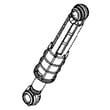
Capacity is about usable drum space, not just “how much you can cram in.” Choosing the right size helps your washer rinse and spin properly, reduces out-of-balance events, and can extend the life of vibration-control parts such as the washer shock absorber WH01X10727.
Last updated: February 2026
Is a 4.8 cubic feet washer big enough for a king size comforter?
Yes. A 4.8 cu. ft. washer is a large-capacity size and is typically big enough for a king-size comforter, as long as you load it loosely so the comforter can tumble and rinse properly. For GE model GFWR4800F2WW, follow the load examples and loading rules in the GFWR4800F2WW owner's manual.
- Shake the comforter out first to loosen clumps and redistribute fill.
- Load it loosely; do not pack it tight against the door glass.
- Add 1 to 2 smaller items (like towels) only if needed to help balance; avoid overfilling.
- Use HE detergent only; too much detergent can cause oversudsing and poor rinsing.
- Choose a bulky/beddding cycle (or the closest equivalent) and use an extra rinse if available.
Capacity is only part of the story. A comforter needs space to lift, drop, and move water through the fabric. Overloading can reduce cleaning performance and can also trap items between the door glass and the door gasket.
| Item | Usually fits in 4.8 cu. ft.? | Best practice |
|---|---|---|
| King comforter (most fills) | Yes | Load loosely; bulky cycle |
| Oversized, extra-thick comforter | Sometimes | Use a laundromat-size machine if it cannot tumble |
| King comforter + full sheet set | Often no | Split into 2 loads for better agitation |
- The comforter stays plastered to the drum wall and does not tumble
- Excess vibration or repeated rebalancing (cycle time keeps extending)
- Detergent residue or suds lingering late in the cycle
- The door gasket area gets pulled or pinched by fabric
When a comforter cannot tumble freely, the washer cannot circulate water and detergent through the layers. That leads to poor cleaning, poor rinsing, longer cycle times, and extra stress on the suspension and door boot.
Last updated: February 2026
Where is the filter on my GE GFWR4800F2WW washing machine?
On the GE GFWR4800F2WW, the serviceable filter is the drain pump filter, and it’s accessed from the lower front of the washer (behind the small access panel at the bottom). You open that panel, then slowly turn the filter cap counterclockwise to remove it.
- Unplug the washer to prevent an accidental start.
- Place a shallow pan and towels under the lower front access area.
- Open the small lower front access panel.
- Turn the filter cap slowly counterclockwise; let water drain out in a controlled way.
- Pull the filter out, remove lint, coins, and debris, then rinse it clean.
- Reinstall the filter by turning clockwise until snug (do not overtighten).
| What you see | What it usually means | What to do |
|---|---|---|
| Water drains out right away | Normal; water remains in the sump | Keep the cap cracked open until flow slows |
| Lots of lint, hair, small items | Restricted drain path | Clean filter and check the pump inlet |
| Filter won’t turn easily | Debris or cross-threading | Apply steady pressure; do not force hard |
| Still not draining after cleaning | Pump or hose restriction | Check the drain hose and consider the pump |
A clogged filter is common, but if the tub still won’t empty, focus on the drain path components:
- Check the drain hose for kinks or a clog.
- Inspect the pump-to-hose connection for debris.
- If the pump hums but doesn’t move water, the pump may be failing.
If you need a replacement, the correct drain pump for this model is the washer drain pump WH23X10051. For step-by-step safety and access details, follow the owner's manual.
Keeping the drain pump filter clean helps prevent no-drain errors, slow draining, standing water odors, and pump damage. It also reduces vibration caused by water not evacuating before spin.
Last updated: February 2026