 Installation guide
 Owner’s manual
What is the most common problem with GE washers?
The most common GE washer problem is a no-spin or weak-spin condition, which customers often notice as clothes coming out wetter than normal. On the GE WHDSR209DAWW, the most frequent causes are load and lid-related (agitation will not start with the lid up) or a worn drive system such as the belt WH1X2026.
Quick checks first (fastest fixes)
- Make sure the lid is fully closed; agitation and spin can stop with the lid up.
- Reduce the load size; bulky loads can prevent proper spin.
- Rebalance the load (especially towels, jeans, and sheets).
- Confirm the water level is appropriate; water should just cover the clothes for good movement.
- Start the washer with detergent first, then add clothes (helps prevent performance issues).
Other common GE washer issues and what they usually point to
| Symptom | What it often means | Common next step |
|---|---|---|
| Won’t spin or agitate | Drive belt worn, lid not closed, drive motor issue | Inspect belt and drive components |
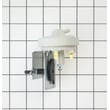
| Won’t fill or fills wrong | Water-level sensing issue | Check the hose pressure switch WH41X365 for kinks or leaks |
| Leaks | Tub seal, hose clamp, or tub/bearing wear | Inspect for drips under the tub and at hoses |
| Loud roaring during spin | Bearing wear | Check for play/noise at the tub and basket |
Why it matters
A washer that cannot spin correctly leaves excess water in clothing, increases dry time, and can strain the motor and tub bearings. Catching a slipping belt, unbalanced load, or water-level sensing problem early helps prevent bigger repairs.
When to use documentation
For model-specific operating steps, loading guidance, and safety notes (including hot-water system precautions), follow the WHDSR209DAWW owner’s manual.
Last updated: January 2026
Where is the filter on my GE Deep Fill washing machine?
On the GE WHDSR209DAWW washer, there is no user-accessible “filter” like you’ll see on many front-load washers. For this model, routine maintenance focuses on the wash basket and hoses, plus checking for drain or fill restrictions if you have slow draining or filling (details in the WHDSR209DAWW owner’s manual).
What you can check on this model (common “filter” confusion)
- Wash basket: Wipe residue and leave the lid open after washing to help moisture evaporate.
- Fill hoses and inlet screens: Sediment can clog the small screens where the hot and cold hoses connect to the washer.
- Drain path restrictions: A kinked drain hose or a partially blocked standpipe can act like a “filter problem.”
- Water level issues: A pressure-sensing problem can mimic a clog; inspect the hose pressure switch WH41X365 if the washer overfills, underfills, or behaves inconsistently.
- Odor and buildup: Regular cleaning prevents musty smells and detergent film.
Quick steps: cleaning the inlet screens (most common “filter” task)
- Unplug the washer.
- Shut off both water supply valves.
- Remove the hot and cold fill hoses from the washer.
- Gently rinse debris from the small inlet screens (do not puncture them).
- Reconnect hoses, turn water back on, and check for leaks.
Symptoms and likely causes
| Symptom | Most likely cause | What to check first |
|---|---|---|
| Won’t fill or fills slowly | Clogged inlet screens, low water pressure | Inlet screens, supply valves |
| Won’t drain or drains slowly | Kinked drain hose, restricted standpipe | Drain hose routing |
| Overfills or wrong water level | Pressure sensing issue | Hose pressure switch WH41X365 and its hose |
Why it matters
When the “filter” is restricted (usually inlet screens or the drain path), the washer can fill slowly, rinse poorly, or leave detergent residue. Keeping the basket clean and the water connections clear helps wash performance and reduces odors.
Last updated: January 2026
How do I find out what size my washer is?
For your GE WHDSR209DAWW washer, “size” means (1) the washer’s capacity (how much laundry it’s designed to handle) and (2) the cabinet dimensions (width, depth, height). The most accurate way to confirm both is to use the model tag and the specifications listed in the WHDSR209DAWW owner’s manual.
Step 1: Confirm the exact model first
GE places the model identification on the washer so you can match the correct spec information.
- Look for the model/serial tag on the back of the washer.
- Verify the model number reads WHDSR209DAWW.
- Record the serial number as well (helpful for parts and service).
- Use the model number to match the correct specifications section in the manual.
Step 2: Identify capacity (practical load size)
This washer uses a load size selector (small, medium, large, super). That selector is the best day to day way to “size” loads correctly.
- Load clothes loosely, not packed down.
- Keep the load no higher than the top row of holes in the basket.
- Choose a water level so the water just covers the clothes.
- If the washer struggles to agitate or the load rides above the waterline, reduce the load.
Capacity categories (typical for top-load washers)
| Category | Typical capacity range | What it means for loads |
|---|---|---|
| Compact | Under 3.5 cu. ft. | Smaller everyday loads |
| Standard | 3.5 to 4.5 cu. ft. | Most mixed loads |
| Large | Over 4.5 cu. ft. | Bulky items, larger loads |
Step 3: Measure the physical dimensions (fit and clearance)
Measure the cabinet with a tape measure so you know it will fit your laundry space.
- Width: left to right across the front
- Depth: front to back (include hoses if space is tight)
- Height: floor to the top (include lid clearance for opening)
Most GE top-load washers are approximately 27 inches wide, 42 to 44 inches tall, and 25 to 29 inches deep. For the exact WHDSR209DAWW dimensions, use the specifications section in the WHDSR209DAWW owner’s manual.
Why it matters
Correct sizing prevents overloading (better cleaning and less vibration) and helps you plan clearance for the lid, water hoses, drain standpipe, and leveling.
Last updated: January 2026


