Owner’s manual
 Error Codes


Can Samsung fridge height be adjusted?
Yes. On the Samsung RF18HFENBSR bottom-mount refrigerator, we adjust height by leveling the cabinet with the front leveling legs; some Samsung models also include a door height adjustment feature to fine-tune door alignment after the refrigerator is level. See the RF18HFENBSR owner's manual for the exact adjustment points on your unit.
How to adjust the height (level the refrigerator)
- Unplug the refrigerator (or switch off power) for safety.
- Pull the refrigerator forward enough to access the front leveling legs.
- Turn the leveling legs to raise or lower the front corners until the cabinet is stable.
- Recheck that the doors close on their own from a partially open position.
- Confirm the doors are even; if your model has a door height adjuster, use it only after leveling.
Quick checks that tell us leveling is needed
- Doors swing open or won’t stay closed
- One door sits higher than the other
- Gaps at the top of the doors look uneven
- The refrigerator rocks when you press on a corner
- Water or condensation appears around the door area
Door height adjustment vs. cabinet leveling
| Adjustment | What it changes | When to use it | What it won’t fix |
|---|---|---|---|
| Leveling legs | Overall refrigerator height and tilt | First step for any alignment issue | A torn or warped gasket |
| Door height adjuster (if equipped) | Fine door-to-door alignment | After the cabinet is level | A sagging hinge or damaged door |
Why it matters
A properly leveled refrigerator helps the doors seal correctly, keeps temperatures stable, and reduces frost and moisture problems. If the doors still do not seal after leveling, inspect the gasket for damage or deformation.
Related part that can affect door sealing
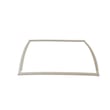
If you find the seal is torn, hardened, or won’t sit flat, replacing the gasket is often the correct fix: Samsung refrigerator door gasket DA63-07733A.
Last updated: February 2026
How to find Samsung fridge part number?
For your Samsung RF18HFENBSR bottom-mount refrigerator, we find the correct part number by matching the model number and the part’s name to the parts diagram and the ID label inside the fresh food section. Use the RF18HFENBSR owner's manual to confirm label location and component names.
Where to look on the refrigerator
Most Samsung refrigerators have the model and serial label inside the refrigerator compartment (not the freezer). Check these common spots first:
- Left interior wall near the crisper drawers
- Side wall near the top shelf area
- Ceiling area inside the fresh food compartment
- Behind the crisper drawers (less common)
- Door jamb area (occasionally)
The fastest way to get the right part number
We recommend this workflow because it prevents ordering the wrong door, gasket, or control board.
- Confirm the model number is RF18HFENBSR (use the full model on the label).
- Identify the part by function and location (example: “right door gasket” or “water inlet valve”).
- Cross-check the part on the exploded-view diagram in the RF18HFENBSR owner's manual.
- Match the diagram callout to the manufacturer part number.
- If multiple versions exist, compare your original part’s sticker numbers and connector style.
Examples of part numbers you might see for this model
These are common replacement items listed for RF18HFENBSR; always match by location and description.
| What you are replacing | What it does | Example part number for this model |
|---|---|---|
| Door gasket | Seals the door to prevent warm air leaks | DA63-07733A |
| Water inlet valve | Controls water flow to ice maker and dispenser | DA62-01477A |
| Electronic control board | Manages cooling and defrost functions | DA92-00420T |
Why it matters
Samsung refrigerators often use similar-looking parts across multiple models. Matching the exact model number and the diagram callout helps avoid fit issues, leaks, cooling problems, and repeat repairs.
Related help
If you are chasing a water or ice issue while identifying parts, use why your Samsung fridge stopped making ice and how to fix it to narrow down whether you need a valve, ice maker module, or a temperature-related component.
Last updated: February 2026
What is the life expectancy of a Samsung refrigerator?
Samsung refrigerators typically last 10 to 15 years. For a Samsung bottom-mount refrigerator like RF18HFENBSR, lifespan depends most on compressor run time, door seal condition, airflow at the condenser, and staying ahead of ice and water system maintenance; see the RF18HFENBSR owner's manual for model-specific care guidance.
Typical lifespan and what affects it
Most refrigerator failures that shorten life come from heat buildup, air leaks, or icing issues.
- Condenser cleanliness and airflow (dust and pet hair raise operating temps)
- Door gasket sealing (warm air leaks force longer run times)
- Defrost and drain performance (ice buildup can block airflow)
- Water filter and inlet valve health (low flow can stress the ice maker system)
- How full the fridge is (overpacked shelves restrict air circulation)
Maintenance that extends life (high impact)
We recommend these habits for Samsung bottom-mount units:
- Vacuum the condenser area and keep rear/under clearance for ventilation.
- Keep fresh food at 37°F and freezer at 0°F (common targets for food safety and efficiency).
- Confirm doors close easily and stay closed; avoid slamming.
- If you see water under drawers or ice in the freezer floor, address the drain early.
- Replace worn sealing parts promptly, such as a Samsung refrigerator door gasket DA63-07733A.
Quick troubleshooting guide: symptom to likely cause
| What you notice | Common cause | What to check first |
|---|---|---|
| Fridge warm, freezer OK | Fresh food airflow problem | Frost behind cover, fan noise, vents blocked |
| Both sections warm | Heat not leaving cabinet | Condenser fan running, coils dusty |
| Water pooling inside | Drain restriction | Drain tube, ice at drain trough |
| Ice maker slow/no ice | Water supply or ice maker issue | Water pressure, filter, valve |
If the ice maker stops, follow why your Samsung fridge stopped making ice and how to fix it to narrow down water supply, temperature, and ice maker module issues.
Why it matters
A refrigerator that runs hot or leaks air can still “work,” but it wears out faster because the compressor and fans run longer. Simple upkeep often adds years of reliable cooling and helps prevent expensive control board or compressor problems.
Last updated: February 2026
Does the Samsung RF18HFENBSR have a filter?
Yes, the Samsung RF18HFENBSR uses water filtration when it is connected to a filtered water source; many installations use an external inline water filter rather than a built-in cartridge. For the exact filter location and replacement guidance for your setup, follow the RF18HFENBSR owner's manual.
What “having a filter” means on this model
On bottom-mount Samsung refrigerators like the RF18HFENBSR, filtration can be set up in two common ways:
- Inline filter on the water supply line (behind the refrigerator or under the sink)
- No filter installed (water goes directly to the ice maker and dispenser, if equipped)
- House filtration system (whole-home or under-sink filter feeding the refrigerator)
Quick checks we use to confirm your filter setup
Use these simple checks before ordering parts:
- Look for a small canister filter on the 1/4-inch water line behind the refrigerator.
- Check under the kitchen sink for an inline filter feeding the fridge line.
- Inspect the fresh food compartment for a twist-in or push-in cartridge housing.
- If ice tastes off or cubes are cloudy, treat it like an unfiltered supply until proven otherwise.
- If water flow is slow to the ice maker, confirm the shutoff valve is fully open and the line is not kinked.
If you want better ice and fewer water system problems
We recommend filtering the water feeding the refrigerator. It improves taste and helps reduce sediment that can contribute to valve and ice maker issues.
Helpful guidance:
- How to replace the water filter in a Samsung refrigerator
- How to install an inline refrigerator water filter
Related parts that affect water and ice performance
If you have low flow, no ice, or intermittent filling, these parts are commonly involved:
| Symptom | Common cause | Part to consider |
|---|---|---|
| No water to ice maker | Valve not opening or restricted | Refrigerator water inlet valve |
| Slow fill or small cubes | Supply restriction, filter restriction, or valve issue | Refrigerator water inlet valve |
| Ice maker not cycling | Ice maker module issue | Refrigerator ice maker module |
Model-matched parts we stock for RF18HFENBSR:
Why it matters
Unfiltered water can carry sediment and minerals that affect ice taste and can contribute to clogs or wear in the water inlet valve and ice maker over time. A properly installed filter helps keep water flow steadier and ice quality more consistent.
Last updated: February 2026