Owner’s manual
 Error Codes


How to remove bottom grille on GE refrigerator?
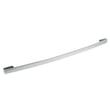
On the GE GNE27EYMNFFS bottom-mount refrigerator, the bottom grille (base grille) typically comes off by removing any retaining screws (if equipped) and then pulling the grille straight out to release the locking tabs. Reinstall by aligning it and pushing it back into place.
- Unplug the refrigerator or switch off power at the breaker to reduce shock risk while working near wiring.
- If you need to roll the refrigerator out, raise the front leveling legs first to protect the floor.
- Pull the refrigerator straight out (not sideways) to avoid floor damage.
- Watch the water line and power cord so you do not pinch or roll over them.
- Look along the top edge or ends of the grille for screws.
- If screws are present, remove them with a Phillips screwdriver.
- Grip the grille at both ends and pull straight outward to pop it off the clips/tabs.
- If it feels stuck, pull one side slightly, then the other; avoid twisting hard so tabs do not crack.
- Line up the grille tabs with the slots on the cabinet.
- Push straight in until it snaps flush.
- Reinstall any screws you removed.
| Item | Why you need it |
|---|---|
| Phillips screwdriver | Removes grille screws (if equipped) |
| Work gloves | Improves grip and protects hands |
| Flashlight | Helps you see hidden screws/tabs |
The bottom grille helps direct airflow across the condenser area. Removing it correctly prevents broken mounting tabs and makes it easier to clean dust buildup that can reduce cooling efficiency.
For model-specific diagrams and access notes, use the owner's manual.
Last updated: February 2026
How to defrost GE GNE27EYMNFFS bottom freezer?
Your GE GNE27EYMNFFS bottom-freezer refrigerator defrosts automatically; for a manual defrost, we recommend moving food to a cooler, turning cooling OFF at the control (touch Freezer and Fridge together for 3 seconds), and leaving the freezer door open until the ice melts, then restarting cooling. See the owner's manual for control details.
- Unplug the refrigerator or switch off power at the breaker (best for safety).
- Remove freezer drawers/baskets so air can circulate.
- Put towels in the bottom of the freezer to catch meltwater.
- Leave the freezer door open; let frost melt naturally.
- Wipe up water as it melts; dry the compartment completely.
- Restore power; set temps back to normal and allow 24 hours to stabilize.
- Do not chip ice with a knife or screwdriver; it can puncture the evaporator.
- Do not use a heat gun or open flame.
- Do not pour boiling water into the freezer.
Heavy frost usually points to an airflow or defrost issue. Check these common causes:
- Door not sealing or door left ajar (warm air leaks in)
- Vents blocked by food packages (poor circulation)
- Freezer drawer not closing fully
- Defrost system problem (heater circuit, thermostat, sensor, or control)
| Symptom | What it often indicates | Example part on this model page |
|---|---|---|
| Thick frost on back wall, weak cooling | Defrost system not clearing ice | Refrigerator defrost bi-metal thermostat WR50X10069 |
| Temps swing, frost patterns seem erratic | Temperature sensing issue | GE profile refrigerator temperature sensor WR55X10025 |
| Repeated cooling/defrost control issues | Control problem | Refrigerator electronic control board WR55X46945 |
A frosted-over evaporator restricts airflow, so the freezer may warm up and the fresh-food section can also lose cooling. Defrosting restores airflow and helps you confirm whether the issue is a one-time door-left-open event or an ongoing defrost failure.
Last updated: February 2026
Does my GE refrigerator have a drain pan?
Yes. Your GE GNE27EYMNFFS bottom-mount refrigerator uses a drain pan (drip pan) to collect water that melts during the automatic defrost cycle; you may even hear water dripping into it during defrost. For this model, the pan is typically not meant to be removed for routine cleaning. See the owner's manual for care and access guidance.
During normal operation, frost melts off the evaporator during defrost and the water flows through a drain tube into the drain pan, where it evaporates.
Why it matters: A working drain system prevents water from pooling inside the fresh food section or leaking onto the floor.
On most newer GE refrigerators like the GNE27EYMNFFS, the drain pan is mounted near the bottom by the compressor area and is fixed in place.
Common signs the drain pan is doing its job:
- You hear occasional dripping or sizzling during defrost
- The pan feels warm at times (heat helps evaporation)
- You do not see standing water under the refrigerator
If you are seeing water where it should not be, the issue is usually a clogged drain tube or ice blockage, not a missing drain pan.
Check these common symptoms:
- Water pooling under the crisper drawers
- A sheet of ice on the freezer floor
- Water leaking from the front of the refrigerator
- Musty odors near the bottom of the cabinet
- Door gaskets not sealing well (adds moisture and frost)
For step-by-step help, use our DIY guide: how to get rid of refrigerator puddles.
| What you see/hear | Usually normal | Usually a problem |
|---|---|---|
| Occasional dripping sound during defrost | Yes | No |
| Small amount of water in pan that later dries up | Yes | No |
| Water collecting inside fridge or freezer | No | Yes |
| Water on the kitchen floor | No | Yes |
If you are diagnosing dispenser or filter-related water issues (not the drain pan), these model-matched parts are commonly involved:
Last updated: February 2026
Why is my GE bottom freezer not freezing?
If your GE GNE27EYMNFFS bottom-freezer is not freezing, the most common causes are incorrect temperature settings, blocked airflow, frost buildup on the evaporator, or a failed cooling component (like the evaporator fan). Set the freezer to the recommended 0°F and allow 24 hours to stabilize. See the owner's manual for the exact control steps.
- Confirm the freezer setpoint is at 0°F (-17.8°C); the factory recommended setting is 0°F.
- Wait 24 hours after any control change for temperatures to stabilize.
- Make sure food packages are not blocking air outlets or vents; blocked vents cause erratic temperatures.
- Check that the freezer door closes fully and seals all the way around.
- Look for heavy frost on the back freezer panel (a sign of airflow restriction).
When the freezer section warms, it is typically an airflow problem (cold air not moving) or a defrost problem (ice blocking the evaporator). These parts are common suspects for this model family:
| Symptom you notice | Most likely area | What to do next |
|---|---|---|
| Freezer warm, fridge also warming | Evaporator fan/airflow | Listen for fan noise; inspect for ice blockage |
| Frost or snow on back freezer wall | Defrost system | Manually defrost, then monitor for refreezing |
| Temps swing up and down | Sensor/control issue | Check for error codes; test sensor/board as needed |
| Ice maker slows, cubes small | Temps not reaching 0°F | Fix freezing issue first, then recheck ice |
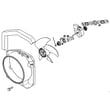
- Evaporator fan issues: If the fan is not moving air across the evaporator, the freezer will not hold 0°F. If you find a damaged blade, replace the hotpoint refrigerator evaporator fan blade WR60X30922.
- Defrost problems: If the evaporator ices over, airflow drops and temperatures rise. A common defrost component is the refrigerator defrost bi-metal thermostat WR50X10069.
- Temperature sensing: A bad sensor can misread temperature and reduce cooling. The GE profile refrigerator temperature sensor WR55X10025 is one example of a sensor used in GE platforms.
- Air distribution: If the damper sticks, cold air may not route correctly. The refrigerator air damper WR60X27396 is a related airflow part.
A bottom freezer that cannot maintain 0°F can lead to thawing and refreezing, poor ice production, and extra compressor run time. Fixing airflow and defrost issues early helps prevent bigger cooling failures.
Last updated: February 2026