Installation guide
 Owner’s manual
 Error Codes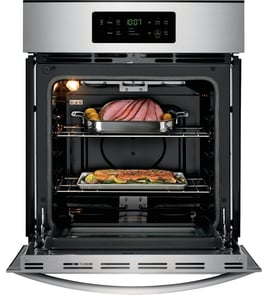




How to reset a GE wall oven?
To reset your GE PT7550EH4ES electric wall oven, cycle power at the home electrical panel: turn the oven’s circuit breaker OFF for about 1 minute, then turn it back ON. This reboots the electronic control and clears many temporary glitches.
- Turn the oven OFF at the control (press Cancel/Off).
- Switch the wall oven circuit breaker to OFF (or remove the fuse).
- Wait 60 seconds.
- Restore power (breaker ON or reinstall fuse).
- Set the clock, then try a simple Bake cycle.
A reset often fixes this, but these checks help narrow it down:
- Breaker/fuse: a tripped breaker or blown fuse can blank the display.
- Clock setting: some feature settings can turn the clock display off.
- Sabbath mode: Sabbath mode can change normal feedback (lights and sounds) and make the oven seem unresponsive.
For the exact key sequences and feature settings on this model, follow the PT7550EH4ES owner’s manual.
This model includes a Default (dEFAULt) option in Special Features that resets special feature settings back to original defaults. Use this when the oven works but settings like tones, temperature offset, or display behavior seem wrong.
| Reset type | What it affects | Best for |
|---|---|---|
| Breaker reset | Reboots control board | Frozen keypad, odd behavior after a surge |
| Special Features Default | Restores feature settings | Incorrect tones, offsets, display settings |
A breaker reset clears temporary control errors, while the Special Features “Default” option restores settings that can make the oven appear to malfunction (for example, clock display changes or mode restrictions).
Last updated: February 2026
What is the best brand for electric wall ovens?
There is no single “best” brand for every kitchen; the best electric wall oven brand is the one that fits your cooking features, reliability expectations, and service availability. For the GE PT7550EH4ES electric wall oven, GE is a strong choice when you want built-in convection features and widely available replacement parts.
Use these factors to compare GE, Bosch, Café, Thermador, and other electric wall oven brands:
- Fit and installation requirements: cabinet cutout, electrical supply, and hard-wiring needs
- Cooking performance: convection type, preheat speed, temperature stability
- Controls and features: probe cooking, special modes, smart features (if included)
- Service and parts support: local technician coverage and parts availability
- Total cost of ownership: purchase price plus typical repair parts over time
GE electric wall ovens are designed to be hard-wired (direct-wired) into an approved junction box; a plug and receptacle is not permitted for this product type. Confirm your electrical and cabinet setup before choosing any brand or model. See the PT7550EH4ES installation guide.
| What you care about most | What to look for in a brand/model | Example parts that support long-term ownership |
|---|---|---|
| Accurate baking | Stable temperature sensing and calibration options | Wall oven temperature sensor WB21X10165 |
| Cooler exterior and electronics protection | Effective cooling airflow and fan control | Wall oven cooling fan assembly WB26X24020 |
| Easy maintenance | Common wear parts available and straightforward access | Door seal, light bulb, hinges |
A wall oven is a long-term built-in appliance; choosing a brand with solid installation documentation, consistent cooking performance, and dependable parts support reduces downtime and helps you keep the oven operating safely and accurately.
Last updated: February 2026
What is the difference between GE and GE Profile wall ovens?
GE Profile wall ovens are positioned as GE’s step-up line; they typically include more premium cooking features (like advanced convection modes, sensor-driven cooking options, and more robust control features) compared with standard GE wall ovens, which focus on core bake and broil performance with fewer built-in enhancements.
While exact features vary by model, these differences show up most often in day-to-day cooking:
- Controls and programming: Profile models more often include expanded cooking modes and deeper programming.
- Cooking performance features: Profile models commonly add enhanced convection systems and specialty modes.
- Convenience features: Profile models more often include extra status indicators and feature toggles.
- Design and finish options: Profile models typically offer more premium styling choices.
- Price and parts cost: Profile models usually cost more upfront; some electronic parts can also be higher cost.
Your GE PT7550EH4ES is a double electric wall oven platform that uses modern electronic controls and convection cooking features (as outlined in the PT7550EH4ES owner’s manual). In practice, that means you should compare another oven to yours by matching:
- Oven size and configuration (single vs. double)
- Convection type and available modes
- Self-clean features and door lock style
- Sensor-based cooking options (probe, temperature sensing)
| Feature area | GE (standard line) | GE Profile (step-up line) |
|---|---|---|
| Cooking modes | Core bake/broil | More specialty modes, more automation |
| Convection | Sometimes basic | More often enhanced convection |
| Controls | Straightforward | More advanced programming and features |
| Fit and finish | Standard | More premium styling options |
When you’re choosing between GE and GE Profile, the biggest difference is how much automation and specialty cooking capability you want. It also affects which parts you may service over time, such as a wall oven temperature sensor WB21X10165 if temperature regulation becomes inconsistent.
Last updated: February 2026
How long do GE wall ovens last?
GE electric wall ovens like model PT7550EH4ES typically last 12 to 15 years with normal household use. Consistent cleaning, good airflow around the cabinet, and fixing small issues early (like temperature problems or a noisy fan) help you reach the upper end of that range.
Most wall ovens fall into a predictable life range; what changes the outcome is heat stress, ventilation, and how often high-heat modes are used.
- Average expected life: 12 to 15 years
- Heavier use (daily baking, frequent self-clean) shortens life
- Poor ventilation in the cabinet increases control and wiring heat stress
- Power issues (surges, loose connections) can damage electronic boards
- Deferred maintenance (door seal leaks, fan noise) accelerates wear
Use these habits to reduce overheating and temperature drift.
- Keep the door seal clean and seated so heat stays in the cavity
- Avoid lining the oven bottom with foil; it can disrupt airflow and heat distribution
- Let the oven cool with the door closed after cooking; the cooling system is designed for that
- If temperatures seem off, test and replace the temperature sensor when needed (common wear item)
- Address cooling fan noise early; a struggling fan can overheat controls
If performance changes, these parts are frequent culprits on wall ovens.
| Symptom | Common cause | Example part for PT7550EH4ES |
|---|---|---|
| Oven temp too hot/cold | Sensor drifting out of range | Wall oven temperature sensor WB21X10165 |
| Loud fan or overheating cabinet | Cooling fan worn or obstructed | Wall oven cooling fan assembly WB26X24020 |
| Door won’t unlock after clean | Latch not moving correctly | Latch assembly WB10X28391 |
A wall oven that runs hot, cool, or overheats the cabinet can shorten the life of expensive components like the control panel and electronic boards. Catching airflow and temperature issues early protects the oven and improves cooking results.
For model-specific care and cleaning guidance, follow the PT7550EH4ES owner’s manual.
Last updated: February 2026