Owner’s manual
 View engine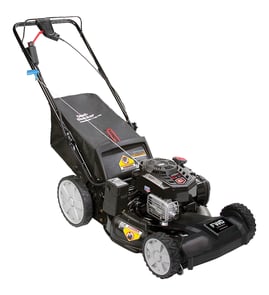

How long can gas sit in a gas can for a lawn mower?
Gas for your Craftsman rotary lawn mower model 917387441 should not be stored from one mowing season to the next; for best starting and to prevent fuel-system problems, use fresh gasoline and replace any gas can that starts to rust. For short-term storage, plan to use fuel within about 30 days unless you treat it with fuel stabilizer.
Practical storage guidelines
- Use fresh gas whenever possible; stale fuel is a common cause of a mower that “does not start.”
- Add fuel stabilizer if the gas will sit longer than a few weeks.
- Store the gas can sealed, in a cool, dry place away from heat sources.
- Replace the gas can if you see rust or dirt inside; contamination causes starting and running problems.
- At season end, do not keep leftover gasoline for next season.
Quick reference table
| Storage situation | What we recommend | Why |
|---|---|---|
| Gas will be used soon | Use within ~30 days | Gas can go stale and cause hard starting |
| Gas may sit 1 to 8 months | Treat with fuel stabilizer and rotate stock | Stabilizer slows breakdown and varnish formation |
| End of season / long storage | Do not store gas for next season | Prevents stale fuel and fuel-system issues |
Why it matters
Stale fuel and contamination (rust, dirt, water) can keep the engine from starting and can cause loss of power. The 917387441 owner guidance also calls out not storing gasoline from one season to another and replacing a rusting gas can, which helps protect the carburetor and fuel passages.
Related owner guidance
For storage steps and seasonal prep details (cleaning, inspection, and storage cautions), follow the 917387441 owner's manual.
Last updated: January 2026
Should I use 87 or 91 gas for lawn mower?
For the Craftsman rotary lawn mower model 917387441, use 87-octane (regular) unleaded gasoline for normal operation. Higher octane (like 91) does not add power in small mower engines; the bigger priority is using fresh, clean fuel and storing it correctly per the 917387441 owner's manual.
What to use (and what to avoid)
- Use: Fresh 87-octane unleaded gasoline from a clean gas can
- Avoid: Old or stale fuel (a common cause of “does not start” issues)
- Avoid: Gasoline contaminated with water, rust, or dirt
- Do not store gasoline from one season to the next
- Replace a gas can that starts to rust (rust and dirt cause fuel system problems)
Quick comparison: 87 vs 91 in a walk-behind mower
| Fuel choice | What you get | Best practice |
|---|---|---|
| 87 octane (regular) | Correct fuel for typical mower engines | Use fresh fuel and keep the container clean |
| 91 octane (premium) | No performance benefit for mowing | Only use if it is the freshest fuel available |
If the mower won’t start after fueling
Stale fuel and fuel contamination are listed causes of no-start conditions. Check these basics first:
- Confirm the tank has fresh fuel
- Check for water in fuel (drain and refill if suspected)
- Inspect the spark plug wire connection
- Replace the spark plug on schedule (yearly is typical)
- Check the air filter for heavy dirt buildup
Why it matters
Using the right fuel is less about octane and more about preventing stale fuel, water contamination, and debris from causing hard starting, rough running, and loss of power. Good fuel habits also reduce carburetor and fuel system issues over time.
Last updated: January 2026
What model number is the Craftsman 917387441?
The model number for this Craftsman walk-behind rotary lawn mower is 917.387441 (often written without the dot as 917387441). You’ll see it printed on the mower’s model tag and on the cover page of the 917387441 owner's manual.
Where to find the model number on the mower
We recommend checking the mower’s identification label first, then matching it to the manual.
- Look for a model tag on the mower deck (top or side of the deck)
- Check near the rear discharge area and handle mounting points
- Wipe off grass and oil residue so the full number is readable
- Record the full model number before ordering parts
- Use the model number (not just engine info) to match diagrams and hardware
Model number vs. engine model number (what’s different)
This mower has its own model number, and the engine has a separate model number. Parts lookup usually starts with the mower model.
| Item you’re identifying | Example for this unit | What it’s used for |
|---|---|---|
| Mower model number | 917.387441 (917387441) | Deck, handle, blade, wheels, controls |
| Engine model number | 143.006200 | Carburetor, recoil starter, engine internals |
Why it matters
Using the correct model number helps us match the right Craftsman diagrams and the exact fasteners and cutting parts for your deck. For example, the blade and mounting hardware can vary by model even when the mower looks similar.
If you’re replacing cutting components, match the part to the mower model first, such as the lawn mower blade 532406713.
Last updated: January 2026
What model number is the Craftsman 917387441?
The model number is 917.387441 (often written without the dot as 917387441). This Craftsman walk-behind rotary lawn mower’s owner’s manual lists the model as 917.387441, which matches the Sears PartsDirect model page for 917387441.
Where to find the model number on the mower
You can confirm the model number on the mower itself by checking common ID locations:
- The model and serial tag on the rear of the deck near the discharge opening
- The tag near the handle mounting brackets
- A label on the top or back side of the mower deck (varies by production run)
- The owner’s manual cover page and parts diagrams
For the official reference, use the 917387441 owner's manual.
Why the dot matters (917.387441 vs 917387441)
Craftsman model numbers are frequently shown in two formats. Both refer to the same mower.
| Format you see | What it means | When you’ll use it |
|---|---|---|
| 917.387441 | Printed manual and some ID tags | Verifying the exact mower identity |
| 917387441 | Online parts lookup format | Searching parts and diagrams |
Why it matters when ordering parts
Using the exact model number helps us match the correct blade, hardware, and control components for your mower.
- Prevents ordering the wrong deck parts for a different 917-series mower
- Ensures the correct blade and blade mounting hardware fit your crankshaft and adapter
- Helps match handle and control parts to the right configuration
If you’re replacing cutting components, match parts by diagram and model, then consider common items like the lawn mower blade 532406713 when it applies to your configuration.
Last updated: January 2026