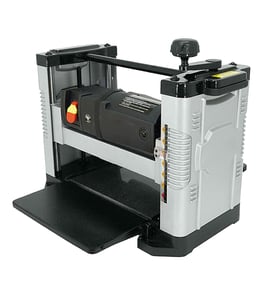

What not to do with a planer?
Don’t use the Craftsman power planer model 315173720 for jobs it isn’t designed to do, or in ways that increase kickback and blade damage. A planer is for thicknessing solid wood that already has one reasonably flat face; misuse can ruin the workpiece and create serious safety hazards.
Avoid these common “don’ts”
- Don’t plane end grain; it can shatter the wood and cause kickback.
- Don’t try to flatten a warped, twisted, or cupped board with only a planer; it tends to follow the existing shape.
- Don’t run plywood, MDF, particleboard, or painted/dirty lumber; glue, grit, and coatings dull knives fast.
- Don’t plane stock that’s too short, too thin, or too narrow to be safely controlled; use proper minimum-size practices.
- Don’t feed wood with loose knots, splits, nails, staples, or screws; projectiles and knife damage are common.
- Don’t take overly deep cuts; it strains the motor, increases snipe, and raises kickback risk.
Safer alternatives for the same goals
| If you’re trying to… | Use this instead | Why it’s better |
|---|---|---|
| Flatten a warped board | Jointer, sled jig, or hand plane | Creates a true reference face first |
| Clean up end grain | Sander, shooting board, or hand plane | Reduces blowout and kickback |
| Size sheet goods | Track saw or table saw | Sheet goods are not planer-friendly |
Quick safety checks before you start
- Unplug the planer before clearing jams, changing knives, or checking the cutterhead.
- Confirm the cutterhead guard and chip ejection path are clear.
- Stand slightly to the side of the infeed/outfeed path.
- Use hearing and eye protection; avoid loose sleeves and gloves near rotating cutters.
Why it matters
Most planer injuries and “mystery” performance problems come from the same root cause: feeding the wrong material or using the planer to do a jointer’s job. Keeping cuts light, stock clean, and technique correct protects the knives, the motor, and you.
For general DIY safety practices that also apply to power tools, see are diy appliance repairs safe.
Last updated: February 2026
What are the parts of a planer?
A planer is built around a flat support surface and a cutter system that removes material to make wood a consistent thickness. For the Craftsman 315173720 power planer, the main parts you’ll deal with are the base/sole, cutter head (drum), blades, depth adjustment, and the drive components that spin the cutter head.
Common planer parts (what they do)
- Base/sole (front and rear shoes): Rides on the workpiece and sets the cut reference.
- Cutter head (drum): Rotating cylinder that holds the blades and does the cutting.
- Planer blades/knives: The cutting edges; dull blades cause tear-out and chatter.
- Depth adjustment knob/lever: Sets how much material is removed per pass.
- Drive belt and pulleys (if belt-driven): Transfers motor power to the cutter head.
- Motor and bearings: Provide rotation and support smooth cutter head spin.
- Chip ejection port and dust chute: Directs shavings away from the cutter head.
Handheld power planer vs. stationary planer
Most customers looking up Craftsman 315173720 are working with a handheld power planer. Here’s how the “parts list” differs from industrial planers.
| Feature | Handheld power planer (like 315173720) | Stationary thickness planer |
|---|---|---|
| Work support | Sole/shoes | Infeed/outfeed tables, bed |
| Cutting system | Cutter head + blades | Cutter head + knives/inserts |
| Feed | You push the tool | Powered feed rollers |
| Common wear items | Blades, belt, bearings | Knives/inserts, rollers, belts |
Why it matters
Knowing the major assemblies helps you troubleshoot faster. For example, snipe or uneven cuts usually point to shoe alignment or technique, while burning, chatter, or tear-out usually points to blade condition or cutter head/bearing issues.
Helpful next step
If you’re not sure you have the exact model, match the tag on the tool to the model listing before ordering parts. Use how to find your appliance model number (and what it means for parts).
Last updated: February 2026
What size planer do I need for woodworking?
For most woodworking, we recommend choosing a planer based on the widest boards you expect to surface; buy the widest capacity you can realistically fit and afford. For a Craftsman power planer like model 315173720, the “right size” is the planer width (inches) that matches your project needs and shop workflow.
How to choose the right planer width
Use your typical stock size and future projects to pick capacity:
- Small projects and trim: 12 to 13 inch planer capacity covers most hobby boards.
- Furniture and wider panels: 15 inch capacity reduces glue-ups and saves time.
- Frequent wide hardwood work: 20 inch capacity is ideal if you routinely mill wide stock.
- Match your jointer (common workflow): Many woodworkers pair planer width to jointer width so both machines handle the same maximum board.
- Plan for snipe control and support: Longer infeed/outfeed support matters as much as width for straight results.
Thickness capacity and cut quality (what matters besides width)
Planer “size” is not only width. These specs affect results and usability:
| What to compare | Typical range | Why it matters |
|---|---|---|
| Max thickness | ~6 in | Determines what stock you can feed safely. |
| Min thickness | ~1/8 to 1/4 in | Helps with thin parts (use a carrier board when needed). |
| Max depth of cut | ~1/16 to 1/8 in per pass | Lighter passes reduce tear-out and motor strain. |
| Feed rate | ~12 to 26 FPM | Slower feed often improves finish; faster feed boosts throughput. |
Quick sizing examples
- If you mostly build shelves, boxes, and small furniture, a 12 to 13 inch planer is the practical sweet spot.
- If you regularly mill rough hardwood for tables or casework, a 15 inch planer is the best step-up.
- If you often work with wide slabs or want fewer glue-ups, a 20 inch planer fits that workflow.
Why it matters
Choosing enough planer width prevents extra glue-ups, reduces wasted material, and keeps your milling process consistent from jointing to planing. The right capacity also helps you avoid forcing oversized stock through a machine, which can lead to poor finish and unsafe operation.
For help confirming you have the correct model number before ordering parts or accessories, use how to find your appliance model number (and what it means for parts).
Last updated: February 2026