
Should I use .030 or .035 MIG wire?
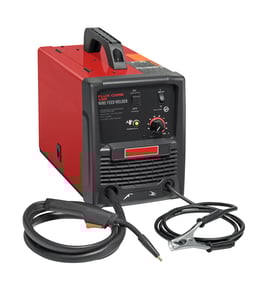
For the Century 117-050 wire-feed welder, use .030 in MIG wire for thin steel and cleaner control, and .035 in MIG wire when you need more fill and penetration on thicker steel. In most home-shop repairs, .030 in is the easiest to tune and least likely to burn through.
Quick pick guide (by metal thickness)
- Up to about 1/8 in steel: choose .030 in for smoother starts and better puddle control
- Around 1/8 in and thicker: choose .035 in if your machine can run it consistently
- Auto body and sheet metal: .030 in (or smaller if your setup supports it)
- Gaps, rusty edges, fit-up issues: .030 in helps you “stitch” and avoid overheating
- Long fillets on thicker brackets: .035 in can build faster when heat is available
What changes when you switch wire size
| What you care about | .030 in wire | .035 in wire |
|---|---|---|
| Arc control on thin metal | Better | Harder to keep cool |
| Deposition rate (how fast it fills) | Lower | Higher |
| Burn-through risk on thin steel | Lower | Higher |
| Typical drive-roll/liner sensitivity | More forgiving | Slightly less forgiving |
Setup checklist (so the wire actually feeds right)
- Match the drive roll groove to the wire diameter (.030 or .035)
- Use the correct contact tip size for the wire
- Keep the liner clean and the gun cable as straight as possible
- Set wire speed first, then fine-tune voltage/heat with test beads
- If the arc stubs or surges, check for a worn tip, dirty wire, or too much drive-roll tension
Why it matters
Wire diameter changes how much metal you push into the weld puddle and how much heat you need to melt it smoothly. On a compact wire-feed welder like the Century 117-050, choosing the right wire size makes dialing in settings faster and reduces spatter, burn-through, and weak cold-lap welds.
Parts and help
If you are shopping for consumables or replacement items for your Century 117-050, start with the model parts list, or search by model number on Sears PartsDirect.
Last updated: February 2026
What does er70s 6 mean in welding wire?
ER70S-6 is an AWS classification for a solid mild-steel filler wire commonly used for MIG (GMAW) welding with shielding gas, including on a Century 117-050 wire feed welder. It tells you the filler type, strength class, and chemistry: ER (electrode/rod classification), 70 (70 ksi tensile class), S (solid wire), and 6 (higher deoxidizers).
What each part of ER70S-6 means
- ER: Filler metal classification that indicates it can be used as an electrode (continuous wire in MIG/GMAW) or as a rod (cut lengths in some processes); it does not mean it is a stick (SMAW) electrode.
- 70: Tensile strength class of the deposited weld metal (about 70,000 PSI, or 70 ksi)
- S: Solid wire (not flux-cored)
- 6: Chemistry with more silicon and manganese deoxidizers than some other ER70S wires
Why the “-6” chemistry matters
ER70S-6 is popular because the added deoxidizers help the weld puddle tolerate light oxidation and mill scale better than lower-deoxidizer wires.
Typical benefits:
- Smoother bead appearance
- More stable arc on mild steel
- Reduced sensitivity to light surface scale (good prep still matters)
Quick comparison (common shop guidance)
| Wire classification | Best use case | Notes |
|---|---|---|
| ER70S-6 | Mild steel with mill scale or slightly oxidized surface | Still clean and degrease for best results |
| ER70S-3 | Cleaner, new steel | Less forgiving on scale and oxidation |
Setup checks that affect results
- Use the correct shielding gas for solid wire (solid wire requires gas)
- Confirm polarity for MIG with solid wire (commonly DCEP)
- If you see porosity, check for drafts, leaks, and gas flow before changing wire
Why it matters
Matching wire classification to your material condition helps you get consistent bead quality and strength from your Century 117-050, and it can reduce spatter and rework.
For parts and model lookups, search your Century 117-050 on Sears PartsDirect.
Last updated: February 2026
How do I find the model number on my 117-050?
The model number is usually on the welder’s rating label (data plate). On the Century 117-050 wire feed welder, check the outside cabinet near the power cord entry, the rear panel, or inside the side cover; match what you find to the format shown in [how to find your appliance model number (and what it means for parts)].
Where to look on a Century wire feed welder
Check these common label locations first:
- Rear panel near the input power cord or strain relief
- Side panel near the wire spool compartment door
- Inside the side cover (unplug first, then remove the cover screws)
- Bottom of the cabinet or base frame
- Near the cooling vents or fan opening
What the label should show
Most rating labels include several identifiers. Use the model number for parts lookup.
| Label item | What it means | What to use for parts |
|---|---|---|
| Model number | The exact product version | Use this (example: 117-050) |
| Serial number | Unique unit identifier | Not used to search parts |
| Input rating | Voltage/amps/phase | Helpful for troubleshooting |
| Output rating | Welding output range | Helpful for setup |
Tips to avoid mix-ups
- Write the model number exactly as printed, including dashes (117-050).
- If you see multiple numbers, choose the one labeled MODEL.
- If the label is worn, take a clear photo with angled lighting to make faint text readable.
Why it matters
Century welders can have similar cabinets but different internal components (wire feed parts, switches, transformer, and wiring). Using the exact model number helps us match the correct diagrams and replacement parts.
Last updated: March 2026