Owner’s manual
 Error Codes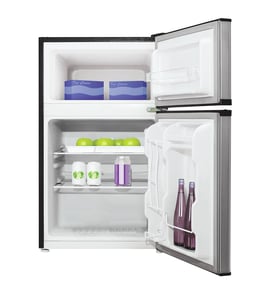

What are the main 5 parts of a refrigerator?
The main five parts that make a refrigerator cool are the compressor, condenser, expansion device, evaporator, and a temperature control (thermostat or sensor). In your Kenmore 25599763 compact refrigerator, these parts work together to move refrigerant and maintain the set temperature (adjusted with the temperature control).
The 5 core cooling-system parts (and what they do)
- Compressor: Pumps refrigerant through the sealed system; it is the “engine” of cooling.
- Condenser (coils): Releases heat to the room as refrigerant condenses.
- Expansion device (capillary tube or valve): Drops refrigerant pressure so it can get cold.
- Evaporator (coils): Absorbs heat from inside the cabinet as refrigerant evaporates.
- Temperature control (thermostat/thermistor): Senses temperature and cycles cooling on and off.
Common “main parts” people also mean (not part of the sealed system)
Many refrigerator problems involve these everyday components rather than the sealed system:
- Door gasket: Keeps warm air out; a poor seal can cause warm temps and frequent running.
- Door switch: Controls the interior light and can affect operation on some designs; see refrigerator door switch 502408000009.
- Control housing/controls: Holds the temperature control and wiring; see refrigerator control box 501108810037.
Quick troubleshooting: which part to suspect
| Symptom | Most likely area | What to check first |
|---|---|---|
| Food too warm | Air leaks or control setting | Door seal, temperature setting, door openings |
| Runs a lot | Air leaks or hot room | Gasket seal, clearances, room temperature |
| Too cold/freezing | Control setting | Adjust to a warmer setting and wait several hours |
| Light issues | Door switch or cover | Switch action, lamp cover fit |
Why it matters
Knowing the “big five” helps you separate sealed-system issues (compressor, coils, refrigerant path) from common serviceable issues like a leaking gasket or a failed switch. For model-specific operating and temperature-setting guidance, use the owner's manual.
Last updated: February 2026
What is the cubic foot of my Kenmore refrigerator model 25599763?
The Kenmore compact refrigerator model 25599763 is a 3.0 cu. ft. unit. You can confirm the capacity and other key specs in the 25599763 owner's manual.
How to confirm the capacity on your refrigerator
We recommend verifying the capacity using the model’s documentation and rating label so you match parts and storage expectations correctly.
- Check the front section of the 25599763 owner's manual for the listed capacity.
- Look for the model and serial label inside the cabinet (typically on an interior wall).
- Compare your unit’s features (freezer compartment, shelves, crisper) to the manual’s parts and features diagram.
- If your door was reversed, capacity does not change, but door alignment and sealing can affect performance.
Why your capacity matters
Capacity affects how the refrigerator cools when loaded, how much airflow you need around the cabinet, and what storage accessories fit best (door racks, guardrails, and shelf layout).
Related specs you may want to check
Here are common specs customers verify alongside cubic feet.
| Spec | What to look for | Where to find it |
|---|---|---|
| Capacity | 3.0 cu. ft. | 25599763 owner's manual |
| Clearance | Side/top/back spacing | 25599763 owner's manual |
| Electrical | 115V, 15A grounded outlet | 25599763 owner's manual |
When capacity seems “off” in real use
If the refrigerator feels like it holds less than expected, the issue is usually usable space, not rated cubic feet.
- Thick packaging or bins taking up space
- Frost buildup in the freezer compartment
- Shelves set too high or too low for your items
- Door not sealing well (warm air reduces effective storage)
If you are troubleshooting a door that will not close or seal, a worn gasket is a common cause; see the refrigerator door gasket 50110871000C.
Last updated: February 2026
What's the average lifespan of a Kenmore refrigerator?
Most Kenmore refrigerators last 12 to 15 years on average. For your Kenmore 25599763 compact refrigerator, good airflow, correct temperature settings, and keeping the door sealing tightly are the biggest factors that help you reach (or beat) that typical lifespan.
What affects refrigerator lifespan the most
A refrigerator usually fails early because it runs too hot, runs too often, or builds excess moisture and frost. Focus on these basics:
- Keep ventilation clearances around the cabinet (especially the back)
- Avoid overloading the door bins and shelves
- Keep the door closed as much as possible
- Clean spills promptly to prevent odors and corrosion
- Make sure the unit sits level so the door closes consistently
Model-specific setup that helps your 25599763 last longer
Your 25599763 is designed for freestanding installation (not built-in). Proper air circulation helps the compressor and sealed system run cooler and longer.
Recommended clearances:
| Location | Typical clearance for this model |
|---|---|
| Sides | 3/4 inch (18 mm) |
| Top | 2 inches (50 mm) |
| Back | 2 inches (50 mm) |
For the full placement and electrical guidance, follow the 25599763 owner's manual.
Quick checks when performance drops
If your compact refrigerator starts warming up, running constantly, or sweating around the door, these checks often pinpoint the cause:
- Confirm the temperature control knob is set correctly (and not loose or broken)
- Inspect the door seal for gaps, tears, or hardened sections
- Verify the door closes squarely and the hinges are not sagging
- Make sure the door switch works so the light turns off when the door shuts
Parts that commonly restore normal operation
If you find a worn or failed component, these model-matched parts are commonly involved:
- Refrigerator door gasket 50110871000C (helps stop warm air leaks)
- Refrigerator door switch 502408000009 (helps ensure the light shuts off)
- Refrigerator hinge 50290504000Y (helps the door align and seal)
Why it matters
A refrigerator that leaks air or lacks ventilation runs longer cycles, which increases wear on the compressor and raises energy use. Keeping the cabinet clearances and door seal in good shape is the simplest way to protect long-term reliability.
Last updated: February 2026