Installation guide
 Owner’s manual
 Error Codes


How do I know what model my dryer is?
Your Amana gas dryer’s model number is printed on the appliance ID label; for model-specific parts and instructions, match that label exactly to NGD5800HW2. On most dryers, the label is easiest to spot when you open the door and look around the door opening.
Where to look on the dryer
Check these common label locations (use a flashlight and wipe dust off the tag):
- Inside the dryer door opening on the front frame
- On the door itself (inside edge)
- On the back of the cabinet near the top
- On a side panel near the front edge
- On gas dryers, behind the lower front access panel (if your model has one)
What to write down (so you get the right parts)
Record the information exactly as shown on the label.
- Model number (example: NGD5800HW2)
- Serial number (helps identify production run)
- Type (gas dryer) and electrical rating (useful for service)
- Any suffix letters/numbers after the model number (do not drop them)
Quick checklist: model number vs. serial number
| Item | What it does | Used for |
|---|---|---|
| Model number | Identifies the design and parts list | Ordering parts, diagrams, manuals |
| Serial number | Identifies your specific unit | Warranty and service history |
Why it matters
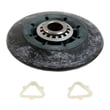
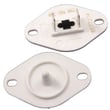
Dryer parts can look identical but fit differently across model revisions. Using the exact model number helps ensure you order the correct items for your NGD5800HW2, such as a dryer drum support roller WPW10314173 or a thermal fuse W10909685, and it also matches the procedures in the NGD5800HW2 owner’s manual.
Last updated: February 2026
How do you know if a thermal fuse is blown on an Amana dryer?
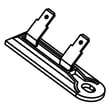
On an Amana NGD5800HW2 gas dryer, a blown thermal fuse commonly shows up as a dryer that will not run at all, or a dryer that runs but has heat problems after an overheating event. The sure way to know is to unplug the dryer and test the fuse for continuity with a multimeter.
Quick symptoms to look for
- Dryer will not start or stops shortly after starting
- Drum tumbles but clothes stay damp (heat is weak or missing)
- Burning smell earlier in the day, then the dryer quit (overheat history)
- Very long dry times (often caused by restricted venting)
The definitive test: continuity check
Use the wiring diagram and component locations in the NGD5800HW2 owner’s manual to access the thermal fuse.
- Disconnect power to the dryer (unplug).
- Access the thermal fuse (typically on the blower housing or exhaust duct area).
- Pull the wires off the fuse terminals.
- Set your multimeter to continuity or lowest ohms.
- Test across the fuse terminals.
How to read the meter
| Meter result | What it means | What to do next |
|---|---|---|
| Beep or near 0 Ω | Fuse is good | Keep troubleshooting airflow, heat, or controls |
| No beep or OL/infinite Ω | Fuse is blown (open) | Replace the fuse and correct the overheating cause |
Fix the cause before replacing the fuse
A thermal fuse usually opens because the dryer overheated. On NGD5800HW2, the most common cause is poor airflow.
- Clean the lint screen and the lint screen housing
- Inspect the vent hose for kinks, crushing, or excessive length
- Clear lint buildup from the wall vent and exterior vent hood
- Confirm the gas supply valve is open (gas models) per the troubleshooting section in the manual
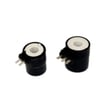
- If the dryer runs but will not heat, also check gas ignition parts such as the thermal fuse W10909685, and for intermittent heat consider the dryer valve coil kit 279834
Why it matters
Replacing a blown thermal fuse without fixing the vent restriction often leads to repeat fuse failures, longer dry times, and higher operating temperatures that can damage other parts like the thermistor or radiant sensor.
Last updated: February 2026
How much does it cost to replace drum bearings on a dryer?
On an Amana gas dryer like model NGD5800HW2, “drum bearing” wear is usually addressed by replacing drum support rollers and related drive parts; typical total cost runs about $150 to $400 with service, or $25 to $75 in parts if you DIY (depending on what’s worn and what you replace together). See the NGD5800HW2 owner’s manual for care steps that help prevent repeat wear.
Typical cost breakdown
- Parts only (DIY): $25 to $75 for common wear items (rollers, idler pulley, sometimes a belt)
- Service labor: about $100 to $300 (varies by local rates and access)
- Service call/diagnostic: often $75 to $125 if charged separately
- If multiple parts are worn: costs rise, but the repair is still usually far less than replacing the dryer
| Scenario | What’s usually replaced | Typical total cost |
|---|---|---|
| DIY refresh | Rollers and idler pulley | $25 to $100 |
| Pro repair | Rollers, idler pulley, inspection and tune-up | $150 to $400 |
| Major rebuild | Multiple drive parts plus additional issues found | $300 to $600 |
Parts that commonly fix “bearing” type noises
If your NGD5800HW2 squeals, rumbles, or thumps, these are the most common wear items we see:
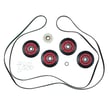
- Dryer drum support roller WPW10314173 (worn flat spots can cause thumping)
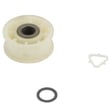
- Dryer idler pulley W10837240 (can squeal or chirp)
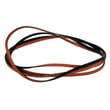
- A belt and other wear hardware (often bundled in a kit)
Why it matters
Worn rollers or an idler pulley can make the dryer louder, increase drying time, and add strain to the motor and drum. Keeping airflow strong also helps overall performance; the manual recommends cleaning the lint screen before each load and cleaning the vent system regularly.
Before you pay for parts or labor
- Confirm the noise type: squeal, rumble, thump, or scraping
- Check for small objects at the front and rear drum edges
- Make sure the dryer is level (vibration can mimic bearing noise)
- Maintain airflow: clean lint screen and keep the vent run short with minimal elbows
Last updated: February 2026