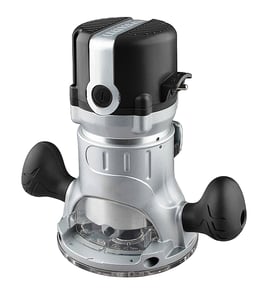

What's the difference between a plunge router and a trim router?
A plunge router and a trim router do different jobs: a trim router is compact for light edge work, while a plunge router uses a spring-loaded base so you can start cuts in the middle of a board (like mortises and inlays). For a Dewalt DW610 router, the key is whether you need plunge-style “drop-in” cutting or simple edge profiling.
Quick comparison
| Feature | Trim router | Plunge router |
|---|---|---|
| Typical use | Edge profiling, roundovers, flush trimming laminate | Mortises, dados, inlays, stopped grooves |
| How the cut starts | Bit is already at set depth before you power on | You lower (plunge) the spinning bit into the work |
| Size and feel | Smaller, lighter, often one-handed | Larger, heavier, usually two-handed |
| Depth control | Good for shallow to moderate passes | Best for controlled depth changes mid-cut |
When a plunge router is the better choice
- Cutting mortises, hinge recesses, or inlay pockets
- Routing stopped grooves where you cannot start from an edge
- Making repeated depth changes using a turret stop (common on plunge bases)
- Working with jigs where controlled entry and exit matters
When a trim router is the better choice
- Rounding over edges and light decorative profiles
- Flush-trimming veneer, laminate, or edge banding
- Quick, small jobs where maneuverability matters
- Working in tight spaces where a full-size router feels bulky
Why it matters
Choosing the right router style affects cut quality and safety. Plunge action helps you start and stop cuts cleanly without tipping the tool, while trim routers reduce fatigue and make edge work faster and more precise.
Helpful DIY reference
If you are troubleshooting power, switches, cords, or intermittent operation on a router, our how to use a multimeter to test electrical parts video is a solid starting point before replacing components.
Last updated: February 2026
What's the best cordless router?
The best cordless router depends on what you build most often, but for most DIY and trim-routing jobs we recommend a compact brushless model with a 1/4-in collet, solid depth adjustment, and a battery platform you already own. Your Dewalt DW610 is corded, so this is a “best alternative” comparison.
Quick picks by use case
- Best all-around compact router: Dewalt 20V MAX XR compact router (DCW600)
- Best for power and runtime: Milwaukee M18 FUEL compact router (2723)
- Best for ultra-compact/light duty: Bosch 12V Max palm edge router (GFK12V-25N)
- Best if you want a plunge-style cordless option: Metabo HPT 36V plunge router (M3612DA)
What to look for (so you do not regret the purchase)
- Collet size: 1/4-in is the most common for cordless trim routers; confirm your bit shanks match.
- Speed control: Variable speed helps prevent burning on hardwoods and plastics.
- Depth adjustment: Micro-adjust plus a clear scale makes repeat passes easier.
- Base options: Fixed base is standard; plunge base is a big upgrade for mortises and inlays.
- Dust collection: Better visibility and cleaner cuts, especially for edge profiling.
Cordless vs corded (DW610) at a glance
| Feature | Cordless compact router | Dewalt DW610 (corded) |
|---|---|---|
| Mobility | Excellent | Limited by cord |
| Sustained heavy cuts | Good, but battery-dependent | Strong and consistent |
| Best tasks | Roundovers, chamfers, light dados | Longer sessions, heavier routing |
| Typical bit size | Mostly 1/4-in shank | Commonly supports larger workloads |
Why it matters
A cordless router is usually chosen for convenience and control on edge work. If you routinely cut deep dados, run large profile bits, or route for long stretches, a corded router like the DW610 typically stays cooler and maintains steadier power.
Helpful related reading
If you are comparing models or trying to match parts and accessories to your tool, use how to find your appliance model number (and what it means for parts) to avoid ordering the wrong item.
Last updated: February 2026
Does DeWalt make a battery-powered router?
Yes. Dewalt makes battery-powered (cordless) routers, including compact trim routers that run on 20V battery platforms. Your Dewalt DW610 is a corded router model, so cordless options are a separate tool line rather than a conversion.
Common Dewalt cordless router types
Most Dewalt cordless routers you will see fall into these categories:
- Cordless compact router (trim router): best for edge profiles, laminate trimming, and light dado work
- Fixed-base cordless router: simple depth setting, good for repeatable edge work
- Plunge-style router: less common in cordless; used for mortises and inlay work
What to check before you buy a cordless router
Cordless routers are convenient, but they behave differently than corded routers like the DW610.
- Battery platform: match the tool to the batteries you already own (for example, 20V systems)
- Collet size: confirm whether you need 1/4-inch bits, 1/2-inch bits, or both
- Runtime expectations: heavier cuts and larger bits drain batteries faster
- Base style: fixed base for edges, plunge base for interior cuts
- Dust collection: helps visibility and reduces cleanup
| Feature | Corded router (like DW610) | Cordless compact router |
|---|---|---|
| Power delivery | Steady under long cuts | Strong for light to medium cuts; depends on battery |
| Best use | Longer sessions, heavier routing | Quick jobs, trim work, portability |
| Convenience | Outlet and cord management | No cord; easier on ladders and in tight spaces |
Why it matters
Choosing the right router type helps you avoid burning bits, chatter, and rough edges. A cordless compact router is excellent for finish work, while a corded router like the DW610 is typically better for extended routing sessions and deeper passes.
Helpful related DIY content
If you are also troubleshooting power or switch issues on a router, our electrical testing basics apply to many power tools: how to use a multimeter to test electrical parts video.
Last updated: February 2026
Which router is better, Bosch or DeWalt?
Neither brand is universally “better”; the best choice depends on the work you do most. For a Dewalt DW610 (a fixed-base router), Dewalt is a strong fit for edge profiling and general routing, while many Bosch options are popular when you specifically need a plunge base for mortises, inlays, and stopped cuts.
Quick way to choose
- Choose Dewalt (DW610-STYLE fixed base) if most of your work is edge routing, roundovers, chamfers, and trimming.
- Choose Bosch if you want a plunge router or a combo kit for frequent plunge cuts.
- Choose the router that matches your bit shank size needs (1/4-inch vs 1/2-inch, model-dependent).
- Choose the tool with the depth adjustment style you can set accurately and repeat.
What to compare (objective features)
- Base type: fixed base, plunge base, or combo kit
- Motor power and speed control: single speed vs variable speed (important for larger bits)
- Collet capacity: 1/4-inch only vs 1/4-inch and 1/2-inch
- Depth adjustment: micro-adjust range, lock strength, and ease of repeat settings
- Dust collection compatibility: port availability and how well it captures chips
- Service items: cord condition, switch, brushes (if applicable), and base wear
Bosch vs Dewalt: use-case comparison
| If your main job is… | A fixed-base router (like DW610) fits best | A plunge-capable router fits best |
|---|---|---|
| Edge profiles on boards | Yes | Optional |
| Flush trimming laminate/veneer | Yes | Optional |
| Mortises, inlays, stopped dados | Not ideal | Yes |
| Frequent depth changes mid-project | OK | Yes |
Why it matters
Matching the base style and bit capacity to your most common cuts improves control and repeatability, and it reduces burning, chatter, and the temptation to take overly deep passes.
If you are buying parts for a DW610
- Confirm the tool label shows DW610 before ordering
- Compare the part diagram to your tool version
- Replace worn cords, switches, and bases promptly for safe operation
For help locating the correct DW610 parts and diagrams, use how to find your appliance model number (and what it means for parts).
Last updated: February 2026