Installation guide
 Owner’s manual
 Error Codes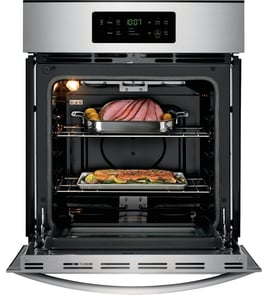




What is the code F27 on a Frigidaire oven?
On the Frigidaire FFET2726TSC electric wall oven, error code F27 points to a communication problem between the oven user interface (control panel) and the oven relay/control board. Start by resetting power; if the code returns, the wiring connections between those boards need to be checked.
- Turn the oven controls to OFF.
- Shut off power at the breaker (recommended) or unplug if accessible.
- Wait 5 minutes.
- Restore power and set the clock.
- Try Bake or Broil again.
These steps align with the “Before You Call” guidance for F or E error codes in the FFET2726TSC owner’s manual.
F27 is most often triggered by an intermittent or failed connection in the low-voltage communication path between the user interface and the relay/control board.
Common causes include:
- Loose plug connection at the user interface board
- Loose plug connection at the relay/control board
- Pinched, damaged, or corroded harness connector
- Failed user interface board
- Failed relay/control board
If you find damaged wiring or overheated connectors, the harness is a common repair path.
| What we check | What it affects | Example part for this model |
|---|---|---|
| Harness connectors fully seated | Prevents communication dropouts | Wall oven wire harness 5304518444 |
| Harness not pinched or heat-damaged | Prevents intermittent faults | Main wiring harness 5304517377 |
When the control boards cannot communicate reliably, the oven may beep, stop heating, or refuse to start a cycle. Fixing the connection issue prevents repeat shutdowns and protects the controls from repeated fault cycling.
Last updated: January 2026
Why are wall ovens not gas?
Most wall ovens, including the Frigidaire FFET2726TSC electric wall oven, are electric because built-in installations are simpler and safer to standardize with a dedicated 240V circuit, grounding, and cabinet cutout requirements. Gas wall ovens add fuel-line routing, combustion ventilation, and leak-testing complexity.
- Simpler utility hookup: a hardwired 240V electrical connection is straightforward for a built-in cabinet.
- Easier code compliance: electrical grounding and circuit sizing are standardized for wall ovens.
- Cleaner cabinet design: no gas piping to route through tight cabinetry.
- Less ventilation planning: gas combustion products can require additional venting considerations.
- More consistent baking: electric elements typically provide even heat for baking and roasting.
Your FFET2726TSC is designed around specific cabinet cutout dimensions and safe electrical installation practices. The installation instructions emphasize measuring the cutout, keeping the oven centered (spacers), and having installation and service performed by a qualified installer. See the FFET2726TSC installation guide.
| Feature | Electric wall oven | Gas wall oven |
|---|---|---|
| Primary hookup | 240V circuit | Gas line plus electrical |
| Built-in cabinet routing | Wiring only | Gas piping plus wiring |
| Venting needs | Typically kitchen ventilation | Combustion ventilation considerations |
| Heat characteristics | Even, steady bake | Strong heat, varies by design |
A wall oven is enclosed by cabinetry, so manufacturers prioritize designs that are repeatable to install, easy to ground correctly, and less likely to create heat or airflow issues in a tight cutout. Following the FFET2726TSC installation guide helps prevent excess heat buildup and protects surrounding cabinets.
Last updated: January 2026
Where is the temperature sensor on a Frigidaire wall oven?
On the Frigidaire FFET2726TSC electric wall oven, the oven temperature sensor is typically mounted inside the oven cavity on the rear wall, with its probe extending into the oven and a small mounting plate held by screws. For model-specific diagrams and access steps, use the FFET2726TSC owner’s manual.
- A thin metal probe sticking into the oven cavity
- A small mounting flange/plate on the back wall
- 1 to 2 mounting screws holding the sensor in place
- A wire harness connection behind the rear wall (accessed from the back of the oven in many installations)
Because the sensor wiring connects to the oven’s control circuit, we recommend these basics before touching the part:
- Turn off power at the breaker (wall ovens are hard-wired and stay energized unless the breaker is off)
- Let the oven cool completely
- Pull the oven forward only as needed and support it properly
- Take a photo of the wire routing and connector before disconnecting
- If the connector slips back into the insulation, use tape or a clip to keep it from falling behind the liner
If you’re troubleshooting inaccurate temperatures, long preheat times, or temperature-related error symptoms, the sensor is a common first check.
| Item | What it does | When it’s suspect |
|---|---|---|
| Cooking appliance oven temperature sensor 5304504897 | Measures oven temperature and reports it to the electronic control | Oven runs too hot/too cool, temps swing widely, baking results inconsistent |
The control relies on the sensor’s resistance signal to regulate bake and broil heat. If the sensor is out of range or the connector is loose, the oven can overshoot, underheat, or cycle erratically, which shows up as uneven cooking and poor temperature accuracy.
Last updated: January 2026