Owner’s manual
 View engine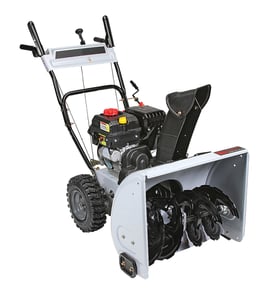



How long does a gas-powered snow blower last?
For the Craftsman gas snow blower model 247883941, the operator’s manual lists an Average Useful Life of 7 years or 60 hours of operation. With consistent seasonal maintenance and proper off-season storage, many gas snow blowers continue running beyond that, but wear items and safety checks become more important.
What “7 years or 60 hours” means
This is a benchmark used for inspection and safety planning, not a hard stop date.
- 7 years is a time-based guideline (age-related wear, corrosion, rubber aging)
- 60 hours is a usage-based guideline (drive system, auger/impeller, engine wear)
- Reaching either milestone means we recommend annual inspections of mechanical and safety systems
| Measure | What to track | Why it matters |
|---|---|---|
| Years | Purchase year or first season used | Rubber parts, cables, seals, and corrosion age over time |
| Hours | Approximate run time each season | Wear increases with load, snow density, and operating time |
| Condition | Performance and noises | Early symptoms help prevent bigger failures |
Maintenance that extends service life
Following the maintenance and storage steps in the owner's manual helps reduce the most common life-shortening problems (fuel system varnish, rust, and drive wear).
- Lubricate the gear (hex) shaft at least once per season or every 25 hours (keep oil off the drive plate and friction wheel)
- Run the machine a few minutes after use to clear snow and help prevent freeze-up
- Check the fuel line, tank, cap, and fittings for cracks or leaks and replace as needed
- For storage over 30 days, run the engine until it stops to remove fuel from the tank (do not pour fuel out)
- Change engine oil before storage and protect rust-prone areas with a light film of oil
Why it matters
A snow blower can still start and throw snow while hidden wear builds in the drive system, cables, and fuel components. Using the manual’s useful-life guideline helps you plan preventive service so the machine stays reliable and safe during peak storms.
Last updated: February 2026
How do I tell what year my snowblower is?
For your Craftsman gas snow blower model 247883941, the most reliable way to identify the year is to read the model and serial number from the ID label on the machine and decode the serial number format shown in the 247883941 owner's manual. If the unit’s label is missing or unreadable, the engine model and code numbers can also help narrow the engine’s build date.
Where to find the model and serial number
On most Craftsman snow throwers, the ID label is on the frame or near the engine area. Look for a sticker or metal tag that lists:
- Model number (you already have 247883941)
- Serial number (this is what you decode for the year)
- Sometimes a manufacturing date or code
- Engine model/type/code (on the engine shroud, valve cover, or muffler shield)
How to decode the year (what to do next)
Use the serial number format for your Craftsman unit and decode the year digit(s). We recommend following the decoding guidance in the 247883941 owner's manual first, then confirming with the engine code if needed.
- Write down the full serial number exactly as shown
- Check whether the serial includes a date-style sequence (some formats embed month and year)
- If your snowblower uses a “character position” format, identify which character indicates the year
- Compare the decoded year with the manual’s covered model family and publication date (the manual set shown includes a form dated June 23, 2017)
- If the snowblower has an engine code, use it as a cross-check for the engine’s build timeframe
Quick reference: what each number tells you
| Number/code | Where you find it | What it helps with |
|---|---|---|
| Model number | Frame ID label | Confirms the exact machine family and parts list |
| Serial number | Frame ID label | Identifies production year (and sometimes month) |
| Engine model/type/code | Engine shroud/cover | Helps estimate engine build date and correct engine parts |
Why it matters
Knowing the year helps us match the correct parts and revisions for your 247883941, especially for wear items that can vary by production run, such as belts, cables, and shear pins.
If you’re already seeing symptoms like weak auger engagement or slipping under load, common maintenance parts to check include the mtd snowblower auger drive belt, 1/2 x 35-1/4-in 256963.
Last updated: February 2026
How to read Craftsman snowblower serial number?
On your Craftsman gas snow blower model 247883941, the serial number is on the product identification label on the machine (not in the engine manual). Use the serial number to identify the production run, and use the model number to match the correct parts list and diagrams in the 247883941 owner's manual.
Where to find the model and serial label
We typically see the identification label on the rear or side of the snowblower frame, near the axle area or the back of the housing.
- Look on the rear of the unit near the wheel axle area
- Check the back of the auger housing (lower front housing)
- Look along the frame rails near the engine mounting area
- Wipe off packed snow, salt, and grime so the label is readable
- Write the serial number exactly as shown (include any letters)
How to “read” the serial number (what it tells you)
The serial number format varies by production run, but it is mainly used to identify when your unit was built and which version you have for parts changes.
| What you have | What it’s used for | When you need it |
|---|---|---|
| Model number (247883941) | Matching diagrams and correct replacement parts | Any time you order parts |
| Serial number | Identifying the production run/version | When parts differ by serial range |
| Date of purchase | Warranty and maintenance records | Service history and documentation |
Why it matters for parts and repairs
Many snowblower parts (belts, cables, shear pins, friction drive components) can change across production runs. Having the serial number helps us confirm you are selecting the correct version when a part listing is split by serial range.
Common parts that can vary by version
- Auger drive belt
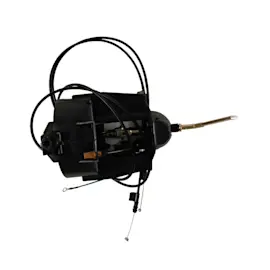
- Auger clutch cable
- Drive cable
- Speed selector cable
- Chute control components
If you are troubleshooting an auger that will not engage, a worn belt is a common cause; the mtd snowblower auger drive belt, 1/2 x 35-1/4-in 256963 is one of the listed auger belt options for this model.
Last updated: February 2026
Is it worth fixing a snowblower?
Yes, it’s worth fixing a Craftsman gas snow blower model 247883941 when the problem is a normal wear item (belt, cable, shear pin, skid shoes) and the machine is otherwise solid; these repairs restore performance and protect major components like the auger gearbox. Use the owner's manual to match the repair to the correct adjustment and safety steps.
Quick decision checklist
- Fix it when the issue is a wear part: auger belt, drive belt, shear pin, control cable
- Fix it when the engine starts and runs smoothly (no persistent stalling or heavy smoke)
- Fix it when the auger or drive problem is isolated (for example, a broken shear pin)
- Replace it when the machine has repeated major failures season after season
- Replace it when the repair involves major drivetrain teardown and the rest of the unit is heavily worn
Common “worth it” repairs for model 247883941
These are the most common repairs that usually make sense because they are straightforward and prevent bigger damage.
| Symptom | Likely cause | Typical fix | Parts to consider |
|---|---|---|---|
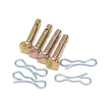
| Auger won’t turn but engine runs | Shear pin sheared | Replace shear pin and clip | Craftsman snowblower shear pin 738-04124A |
| Auger engages poorly or slips | Worn/stretched auger belt | Replace auger belt; re-test auger control | Mtd snowblower auger drive belt, 1/2 x 35-1/4-in 256963 |
| Unit won’t pull itself forward | Friction wheel rubber worn/cracked | Inspect and replace friction wheel assembly if needed | (Browse friction wheel parts for this model) |
Safety and “hidden cost” items to factor in
Why it matters: a low-cost part can prevent expensive damage, but only if the repair is done safely and the controls are adjusted correctly.
- Before cleaning, inspecting, or repairing: stop the engine, wait for auger/impeller to fully stop, then disconnect and ground the spark plug wire
- Check bolts and screws for tightness; loose hardware can cause repeat failures
- Use the correct OEM shear pin; the manual warns against substituting other fasteners
- After belt work, perform the auger control test described in the manual
- If storing 30+ days, run the engine until it stops to remove fuel from the tank (helps prevent carburetor gumming)
A simple rule of thumb
If the repair is a belt, cable, or shear pin and the engine is healthy, fixing your 247883941 is usually the best value. If the repair is a major drivetrain overhaul plus multiple worn systems, replacement is typically the better long-term choice.
Last updated: February 2026