Error Codes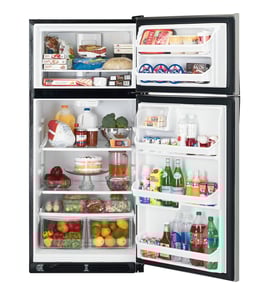






What are the disadvantages of a top mount fridge?
A top-mount refrigerator like the GE GTS19KGNCRWW typically makes you bend more to reach fresh foods, offers fewer convenience features than many bottom-freezer styles, and can feel less organized in the freezer. The tradeoff is usually simpler design and lower purchase cost.
Common disadvantages (what most owners notice)
- Less convenient fresh-food access: the refrigerator section is lower, so you bend more for everyday items.
- Freezer organization can be basic: fewer bins and dividers compared with many bottom-mount designs.
- Fewer built-in features: many top-mount models skip exterior ice and water dispensing.
- More temperature variation: top shelves in the fresh-food section can run a bit warmer than lower shelves.
- Harder to see everything at once: deeper shelves and fewer pull-out features can hide items.
Quick comparison: top-mount vs bottom-freezer
| Feature | Top-mount refrigerator | Bottom-freezer refrigerator |
|---|---|---|
| Fresh-food access | Lower, more bending | Eye-level, easier access |
| Freezer access | Eye-level | Lower drawer, less bending |
| Typical features | More basic | More convenience options |
| Organization | Often simpler | Often more flexible |
Why it matters
If you use fresh foods more than frozen foods, the top-mount layout can feel inconvenient day to day. If you mainly want reliable cooling with fewer “extras,” a top-mount can still be a practical choice.
Tips to reduce the downsides
- Keep everyday items on the upper refrigerator shelves to reduce bending.
- Use clear bins to group snacks, deli items, and leftovers.
- Avoid overpacking; airflow helps keep temperatures more even.
- If you have ice maker or water supply issues, start with the how to diagnose a faulty refrigerator water inlet valve guide.
- For ice production problems, use the common refrigerator ice maker problems and solutions checklist.
Last updated: January 2026
Is top mounted refrigerator better than bottom mounted?
A top-mount refrigerator like the GE GTS19KGNCRWW is “better” when you want strong value, simple reliability, and typically lower purchase and repair costs; a bottom-mount is “better” when you want fresh-food items at eye level and easier access to the refrigerator section.
Quick comparison
- Top-mount (freezer on top): usually lower cost, fewer complex features, efficient layout
- Bottom-mount (freezer on bottom): easier access to fresh food, often wider drawers and better organization
- Best choice: depends on how often you use the freezer vs. fresh-food section
| Feature | Top-mount | Bottom-mount |
|---|---|---|
| Fresh-food access | Bend more | Eye-level, easier |
| Freezer access | Eye-level | Bend more |
| Typical price | Lower | Higher |
| Repair complexity | Often simpler | Often more complex |
| Space efficiency | Very good | Very good, varies |
When a top-mount is the better pick
- You want a straightforward refrigerator with fewer “extras” to maintain.
- You use the freezer often and prefer it at chest or eye level.
- You want a layout that fits tighter kitchens and smaller budgets.
- You prefer simpler service access for common issues like airflow and fan noise.
If you ever run into warm temperatures or unusual noise, the evaporator fan is a common airflow component to check on many top-mount designs; see the evaporator f WR60X31522 if you are diagnosing a fan-related cooling problem.
When a bottom-mount is the better pick
- You cook frequently and want fresh-food shelves and drawers at eye level.
- You store lots of produce and prefer larger, easier-to-reach refrigerator drawers.
- You access the freezer less often than the refrigerator.
Why it matters
Choosing the right configuration affects daily comfort (bending and reaching), food organization, and long-term ownership costs. For many households, a top-mount like the GE GTS19KGNCRWW hits the best balance of simplicity and performance.
Last updated: January 2026
What is the most common problem with a GE refrigerator?
The most common problem we see on GE refrigerators like model GTS19KGNCRWW is a cooling complaint (warm fresh food section, warm freezer, or both). In many cases, the root cause is airflow or heat removal, such as a failing evaporator fan motor, dirty condenser area, or a defrost-related ice buildup.
Quick checks before replacing parts
- Confirm the temperature controls were not accidentally changed.
- Make sure the doors close fully and are not held open by bins or food packages.
- Listen for the evaporator fan in the freezer; it should run when the compressor is running.
- Check for heavy frost on the freezer back wall (often points to a defrost problem).
- Verify the condenser area is not packed with dust and pet hair.
Common causes and what they look like
| Symptom | Most likely area | What you may notice |
|---|---|---|
| Fresh food warm, freezer cold | Airflow from freezer to fridge | Weak airflow at fridge vents, items near vents freeze or stay warm |
| Both sections warm | Heat removal or sealed system | Compressor runs a lot, cabinet sides may feel hot, little cooling |
| Freezer fan noisy or not running | Evaporator fan system | Rattling, squealing, or no fan sound |
| Temps swing, frost builds up | Defrost system | Frost blanket on evaporator area, reduced airflow |
Parts that commonly relate to cooling problems on this model
If your symptoms match, these are model-specific parts we often see involved:
- Evaporator f WR60X31522 (evaporator fan motor) for weak or no airflow
- Refrigerator evaporator fan motor grommet WR02X12008 for vibration or rattling after fan service
- Condenser fan and housing WR17X31476 or refrigerator condenser fan blade WR60X10207 if the condenser fan is noisy, broken, or not moving air
Why it matters
A refrigerator cools by moving heat out of the cabinet. When airflow is restricted (fan issue or frost buildup) or heat cannot be rejected efficiently (dirty condenser area or condenser fan issue), temperatures rise and food quality and safety can be affected.
Helpful DIY guidance
For GE-specific troubleshooting steps, we recommend starting with GE refrigerator error codes if your unit is displaying a code, and using how to fix your evaporator cooling fan when the freezer fan is noisy or not running.
Last updated: January 2026