Installation guide
 Owner’s manual


How to rebalance a Frigidaire washer?
To rebalance your Frigidaire FTF530FS3 washer, stop the cycle, redistribute the load evenly in the drum, then make sure the washer sits firmly on the floor with the leveling legs adjusted. This corrects most thumping and vibration caused by an out-of-balance load.
Quick rebalance steps (what we recommend)
- Press in the cycle selector knob to stop the washer.
- Open the door only after the Door Lock light turns off; wait 1 to 2 minutes if it was spinning.
- Remove a few items if the load is heavy, then spread items evenly around the drum.
- Restart the cycle and listen during spin; a brief thump can be normal, but repeated banging is not.
- If vibration continues, adjust the leveling legs so all four corners rest firmly on the floor.
- Confirm shipping hardware was removed; shipping bolts and the foam block left in place can cause severe vibration.
Leveling and installation checks
Use the installation guide to verify the setup details that directly affect balance.
| Check | What “good” looks like | What happens if it’s not right |
|---|---|---|
| Washer stance | All four feet firmly on the floor | Walking, shaking, loud vibration |
| Load distribution | Evenly spread, not overloaded | Thumping, off-balance spin |
| Shipping hardware | Bolts/spacers/foam block removed | Extreme vibration and noise |
| Drain hose routing | U-shape with an air gap at standpipe | Siphoning, poor draining, odd cycle behavior |
If the washer still shakes during spin
These are the most common next steps for the FTF530FS3:
- Recheck that the load is not overloaded (overloading can cause thumping and hot rubber odors).
- Look for foreign objects (coins, pins) in the drum; if noise persists, objects can be in the pump.
- If the tub seems to bounce excessively even with small loads, inspect the suspension; worn shocks can’t control tub movement.
Helpful parts to consider when vibration is chronic:
- Shock absorber 5304485917 (helps control tub movement during spin)
Why it matters
Running out of balance can damage the tub support system, increase wear on the drive components, and make the washer “walk,” which can strain the drain hose and power cord.
For operating details like stopping, restarting, and safe door unlocking, follow the owner's manual.
Last updated: February 2026
Why is my Frigidaire washer leaking water from underneath?
A leak from underneath on a Frigidaire FTF530FS3 washer is usually caused by a loose fill-hose connection, a drain system issue (hose or pump), or oversudsing that forces water out where it should not. We focus first on hose connections, then the drain path, then door seal and tub-to-pump leaks.
Quick checks that fix most bottom leaks
- Unplug the washer and turn off both water supply faucets.
- Check the hot and cold fill hoses at the faucet and at the washer; tighten connections and confirm the rubber sealing washers are installed.
- Inspect the drain hose for kinks, cracks, or a loose connection; make sure it is secured properly.
- Reduce detergent if you see excessive suds; oversudsing can cause leaks.
- Confirm the dispenser drawer is fully closed during operation.
Most common leak sources on this model
| Where you see water | Most likely cause | What to do next |
|---|---|---|
| Front, near door area | Door boot (bellows) not sealing, debris on seal | Clean the seal and check for tears; replace if damaged |
| Back/bottom during fill | Loose fill hose, missing rubber washer | Tighten and reinstall sealing washers |
| Bottom/center during drain or spin | Drain pump or drain hose leak | Check pump housing and hose clamps; replace leaking part |
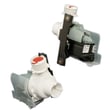
If the leak happens mainly during draining, the drain pump is a prime suspect; for this model, check the pump 137108000 for seepage at the housing or hose ports.
Installation details that can mimic a “leak”
A poorly positioned drain hose can cause siphoning or overflow symptoms. The installation guidance calls for an air gap around the drain hose and a proper U shape when using a standpipe; review the drain hose setup in the FTF530FS3 installation guide.
Why it matters
Bottom leaks can damage flooring and can also lead to washer performance problems (slow draining, poor spin, or error conditions). Fixing the leak source early helps protect the drain pump, wiring, and cabinet base.
Last updated: February 2026
How do I find the model number on my FTF530FS3?
On the Frigidaire FTF530FS3 washer, the model number is printed on the washer serial plate located at the top, inside the door opening. Open the door and look along the upper edge of the opening for the label with the model and serial numbers.
Where to look (quick steps)
- Unplug the washer or keep hands dry and avoid touching wiring while you look.
- Open the washer door fully.
- Look at the top area inside the door opening (the serial plate is mounted there).
- Write down the model number and serial number exactly as shown.
- Take a clear photo of the label for future parts ordering and service records.
What the label typically includes
| Label item | What it’s used for |
|---|---|
| Model number | Matching diagrams and ordering the correct parts for your washer |
| Serial number | Identifying the production run for service and documentation |
| Electrical ratings | Confirming power requirements during installation or troubleshooting |
Why it matters
Using the exact model number helps us match your washer to the correct Frigidaire parts, diagrams, and procedures. Even small model number differences can change components such as the door lock switch, drain pump, or wiring harness.
Helpful reference
For the same location details and record-keeping tips, check the FTF530FS3 owner’s manual.
Last updated: March 2026