
What size spindles are angle grinders?
Most angle grinders use either a 5/8 in.-11 threaded spindle (common on many U.S. grinders) or an M14 x 2.0 threaded spindle (common on many metric grinders). For your Craftsman 315FS3000B angle grinder, confirm the spindle thread by checking the flange nut and measuring the arbor threads before buying wheels or accessories.
Here are the spindle sizes we see most often on right-angle grinders:
- 5/8 in.-11 (UNC) thread
- M14 x 2.0 thread
- M10 x 1.5 (more common on smaller grinders)
- 3/8 in.-24 (less common; often specialty tools)
Use one of these methods to match the thread correctly:
- Look at the accessory packaging: many wheels list “5/8-11” or “M14”.
- Measure the outside diameter of the spindle threads with a caliper.
- Count threads: 5/8-11 has 11 threads per inch; M14 x 2.0 has 2.0 mm pitch.
- Test-fit the flange nut: if it is clearly metric, the spindle usually is too.
- Check for wear or cross-threading: damaged threads can make the wrong size seem like it “almost fits”.
Spindle thread and wheel arbor hole are different specs. This table helps avoid mix-ups:
| Spec you’re checking | What it affects | Example values |
|---|---|---|
| Spindle thread size | What accessories and flange nuts screw onto | 5/8-11, M14 x 2.0 |
| Wheel arbor hole size | What diameter hole the wheel has | 7/8 in., 22.23 mm |
Using the wrong spindle-thread accessory can strip threads, loosen during use, or prevent the guard and flanges from clamping the wheel correctly. Matching the correct thread and the correct wheel arbor hole keeps the grinder running safely and smoothly.
For help confirming the model number on the tool tag before ordering parts, use how to find your appliance model number (and what it means for parts).
Last updated: February 2026
Are all angle grinder discs interchangeable?
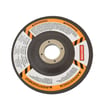
No. Angle grinder discs are only interchangeable when they match your Craftsman 315FS3000B grinder’s wheel diameter, arbor (center hole) size, and maximum RPM rating; you also need the correct disc type for the job (cutting, grinding, flap sanding, wire brushing).
- Disc diameter: Common sizes include 4-1/2 in. (115 mm) and 5 in. (125 mm); the guard and tool are designed around a specific max diameter.
- Arbor size: The disc’s center hole must match the grinder’s spindle (common arbors include 7/8 in. on many small grinders).
- Max RPM rating: The disc must be rated at or above the grinder’s no-load RPM.
- Disc thickness and style: Some guards and flanges fit certain wheel profiles better than others.
- Material and application: Use a wheel made for metal, masonry, or tile as appropriate.
| Check | What you’re looking for | Why it matters |
|---|---|---|
| Size | Same diameter as your grinder’s rated wheel | Prevents guard interference and overspeed risk |
| Hole | Same arbor size as the spindle | Prevents wobble and poor clamping |
| Speed | Disc RPM rating meets or exceeds tool RPM | Prevents wheel failure |
| Type | Cutting vs grinding vs flap vs wire | Prevents kickback and poor results |
- 4-1/2 in. discs on a 5 in. grinder: Often physically possible, but only if the arbor and RPM rating match.
- Cutoff wheel vs grinding wheel: Not interchangeable for use; a cutoff wheel is for cutting, not side grinding.
- Wire cup/brushes: Must match spindle thread and be rated for speed; they can be more sensitive to imbalance.
A disc that “fits” but is the wrong RPM rating, diameter, or wheel type can vibrate, cut poorly, damage the guard/flanges, or fail during use. Matching the specs keeps your Craftsman angle grinder running smoother and safer.
For general DIY safety guidance before tackling repairs or electrical checks on power tools, see are diy appliance repairs safe.
Last updated: February 2026
What are the parts of an angle grinder?
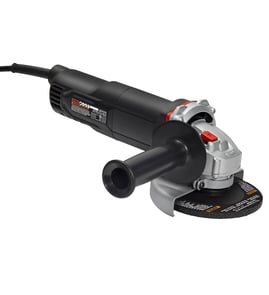
On a Craftsman angle grinder like model 315FS3000B, the main parts include the power switch, motor, gear head, spindle (arbor), wheel guard, and side handle. These components work together to spin the accessory wheel safely and keep the tool controllable during cutting or grinding.
- Power switch/trigger (sometimes with a lock-on button)
- Main handle/body housing (grip and protective shell)
- Side handle (adds control and stability)
- Wheel guard (deflects sparks and debris)
- Spindle/arbor (shaft the wheel mounts to)
- Flange and lock nut (clamp the wheel to the spindle)
- Motor (armature and field) that creates rotation
- Carbon brushes (deliver power to the spinning armature)
- Gear set/gear head (transfers motor speed to the spindle)
- Bearings (support smooth rotation)
- Power cord and internal wiring (deliver electricity to the switch and motor)
| Part | What it does | Common symptom when it fails |
|---|---|---|
| Switch | Turns tool on/off | Won’t start, intermittent power |
| Brushes | Feed power to motor | Runs weak, sparks excessively, stops under load |
| Gears | Drive the spindle | Loud grinding noise, poor power transfer |
| Spindle/flanges | Hold accessory | Wheel loosens, wobble, vibration |
| Guard/side handle | Control and protection | Hard to control, higher injury risk |
Knowing the component names helps you match symptoms to likely problem areas (for example, “won’t start” often points to the switch, cord, or brushes). It also helps you identify the correct diagram section when you are looking up Craftsman 315FS3000B angle grinder parts on Sears PartsDirect.
- Unplug the grinder; confirm the wheel spins freely by hand.
- Inspect the cord for cuts, kinks, or loose strain relief.
- Check the guard and side handle are tight and correctly positioned.
- If the tool has brush caps, inspect brush length and spring tension.
- If you suspect an electrical issue, use a meter to test safely: how to use a multimeter to test electrical parts video.
Last updated: February 2026
Which is better, a 4 inch or 5 inch angle grinder?
A 5-inch angle grinder is better for all-around cutting and grinding because it gives more cutting depth and wheel surface area. A 4-inch grinder is better for control, lighter work, and tight spaces. For Craftsman model 315FS3000B, use the wheel size the tool is designed for; do not oversize the wheel.
| Feature | 4-inch grinder | 5-inch grinder |
|---|---|---|
| Best for | Light cutting, detail work, tight areas | General-purpose cutting and grinding |
| Control | Lighter, easier to maneuver | More leverage, slightly heavier feel |
| Cutting depth | Shallower | Deeper |
| Typical fatigue | Lower | Higher on overhead work |
- Choose 4-inch for thin metal, small brackets, quick touch-ups, and confined areas.
- Choose 5-inch for thicker stock, grinding welds, and faster material removal.
- Match the accessory type to the job: cutoff wheel, flap disc, grinding wheel, wire cup.
- Prioritize guard and handle use; keep the guard installed and use the side handle for control.
- Use the rated RPM wheel for your grinder; never exceed the wheel’s speed rating.
Wheel size is not a “better vs worse” choice if your grinder is built for a specific diameter. Using a larger wheel than the grinder’s rating can prevent proper guard fit and increases kickback risk. If you are unsure what diameter your 315FS3000B takes, confirm it from the wheel/guard markings and the model’s parts information on Sears PartsDirect.
Wheel diameter affects cutting depth, how much torque the wheel can apply, and how controllable the grinder feels under load. Picking the right size for the job improves results and reduces fatigue.
Related safety guidance: are diy appliance repairs safe.
Last updated: February 2026
How deep will a 230mm angle grinder cut?
A 230 mm (9-inch) angle grinder typically reaches about 70 mm (2-3/4 in.) of maximum cut depth in a straight plunge with a new cutoff wheel. Your Craftsman 315FS3000B is a smaller grinder; with a 115 mm (4-1/2 in.) wheel, typical max depth is about 30 mm (1-3/16 in.).
| Wheel diameter | Common grinder size name | Typical max cut depth |
|---|---|---|
| 115 mm | 4-1/2 in. | ~30 mm (1-3/16 in.) |
| 125 mm | 5 in. | ~38 mm (1-1/2 in.) |
| 230 mm | 9 in. | ~70 mm (2-3/4 in.) |
- Wheel wear: as diameter shrinks, depth drops quickly.
- Guard and flange clearance: the guard limits how far the wheel can plunge.
- Wheel type: cutoff wheels usually cut deeper than grinding wheels.
- Cut angle: a 90-degree plunge gives the most depth; angled cuts reduce it.
- Material and technique: binding or flexing reduces effective depth and increases kickback risk.
- Unplug the grinder.
- Install the wheel you plan to use and close the guard.
- Measure the wheel radius (center to edge).
- Subtract the guard and flange offset (commonly about 5 to 10 mm total on small grinders).
Matching wheel size to the material thickness helps you avoid forcing the tool, which reduces binding, kickback, and premature wheel wear.
For general DIY safety guidance before working on power tools, use are diy appliance repairs safe.
Last updated: February 2026