Installation guide
 Owner’s manual
 Error Codes


Where is the model number on a Kenmore side by side refrigerator?
On Kenmore model 10651269102 side-by-side refrigerators, we find the model number on the model and serial number label located on the inside wall of the refrigerator compartment. Open the fresh food door and look along the interior side walls for the rating label.
- Open the refrigerator (fresh food) door, not the freezer door
- Look on the inside wall of the refrigerator compartment
- Check the left and right interior side walls first
- Look near the crisper area and shelf supports if you do not see it at eye level
- Use a flashlight; the label can be easy to miss in low light
The label typically includes both the model number and serial number. Use the model number to match parts and diagrams for your exact Kenmore refrigerator.
| Item on label | What it’s used for | Example format |
|---|---|---|
| Model number | Ordering the correct replacement parts and checking fit | 10651269102 |
| Serial number | Identifying production details for service records | Letters plus numbers |
| Purchase date (your record) | Warranty and maintenance tracking | Your date |
Kenmore side-by-side refrigerators often have similar-looking shelves, bins, and water system parts across multiple models. Using the exact model number helps us match the correct parts list and avoid ordering the wrong item.
For diagrams, part identification, and installation clearances, use the owner's manual.
Last updated: February 2026
What are the most common problems with Kenmore refrigerators?
For Kenmore model 10651269102 side-by-side refrigerators, the most common problems are not cooling well, water or ice dispenser issues, leaks, ice maker problems, and unusual noises. These usually trace back to airflow restrictions, dirty components, door sealing issues, or a defrost or water-supply problem; our owner's manual troubleshooting section helps narrow it down fast.
- Not cooling or warm temperatures: poor airflow, dirty condenser area, evaporator fan issue, or defrost system trouble (frost buildup).
- Water or ice leaking at the dispenser: air in the water lines after filter changes, a cube stuck holding the chute door open, or a supply/filter restriction.
- Ice maker not keeping up: recent heavy ice use (needs up to 24 hours to recover), control settings, or a clogged/incorrectly installed water filter.
- Bad taste or odor in ice: old ice, dirty bin, or food odors transferring due to poor wrapping.
- Doors hard to open: dirty or sticky door gaskets that need cleaning.
- Confirm control settings are correct for normal operation.
- Inspect the water filter: a clogged or incorrectly installed filter can cause low flow, dispenser dripping, leaks, and ice maker fill problems.
- Check for a stuck ice cube in the chute if ice is spilling or the trap door is held open.
- Look for kinks in the home water line and confirm the shutoff valve is fully open.
- Clean door gaskets if doors feel sticky or hard to open.
| Problem you notice | Common system involved | Example part on this model page |
|---|---|---|
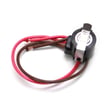
| Frost buildup, warming, cycling issues | Defrost system | Refrigerator defrost bi-metal WPW10225581 |
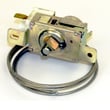
| Temperature control problems | Cold control/thermostat | Refrigerator thermostat WP2198202 |
| Water dispenser or ice maker not filling correctly | Water supply/inlet valve | Refrigerator inlet valve W10822681 |
| Drips, slow water, filter-related leaks | Filter housing and lines | Refrigerator water filter housing WP2186443 |
Catching these issues early protects food, reduces compressor run time, and prevents secondary damage like ice buildup around the evaporator or water leaks that can spread under the refrigerator.
Last updated: February 2026
How to tell if a Kenmore refrigerator compressor is bad?
If your Kenmore 10651269102 side-by-side refrigerator is warm and you hear repeated clicking, constant running with poor cooling, or no compressor sound at all, the compressor circuit is failing or the compressor is locked. Some compressor and fan noises are normal; confirm symptoms against the owner's manual.
- Refrigerator and freezer both warm (not just one section)
- Compressor clicks every few minutes (start attempt then stops)
- Compressor runs a long time but temperatures do not drop
- Compressor is very hot to the touch after trying to run (use caution)
- You hear fans, but there is little or no cold air movement
- You notice intermittent cooling that gets worse over days
- Power and controls: Make sure the unit has steady power and the temperature controls are set correctly.
- Normal sound vs. problem sound: This model can make pulsating or high-pitched compressor sounds and longer run times because it is designed to run efficiently.
- Airflow basics: Verify the evaporator fan is moving air; a failed fan can mimic a compressor problem. If the blade is damaged, replace the refrigerator evaporator fan blade WP2169142.
- Defrost-related icing: Heavy frost buildup can block airflow and cause warm temps; a failed defrost safety can contribute. Consider the refrigerator defrost bi-metal WPW10225581 if you find icing patterns consistent with defrost failure.
| What you observe | Most likely cause | What we do next |
|---|---|---|
| Clicking, compressor not staying on | Start device/capacitor issue or locked compressor | Check compressor start components; inspect wiring |
| Runs constantly, both sections warm | Sealed system or compressor not pumping | Check condenser cleanliness, airflow, then sealed system |
| Freezer cold, fresh food warm | Airflow/defrost/damper issue | Check evaporator fan, frost pattern, vents |
| No sound, no cooling | Power/control issue | Verify outlet, settings, and internal fans |
A true compressor or sealed-system failure affects both compartments and typically worsens over time. Ruling out airflow and defrost problems first prevents replacing high-cost parts unnecessarily.
Last updated: February 2026
How many cubic feet is my Kenmore refrigerator by model number?
Your Kenmore refrigerator model 10651269102 has its exact cubic-foot capacity listed on the model and serial number label inside the fresh food compartment, and it may also be shown in the specifications section of the owner's manual. Using the rating label is the most accurate way to match capacity to your exact configuration.
- Check the model and serial number label on the inside wall of the refrigerator compartment; capacity is often printed with other key specs.
- Look in the specifications or product information section of the owner's manual.
- If the label is hard to read, clean it gently and use a flashlight; take a photo and zoom in.
- If you are measuring for fit, also confirm required clearance space from the manual before moving the unit.
Most Kenmore 106 series side-by-side refrigerators are commonly in the 20 to 26 cu. ft. range. Use this only for rough planning; the rating label gives the exact number for model 10651269102.
| What you are doing | Use this | Why |
|---|---|---|
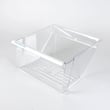
| Ordering shelves, bins, drawers | Model number and part diagram | Parts fit by model, not by cubic feet |
| Checking kitchen fit | Cabinet opening plus clearances | Door swing and airflow matter as much as capacity |
| Comparing refrigerator sizes | Exact cu. ft. from rating label/manual | Prevents buying the wrong size replacement |
Cubic feet helps you compare storage space, but parts compatibility and installation clearances depend on the exact model design. For example, door bins and drawers must match the 10651269102 layout, not a “similar capacity” refrigerator.
Last updated: February 2026
What causes a side-by-side refrigerator to stop cooling?
A Kenmore side-by-side refrigerator model 10651269102 usually stops cooling because power is interrupted, the controls are set incorrectly or need a reset, airflow is blocked, or the unit is in a defrost cycle. We recommend checking the simple items first, then moving to cooling-system components.
- Confirm the cord is fully plugged into a grounded 3-prong outlet.
- Reset the house circuit breaker or replace a blown fuse.
- Make sure the refrigerator and freezer controls are not set to OFF.
- If your model has digital controls, turn the unit OFF then ON to reset.
- Check that air vents in both compartments are not blocked by food packages.
- Allow time after changes; cooling can take time to stabilize after doors are open or warm food is added.
Cold air has to move from the freezer through vents to cool the fresh-food side. If vents are blocked, temperatures rise even if the compressor is running.
| What you notice | Most likely area | What to do next |
|---|---|---|
| Freezer cold, fridge warm | Blocked vents or airflow issue | Clear vents; avoid overpacking; confirm door closes fully |
| Both sections warm, lights on | Control setting, defrost cycle, or cooling system issue | Verify settings; wait 30 minutes for defrost to end; then reset controls |
| Warm temps after install | Normal pull-down time | Allow up to 24 hours to cool completely |
If the basic checks do not restore cooling, these model-compatible parts are often involved in temperature control or defrost-related cooling loss:
- Refrigerator thermostat WP2198202 (temperature control issues)
- Refrigerator defrost bi-metal WPW10225581 (frost buildup leading to poor airflow)
- Refrigerator defrost timer WPW10366605 (defrost system timing problems)
When a refrigerator stops cooling, food safety and compressor run time become immediate concerns. Clearing airflow restrictions and confirming correct control operation prevents unnecessary strain on the compressor and fans.
For the exact control reset steps, vent locations, and troubleshooting guidance for model 10651269102, use the owner's manual.
Last updated: February 2026