Installation guide
 Owner’s manual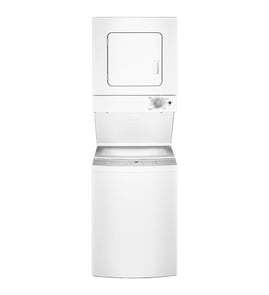




How does a 2 in 1 washer/dryer combo work?
A true 2-in-1 washer/dryer combo washes and then dries in the same drum. Your GE GUD24GSSM1WW is a stacked laundry center (separate washer tub and dryer drum), so you move clothes from the washer to the dryer; both sections can run at the same time. See the GUD24GSSM1WW owner’s manual for cycle basics and operating steps.
How the GE GUD24GSSM1WW laundry center works (model-specific)
In this GE laundry center, the washer cleans and spins to remove water, then the dryer tumbles and heats to evaporate moisture and exhaust it outdoors.
- Washer side: fill, agitate, drain, spin (high-efficiency water levels are normal)
- Dryer side: heated air passes through tumbling clothes, then moist air exits through the vent
- Parallel operation: you can wash one load while drying another
- Key maintenance: clean the dryer lint screen every load and keep the exhaust duct clear
How a true “all-in-one” washer/dryer combo differs
All-in-one combo units use one drum for both steps and handle moisture removal differently depending on design.
| Feature | Stacked laundry center (GUD24GSSM1WW) | True all-in-one combo |
|---|---|---|
| Wash and dry in same drum | No | Yes |
| Transfer clothes needed | Yes | No |
| Drying exhaust | Vented to outdoors | Vented or ventless (condensing/heat pump) |
| Can wash and dry at same time | Yes (separate sections) | No (same drum) |
Why it matters
Knowing whether you have a stacked laundry center or a true combo helps set expectations for drying time, venting requirements, and daily workflow (transfer vs. no transfer). For the GUD24GSSM1WW, proper outdoor venting is critical for safe, efficient drying.
Quick tips for best results
- Don’t overload the washer; better spin-out means faster drying
- Use the correct washer cycle and water temperature for the fabric
- Clean the lint screen before or after each dryer load
- Avoid crushed or kinked 4-inch vent ducting; airflow drives drying performance
- If drying is slow, inspect and clean the exhaust duct and outside hood
Last updated: January 2026
How long should a GE washer and dryer last?
GE doesn’t publish a specific expected lifespan for the GE GUD24GSSM1WW laundry center in the product literature; in real-world use, service life varies widely based on installation, load habits, and maintenance. We focus on the care steps GE does specify to help you maximize longevity.
What we can confirm for GUD24GSSM1WW from GE guidance
From the GUD24GSSM1WW owner’s manual, GE calls out several habits that directly reduce wear and common failures:
- Clean the dryer lint filter before each use
- Avoid overloading; loosely add items for better wash and dry performance
- Use High Efficiency (HE) detergent and measure carefully to prevent oversudsing
- Leave the washer lid open after washing to let moisture evaporate
- Replace washer fill hoses every 5 years
Biggest factors that shorten life (any laundry center)
- Restricted dryer venting (long run times, higher heat stress)
- Chronic overloading (extra strain on belts, motor, and bearings)
- Too much detergent or hard-water buildup (residue, odors, poor rinsing)
- Skipping lint removal (airflow restriction and overheating risk)
- Ignoring early symptoms (squealing, burning smell, slow drain, no-heat)
Quick “repair vs. replace” checkpoints
| Situation | Usually makes sense to do first | Why |
|---|---|---|
| Dryer won’t start | Check door switch and start circuit | Simple, common failure points |
| Dryer runs but won’t heat | Check venting, then heat components | Airflow issues mimic part failures |
| Washer won’t drain | Check for clogs, then pump | Drain restrictions are common |
If your washer won’t drain and you’ve ruled out a clog, the laundry center washer drain pump WH23X26206 is a common repair part on this model.
Why it matters
Because GE doesn’t assign a fixed lifespan to the GUD24GSSM1WW, the best way to plan is to follow the model’s maintenance guidance and address small problems early; that helps prevent heat, moisture, and drive-system damage.
Last updated: January 2026
Why is my GE washer not spinning clothes completely dry?
If your GE GUD24GSSM1WW laundry center washer leaves clothes wetter than normal, the most common causes are an out-of-balance load, a low-spin cycle selection, excess suds, or a drain or drive issue that prevents full-speed spinning. Start with load redistribution and a Drain & Spin cycle as outlined in the GUD24GSSM1WW owner’s manual.
Quick checks that fix most “clothes too wet” complaints
- Redistribute the load evenly; avoid washing one heavy item by itself.
- Run Drain & Spin to re-extract water after rebalancing.
- Confirm you did not select a gentle/delicates cycle for heavy items (lower spin speed).
- Use the right amount of HE detergent; too many suds can reduce spin performance.
- Make sure the lid is fully closed; the washer will not spin properly if the lid is open.
What to check next on GUD24GSSM1WW
The manual for this platform notes that the washer may not reach full spin speed if it cannot balance the load; it may also leave clothes wet if it cannot drain efficiently.
Symptoms and likely causes
| What you notice | What it often points to | What to do next |
|---|---|---|
| Spin and Rinse lights blink; load still wet | Out-of-balance condition | Redistribute load; run Drain & Spin |
| Water remains in tub at end | Drain restriction or weak pumping | Check drain hose for kinks; clear clogs |
| Spins but seems “weak” | Belt slipping or drive issue | Inspect belt for wear/glazing |
| Repeated banging during spin | Suspension not controlling tub movement | Inspect suspension components |
Parts that commonly relate to poor spin-out
If the basic checks do not help, these model-compatible parts are often involved:
- Laundry center washer drive belt WE12X27300 (drives the washer; a worn belt can slip and lower spin speed)
- Laundry center washer drain pump WH23X26206 (pumps water out; slow draining leaves clothes wetter)
- Laundry center washer suspension rod WH16X27181 (helps stabilize the tub; weak suspension can trigger out-of-balance limits)
Why it matters
When the washer cannot balance, drain, or reach full spin speed, more water stays in fabrics. That increases dryer time, energy use, and wear on the laundry center.
Last updated: January 2026