Installation guide
 Owner’s manual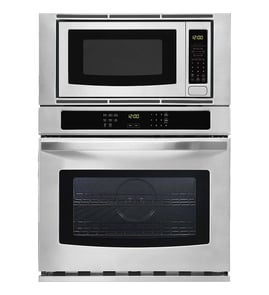


How to use a Frigidaire convection microwave?
On the Frigidaire FGMC3065PFJ wall oven/microwave combo, you use convection cooking by selecting the convection mode, setting a temperature, and letting the unit preheat before you place food inside. Convection uses heating elements plus a fan to circulate heat for faster, more even cooking; follow the steps in the FGMC3065PFJ owner's manual for your exact control-panel sequence.
- Use the convection tray or rack (if your model includes one) so air can circulate around the food.
- Preheat before cooking; convection performance depends on stable, circulating heat.
- Use low-sided pans when possible to improve airflow.
- Expect darker pans to cook faster than shiny pans.
- For single-rack cooking, use a middle rack position; for multi-rack cooking, stagger racks to improve airflow.
In this model family, convection cooking works like this:
- Press the convection function.
- Set the target temperature.
- Press Start; the fan icon typically appears while the oven heats and circulates air.
- When preheat is reached, place food in the cavity and cook.
| Setting | What to expect |
|---|---|
| 170°F to 550°F | Convection temperature range used for baking/roasting |
| 350°F | Common default convection bake temperature |
If your recipe is written for conventional baking, use the convection convert feature (when available) to automatically reduce the set temperature (commonly by 25°F). This helps prevent over-browning while still getting the benefits of fan-driven heat circulation.
- Use convert when the recipe does not already list a convection temperature.
- If you are using timed baking features, watch for “check food” prompts near the end of the cook cycle.
Convection cooking is all about airflow. Using the right rack placement, preheating, and the right bakeware helps the fan circulate heat evenly, which improves browning and reduces hot spots.
Last updated: February 2026
What are the dimensions of the FGMC3065PFJ?
The FGMC3065PFJ is a 30-inch class Frigidaire wall oven/microwave combo; the exact overall width, height, depth, and the required cabinet cutout dimensions are listed in the model’s installation guide. Use that chart to match your opening before installation.
We recommend pulling the numbers directly from the cutout and product-dimensions chart in the installation guide and comparing them to your cabinet.
- Overall product width, height, and depth (appliance size)
- Cutout width, height, and depth (cabinet opening)
- Minimum front clearance for the door when open
- Base support requirement (listed as 225 lb in the guide)
- Junction box location and cable routing clearances
| Measurement | What it controls | Common installation issue if wrong |
|---|---|---|
| Product dimensions | Whether the unit physically fits | Unit will not slide in or sits proud |
| Cutout dimensions | Whether the cabinet opening is correct | Trim will not sit flush, gaps appear |
| Cutout depth (critical) | Whether decorative trim butts to cabinet | Trim does not meet cabinet face |
| Door clearance | Whether the door can open fully | Door hits adjacent cabinetry or island |
Built-in combos like the FGMC3065PFJ rely on precise cutout depth and proper centering so heat does not build up in the cabinet. Verifying the chart first prevents rework, cabinet damage, and door interference.
Last updated: February 2026
What is the average lifespan of a Frigidaire microwave?
A Frigidaire microwave typically lasts 7 to 10 years with normal household use. Heavy daily use can shorten life to about 4 to 5 years, while light use plus good cleaning and airflow can push service life to 10 years or more (including the microwave in model FGMC3065PFJ).
- How often you run it (multiple cycles per day wears door switches, magnetron, and controls faster)
- Running it empty (avoid this; the manual notes food should be in the oven to absorb microwave energy)
- Ventilation (openings must not be blocked; heat buildup shortens component life)
- Door use and slamming (stresses latches and interlock switches)
- Cleaning habits (grease and food soils can cause odors, arcing, and overheating)
- Keep the cavity clean and dry after spills; wipe condensation and splatter promptly.
- Do not block vents; leave clearance around the unit face and keep intake/exhaust paths clear.
- Use microwave-safe cookware; avoid metal where it does not belong.
- Stop cooking if food is smoking or burning; severe overcooking can create damaging heat and residue.
- Close the door gently so the latch and interlocks stay aligned.
| Symptom | Most common cause | What we check first |
|---|---|---|
| Runs but does not heat | High-voltage system issue | Professional diagnosis recommended |
| Dead display/no power | Power supply or control issue | Outlet, breaker, then internal components |
| Starts only with door pressure | Door latch/interlock problem | Door alignment and switch function |
| Stops mid-cycle | Overheat protection or airflow issue | Vents, fan operation, and cabinet airflow |
If you suspect a door safety issue, a common wear item is the microwave door interlock switch 5304493153.
Microwave performance and safety depend heavily on proper airflow and a correctly closing door. Protecting the door latches, keeping vents clear, and avoiding empty operation are the fastest ways to prevent early failures.
For model-specific operating and care guidance, use the FGMC3065PFJ owner’s manual.
Last updated: February 2026