Error Codes



Is GE Cafe considered high end?
Yes. GE Café is considered a high-end (premium) appliance line within the GE brand, positioned above standard GE models and focused on upgraded design, finishes, and feature sets. For a GE refrigerator like model CWE23SP2MHS1, Café styling and options typically reflect that premium tier.
What “high end” means for GE Café
In practical terms, “high end” usually shows up as a mix of design-forward aesthetics and more advanced convenience features.
Common GE Café traits include:
- Premium finishes and hardware options (often with customizable handle styles)
- More feature-rich controls and user interface options
- Enhanced food storage features (lighting, drawers, temperature management)
- Higher price point than mainstream GE lines
- A more built-in, designer-kitchen look compared with standard models
GE Café vs GE Monogram (quick comparison)
Both are premium, but they target slightly different buyers.
| Line | Typical positioning | What you usually get |
|---|---|---|
| GE Café | Premium, design-focused | Customizable style, strong feature set |
| GE Monogram | Ultra-premium, luxury | More “built-in” feel, luxury finishes, flagship options |
Why it matters
Knowing the product tier helps when you are comparing replacement parts, cosmetic components, and feature expectations. For example, premium lines often use model-specific handles, door components, and electronic assemblies.
If you are replacing a component on this refrigerator, match parts by model CWE23SP2MHS1 and the exact part ID. A common example is the refrigerator main control board WR55X46805, which is a key electronic component that can affect cooling performance and user interface behavior.
Last updated: January 2026
What are the disadvantages of a bottom freezer refrigerator?
A bottom-freezer refrigerator like the GE CWE23SP2MHS1 is convenient for fresh-food access, but the tradeoffs are mostly in the freezer layout and ergonomics: you typically bend more to reach frozen items, and deep drawers can make it harder to see and organize smaller packages.
Common drawbacks you may notice
- More bending and reaching for frozen food: drawers sit low, so frequent freezer use can be less comfortable.
- Harder to organize small items: bags and boxes can stack and hide behind each other in a deep bin.
- Less “at-a-glance” visibility: compared with a side-by-side, you often need to pull the drawer out to find items.
- Heavier drawer loads: a fully loaded freezer drawer can feel heavy and awkward to slide.
- Potential for more frost/ice buildup if the drawer is left open: the wide opening can let in humid air.
Bottom freezer vs. side-by-side: quick comparison
| Feature | Bottom freezer | Side-by-side |
|---|---|---|
| Fresh-food access | Easier (eye level) | Moderate |
| Frozen-food access | More bending | Easier (less bending) |
| Finding small frozen items | Can be harder | Often easier |
| Storing wide frozen items (pizza boxes) | Often easier | Often harder |
Tips to reduce the downsides
- Use bins or baskets inside the freezer drawer to separate categories (meat, veggies, snacks).
- Put “daily use” frozen items in the top basket (if equipped) to reduce bending.
- Avoid overpacking; airflow and visibility both improve when the drawer closes easily.
- If you see water or ice around the freezer area, follow a proven cleanup and prevention routine in how to get rid of refrigerator puddles.
Why it matters
Most shoppers choose bottom-freezer designs for better fresh-food ergonomics, but if your household uses the freezer constantly, the drawer-style layout can feel less efficient than shelves. Matching the layout to how you cook and shop prevents frustration later.
Last updated: January 2026
What is the most common problem with a GE refrigerator?
The most common GE refrigerator complaint is not cooling properly (fresh food warm, freezer soft, or temps swinging). On GE model CWE23SP2MHS1, the fastest wins are checking airflow, cleaning the condenser area, and confirming the evaporator fan is running.
Quick checks we recommend first
- Confirm the controls are set to normal temps (about 37°F fresh food and 0°F freezer).
- Make sure vents are not blocked by food packages (air must circulate).
- Check that doors close and seal fully; a small gap can cause warm temps and frost.
- Listen for the freezer evaporator fan; no fan airflow often means poor cooling.
- Vacuum dust from the condenser area (restricted heat release reduces cooling).
Other common GE refrigerator problems (and what they usually point to)
| Symptom | Most common cause | What to check next |
|---|---|---|
| Not cooling or weak cooling | Airflow issue or failed fan/sensor | Fan noise, frost buildup, vent blockage |
| Strange noises | Fan hitting ice or normal compressor sounds | Ice buildup near fan, level cabinet |
| Ice maker not working | Water supply or filter restriction | Filter age, water pressure, inlet valve |
| Water dispenser slow | Clogged filter or air in line | Replace filter, purge air |
| Water leaking | Defrost drain issue or loose water line | Puddles location, drain pan, tubing |
| Door not closing | Misalignment or gasket issue | Leveling, hinge play, gasket tears |
| Lights not working | Door switch issue | Switch click, interior lights response |
Parts that commonly relate to these symptoms on CWE23SP2MHS1
If troubleshooting points to a component, these are frequent culprits for cooling and water issues:
- Refrigerator temperature sensor WR55X10025 (temperature feedback problems)
- Freezer evaporator fan WR60X35669 (no airflow from freezer to fresh food)
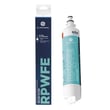
- GE refrigerator water filter RPWFE (slow dispense, ice maker fill issues)
- Refrigerator water inlet valve assembly WR57X27517 (no water to dispenser or ice maker)
Why it matters
A refrigerator that is even 5 to 10°F too warm can spoil food faster, create excess frost, and overwork the compressor. Catching airflow, filter, or fan issues early often prevents bigger repairs.
Helpful DIY guides
- GE refrigerator error codes
- How to fix your evaporator cooling fan
- How to replace the water filter in a GE refrigerator
Last updated: January 2026