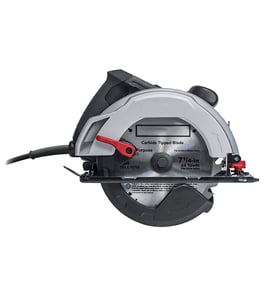

Where is the spindle lock on a Craftsman circular saw?
On most Craftsman circular saws (including model 30610291), the spindle lock is a small push-button on the motor housing near the blade and arbor bolt. Press and hold it while you turn the arbor bolt to lock the blade for removal or installation.
What to look for on model 30610291
The spindle lock is typically:
- On the top or side of the upper blade guard or motor housing
- Close to the arbor (the center of the blade)
- A round or slightly raised button you press inward
- Used only when the blade is stopped (never while the blade is spinning)
How to use the spindle lock to remove the blade
- Unplug the saw (corded) or remove the battery (cordless).
- Retract the lower blade guard and locate the arbor bolt at the center of the blade.
- Press and hold the spindle lock.
- Turn the arbor bolt with the correct wrench until the lock “catches” and the blade stops rotating.
- Keep holding the lock and loosen the bolt fully, then remove the outer washer and blade.
Blade bolt direction (quick reference)
Because some circular saws use a reverse-thread arbor bolt, use this table as a safe way to confirm direction:
| What you do | What you should see | What it means |
|---|---|---|
| Press spindle lock and try turning the bolt | Blade wants to rotate instead of bolt loosening | Lock is not fully engaged; rotate blade slightly and try again |
| Bolt loosens when turned one direction | Bolt backs out smoothly | That is the correct loosening direction for your saw |
| Bolt tightens quickly | Bolt draws in and clamps harder | Turn the opposite direction to loosen |
Why it matters
Using the spindle lock correctly prevents stripped threads, damaged washers, and bent blades. It also keeps the motor shaft from twisting while you apply torque to the arbor bolt.
Related DIY help
If you need to troubleshoot power issues before servicing the saw, use how to tell if a fuse is blown.
Last updated: February 2026
Why is my Craftsman circular saw not spinning?
If your Craftsman circular saw model 30610291 powers on but the blade is not spinning, the most common causes are worn motor brushes, a jammed blade or guard, a failed switch, or an electrical problem in the cord or wiring. Start with the simple mechanical checks, then move to electrical tests.
Quick checks (fastest fixes first)
- Unplug the saw and confirm the blade spins freely by hand (no binding).
- Check the lower blade guard; it should move smoothly and return fully.
- Inspect the arbor area for packed sawdust, pitch, or debris that can lock the blade.
- Verify the blade is installed correctly and the arbor nut is tight (but not overtightened).
- If the saw has a spindle lock, make sure it is not stuck partially engaged.
Electrical causes that stop the motor from turning
Worn motor brushes are a top failure point on many brushed circular saw motors. When brushes are too short, cracked, or burned, they stop making solid contact with the armature, so the motor may hum, spark excessively, or do nothing.
Other common electrical causes include:
- Bad trigger switch (intermittent or no power to the motor)
- Damaged power cord (internal break near the plug or strain relief)
- Loose or burned wire connection inside the handle
- Open thermal protector (some motors use internal overheat protection)
How to narrow it down (symptom guide)
| What you notice | Most likely cause | What to check next |
|---|---|---|
| Motor hums but blade does not move | Jammed blade, seized bearing, debris in guard/arbor | Free-spin test, guard movement, arbor cleanup |
| No sound, no movement | Switch, cord, wiring connection | Cord inspection, switch continuity test |
| Runs only if you wiggle the cord | Broken cord conductor | Inspect cord at plug and handle entry |
| Heavy sparking or intermittent running | Worn motor brushes | Inspect brush length and spring tension |
Why it matters
A circular saw that will not spin is often a simple wear item (like brushes) or a safety-related bind (guard or arbor debris). Fixing the root cause prevents overheating, switch damage, and unsafe kickback conditions.
For safe electrical troubleshooting steps, we recommend using a meter and following a proven process like how to use a multimeter to test electrical parts video.
Last updated: February 2026
What size blade is a Craftsman 30610291 circular saw?
For the Craftsman 30610291 circular saw, the correct blade size is the maximum blade diameter and arbor (center hole) size listed on the saw or on the installed blade. Craftsman circular saws commonly use 5-1/2 inch, 6-1/2 inch, or 7-1/4 inch blades, so confirming the marking on your specific saw is the safe way to match the blade.
How to confirm the blade size on model 30610291
Use these quick checks before you buy a replacement blade:
- Look for a "MAX BLADE" marking on the upper blade guard.
- Read the diameter printed on the current blade (for example, 6-1/2 in).
- Measure the blade across the widest point (tip to tip) if markings are worn.
- Check the arbor size printed on the blade (common sizes include 3/8 in, 5/8 in, or 20 mm).
- Verify the blade is rated for the saw’s RPM (printed on the saw label or guard).
Blade specs to match (not just diameter)
A blade that fits correctly matches diameter, arbor, and type.
| Spec | What to match | Why it matters |
|---|---|---|
| Blade diameter | Must be at or under the saw’s max | Oversize blades can contact the guard and reduce safety |
| Arbor (center hole) | Must match the saw’s arbor | Prevents wobble, vibration, and unsafe mounting |
| Blade type | Wood, plywood, metal, masonry (as labeled) | Wrong blade increases kickback risk and poor cutting |
| Tooth count | Lower for fast rough cuts; higher for smoother cuts | Controls speed vs. finish quality |
Why it matters
Using the correct maximum diameter and arbor size keeps the blade fully guarded and properly clamped. That reduces binding and kickback risk, improves cut accuracy, and helps protect the motor and bearings.
Helpful DIY reference
If you need to diagnose a saw that will not start after a blade change, use how to tell if a fuse is blown for basic electrical checks.
Last updated: February 2026
How to tighten a Craftsman circular saw blade?
On the Craftsman 30610291 circular saw, you tighten the blade arbor bolt by locking the spindle and turning the bolt clockwise (standard right-hand thread). Unplug the saw first; then snug the bolt firmly so the blade seats flat and runs true.
Steps to tighten the blade safely
- Unplug the saw (or remove the battery on cordless versions).
- Set the saw on a stable surface with the lower guard able to move.
- Press and hold the spindle (arbor) lock button.
- Rotate the blade by hand until the lock engages and the blade stops.
- Use the supplied wrench to turn the arbor bolt clockwise to tighten.
- Release the lock; spin the blade by hand to confirm it turns freely with no wobble.
Direction guide (what to turn and why)
Most Craftsman circular saws use a standard right-hand threaded arbor bolt.
| Thread type (typical) | Tighten | Loosen |
|---|---|---|
| Right-hand thread | Clockwise | Counterclockwise |
Quick confirmation
- If turning clockwise tightens and the bolt stops backing out, you are going the correct direction.
- If the bolt is not tightening, re-engage the spindle lock and make sure the wrench is fully seated on the bolt head.
If the blade still feels loose
- Remove the blade and clean sawdust or pitch off the inner and outer flanges.
- Confirm the blade arbor hole matches the saw arbor size and the blade is installed in the correct orientation.
- Inspect the outer flange and arbor bolt for rounding, cracks, or heavy wear.
- Check the blade for warping; a bent blade can feel like a loose mount.
Why it matters
A properly tightened blade reduces vibration and improves cut accuracy; it also helps prevent binding and kickback caused by a shifting blade.
For general DIY safety practices before working on tools, review are diy appliance repairs safe.
Last updated: February 2026
