Owner’s manual
 Error Codes



How to remove bottom grille on GE refrigerator?
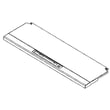
On the GE GFE28GSKKSS bottom-mount refrigerator, the bottom grille (base grille) typically comes off by removing any retaining screws (if present) and then pulling the grille straight out to release the locking tabs. Reinstall by aligning it and pushing it back into place.
- Unplug the refrigerator or switch off power at the breaker (safer when working near wiring).
- Pull the refrigerator straight out if you need more room; avoid dragging it sideways.
- Raise the front leveling legs slightly if the grille is tight against the floor.
- Keep a Phillips screwdriver handy in case your grille uses screws.
- Look along the top edge or corners of the grille for Phillips-head screws.
- If you see screws, remove them and set them aside.
- Grip the grille near both ends.
- Pull the grille straight toward you to pop it free from the clips or tabs.
- If it resists, wiggle gently side-to-side while pulling; do not pry hard against the plastic.
- Line up the grille tabs with the slots in the cabinet.
- Push the grille straight in until it snaps flush.
- Reinstall any screws you removed.
| What you notice | What to do |
|---|---|
| Grille will not budge | Confirm all screws are removed; pull straight out from both ends evenly |
| Bottom edge is catching the floor | Raise leveling legs slightly, then try again |
| Plastic feels like it is bending | Stop and reposition your grip closer to the clips; pull gently |
We remove the base grille to access and clean the condenser area, check for debris, and reach lower-front components. A grille that is not seated correctly can rattle and may reduce airflow.
For model-specific diagrams and handling notes, use the GFE28GSKKSS owner's manual. If you need to look up replacement parts by model, we recommend starting with the parts list for this model, or searching by model number on Sears PartsDirect.
Last updated: February 2026
What is the most common problem with a GE refrigerator?
The most common problem we see with GE refrigerators (including the GE GFE28GSKKSS bottom-mount refrigerator) is a cooling complaint: the fresh food section gets warm, the freezer temperature drifts, or the unit runs constantly. In many cases, the cause is restricted airflow or heat transfer, not a failed compressor.
- Dirty condenser coils causing poor heat removal and longer run times
- Evaporator fan not moving cold air through the refrigerator
- Air vents blocked by overpacked food (especially in the fresh food section)
- Door not sealing well, letting warm, moist air in
- Defrost system issues leading to frost buildup and blocked airflow
- Temperature sensor or control issue causing incorrect cycling
- Confirm settings: Make sure temperature controls are set to normal mid-range values (see the GFE28GSKKSS owner's manual).
- Check airflow: Clear items away from interior vents; leave space around the back wall.
- Inspect door seal: Look for gaps, tears, or areas that do not grip paper when the door is closed.
- Listen for fans: You should typically hear a fan running at times when the compressor is on.
- Clean condenser area: If accessible, remove dust from the condenser coil and grille area.
| Symptom | Most likely cause | What to do next |
|---|---|---|
| Fridge warm, freezer OK | Airflow issue in fresh food section, damper/vent blockage | Clear vents, avoid overfilling, verify fan operation |
| Freezer warm, fridge warm | Dirty condenser coils, evaporator fan issue, sealed system problem | Clean coils, check for fan noise, look for error codes |
| Frost on back wall inside freezer | Defrost problem restricting airflow | Defrost fully, then monitor for repeat frost buildup |
| Runs all the time | Dirty coils, door leak, warm room, frequent openings | Clean coils, check gasket, reduce door openings |
Cooling problems make the compressor and fans run longer, which can shorten component life and lead to food spoilage. Catching airflow and coil issues early is one of the simplest ways to keep the GFE28GSKKSS running efficiently.
If you need replacement parts for your GE GFE28GSKKSS, use the parts list for this model, or search by model number on Sears PartsDirect.
Last updated: February 2026
What are the disadvantages of a bottom freezer refrigerator?
Bottom-freezer refrigerators like the GE GFE28GSKKSS put fresh food at eye level, but the tradeoffs are real: you bend more for frozen items, large freezer drawers can be harder to organize, and some designs are more complex around defrost and drain systems. See the GFE28GSKKSS owner's manual for model-specific features and care guidance.
- More bending and lifting: you reach down for frozen foods, ice bins, and heavy items.
- Freezer organization can be tricky: deep drawers can hide smaller packages under larger ones.
- Less convenient for frequent freezer use: if you access frozen items many times a day, the lower drawer gets old fast.
- Potential for drawer/rail wear: heavy loads can stress slides and baskets over time.
- Defrost and drain issues can be messier: when a drain clogs, water can end up as ice buildup or puddles.
| Feature | Bottom freezer | Top freezer |
|---|---|---|
| Fresh food access | Best (eye level) | Requires bending more |
| Freezer access | Requires bending | Easier access |
| Freezer storage style | Deep drawers/baskets | Shelves/bins |
| Organization | Great for bulk items, weaker for small items | Often easier to see everything |
Choosing a freezer location changes how you use the refrigerator every day. If your household uses the freezer heavily (meal prep, frozen snacks, bulk storage), a bottom drawer can feel less convenient. If you use fresh food more often, the eye-level refrigerator section is a strong advantage.
- Keep everyday frozen items in the top basket or upper drawer area.
- Use small bins to group items (breakfast, veggies, snacks) so they do not disappear under bulk bags.
- Avoid overloading drawers; heavy loads strain rails and make sealing harder.
- If you see water or ice where it should not be, address it early; drain issues get worse when ignored.
- For cleaning and care reminders (including safe handling of shelves and moving the unit), follow the GFE28GSKKSS owner's manual.
You can also search our full catalog by model number on Sears PartsDirect if you’re comparing parts, accessories, or maintenance items for this refrigerator.
Last updated: February 2026